The hyperscalers building the infrastructure of the AI economy have a $650 billion problem hiding in plain sight — and it doesn’t involve tariffs, talent, or chip export bans. It involves helium.
A new report from Moody’s Ratings warns that helium supply disruptions stemming from the Middle East conflict are now threatening the semiconductor supply chains that underpin artificial intelligence and data center buildout. The colorless, odorless gas is used in multiple critical stages of chip manufacturing — including wafer cooling during etching, as a carrier gas, and for leak detection — and no effective substitutes exist at an industrial scale.
“The AI economy runs on tokens, tokens run on GPUs, and GPUs depend on Qatari helium, Israeli bromine, and LNG tankers with a single, 21-mile-wide exit from the Persian Gulf,” said David Pan, Moody’s Director and AI Industry Practice Lead, in a statement to Fortune. “This is the risk of a critical, irreplaceable input in the AI supply chain colliding with surging reliance on AI compute.”
The Qatar chokepoint
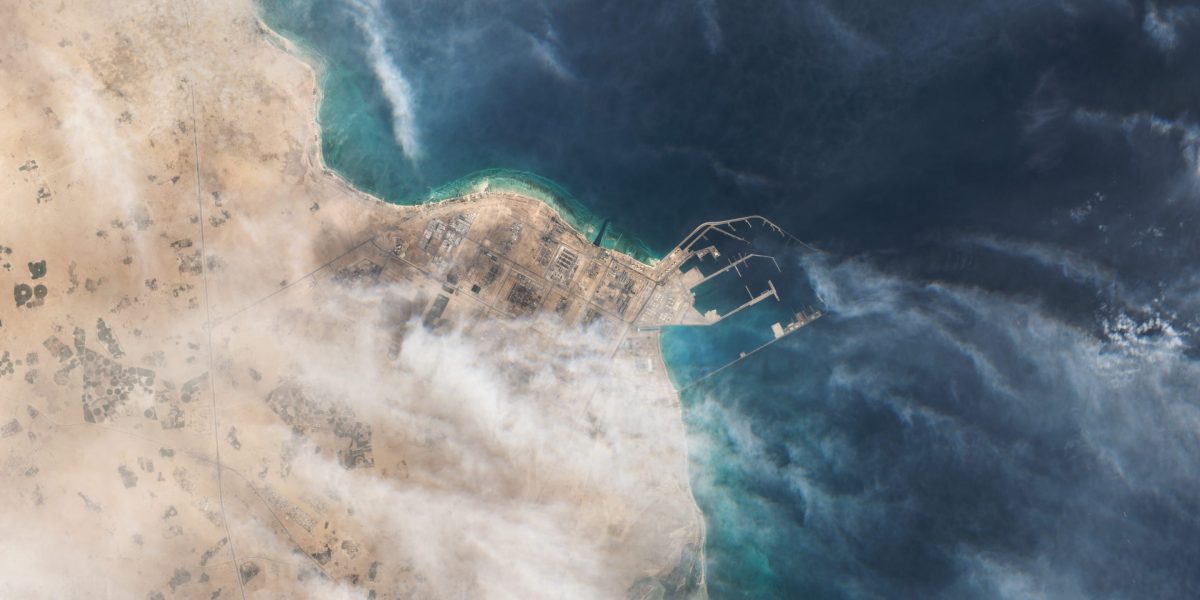
Qatar accounts for roughly 30% of global high-purity helium supply, collecting it as a byproduct of natural gas production. When attacks struck the country’s Ras Laffan industrial complex — one of the world’s largest petrochemical hubs — helium supplier Air Liquide’s AirGas subsidiary declared force majeure, signaling it could no longer fulfill contracted supply volumes. The Qatar complex ceased operations on March 2.
The timing is significant. Hyperscalers, including Amazon, Microsoft, Google, and Meta are collectively committing roughly $650 billion to U.S. AI infrastructure this year alone — investment that assumes the underlying supply chain holds. Helium isn’t manufactured; it accumulates over millions of years through radioactive decay and is captured only as a byproduct of natural gas processing, making it uniquely difficult to replace or ramp up quickly.
The helium crunch fits a pattern that veteran investor Jeremy Grantham has been warning about. In a recent interview with Fortune, the GMO co-founder and famed bubble-spotter argued that the data centers underwriting the AI boom “depend entirely on scarce metals” — resources present in the earth’s crust in shrinking concentrations that no amount of capital investment can replenish. He only saw one outcome, telling Fortune, “We are going to have to get used to slower growth rates, lower resource use.”
Moody’s Ratings notes that the immediate crisis is being managed for now, making Grantham’s warning down the road a bit of a can kicked down the road.
Buffers are buying time — not solving the problem
The global market was actually oversupplied heading into the conflict — worldwide demand ran at about 170 million cubic meters in 2025 against a supply of around 184 million cubic meters — and producers had invested heavily in storage capacity. Air Liquide’s German helium storage cavern can hold close to a year’s worth of its needs, while Linde commissioned a massive storage cavern in Beaumont, Texas, in July 2025, with capacity exceeding 85 million cubic meters, nearly half of last year’s global demand.
South Korean chipmakers Samsung and SK Hynix entered 2026 with sufficient helium inventory to last through at least June, Reuters has reported, though both are paying premiums to secure supply from U.S. sources.
Still, liquid helium can only be maintained in containers for roughly 45 days before it begins to degrade, and spot prices have already surged sharply. A fragile U.S.-Iran ceasefire agreed on April 7 could ease some pressure on the Strait of Hormuz shipping lanes, but Moody’s Ratings cautions that Qatari helium production would not immediately resume even if the conflict de-escalates.
The deeper vulnerability
The episode is exposing a structural fragility that the AI industry has largely ignored. Unlike neon gas — whose supply shock during the Ukraine war spurred recycling investments across chip fabs — helium poses a harder mitigation challenge because some manufacturing steps, like leak detection, offer virtually no recycling opportunity.
One potential relief valve: Russia’s Amur helium complex, which has been operating below capacity under sanctions. A lifting of sanctions could “significantly increase supply,” Moody’s Ratings notes, though it remains unclear over what timeframe. The lifting of sanctions, of course, is a significant political issue. Johns Hopkins professor Steve Hanke recently told Fortune that the Iran War is “good for Russia” for related reasons: everything Russia sells, mainly oil but also resources such as helium, is now being sold in higher volumes at much higher prices.
But even Russia’s return online would not be a silver bullet, according to Moody’s Pan. “Helium doesn’t get much attention in the AI supply chain, but it should,” he told Fortune. Not only is it essential for cooling wafers during chip etching, he argued, “there is no viable substitute at scale.”
For an industry betting hundreds of billions on uninterrupted compute growth, the helium crunch is a reminder that the AI supply chain runs through some of the world’s most volatile geography — and that the atoms holding it together are millions of years in the making.
For this story, Fortune journalists used generative AI as a research tool. An editor verified the accuracy of the information before publishing.
Disclaimer : This story is auto aggregated by a computer programme and has not been created or edited by DOWNTHENEWS. Publisher: fortune.com