
The morning light stretches gently across the still waters, broken only by the quiet rhythm of a sail cutting through. A 15-year-old girl leans into the wind, her hands steady, her eyes fixed on the horizon. The boat responds to her instinct, a delicate balance of force and flow.
There is no hesitation in her movement now. But there was a time when she had never even seen a boat.
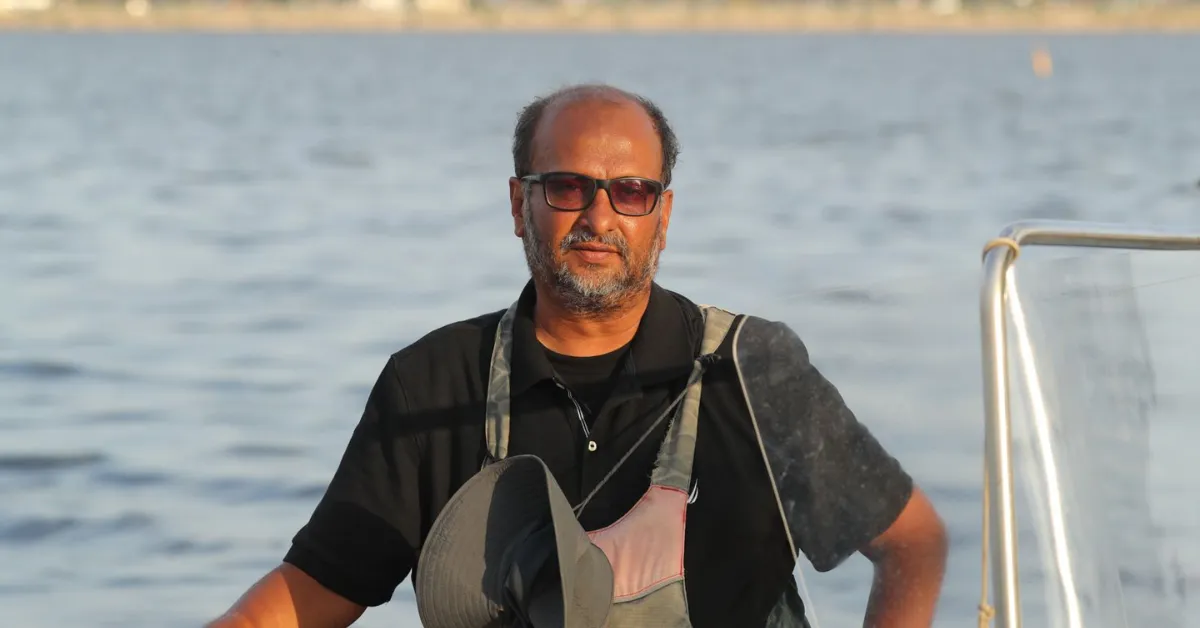
Out here, on these waters, stories like hers are not rare; they are the very reason this space exists. At the centre of it all is a man who saw possibility where others saw privilege.
From just three boats to producing 86 national champions, Suheim Sheikh has quietly built one of India’s most transformative sporting ecosystems, grounded in dignity, driven by discipline, and defined by access and excellence.
A journey shaped by water, and a question of access
Long before he became a coach, a mentor, or a changemaker, Suheim Sheikh was simply a boy drawn to water.
“I think pretty early in life I figured I was very fond of water,” he recalls. “Swimming came quite naturally to me.”
What began as curiosity soon turned into exploration. From paddling around Hussain Sagar to learning sailing informally at a local club, his entry into the sport was gradual and almost accidental. By the age of 14, he had already competed in his first national-level event.
But like many such early passions, life intervened. Academics took over, and he moved from Hyderabad Public School to IIT Madras and eventually into a successful corporate career in financial technology, building a company from the ground up over 18 years.
Yet, the memory of sailing and, more importantly, what it represented, stayed with him.
“Sailing was way too expensive. I could barely afford sailing shoes,” he says. “That’s when I understood what inaccessible sports really mean.”
It was a realisation that would shape everything that came next.
When he stepped away from the corporate world, it wasn’t just to return to sailing; it was to solve a problem.
“The quality and talent in the sport were restricted to the rich and to the armed forces. Ordinary children didn’t have access,” he explains. “So I thought, why not remove that barrier?”
That question became the foundation of the Yacht Club of Hyderabad in 2009.
Building more than a club
In the beginning, it was modest with three boats and one motorboat along with a handful of coaches. They started small, but he knew that the idea had clarity and conviction.
/filters:format(webp)/english-betterindia/media/media_files/2026/04/22/suheim-sheikh-2026-04-22-14-54-25.png)
At its core was a simple belief: talent should not depend on affordability.
The early years were experimental. Teams were built gradually, often drawing children from government schools. Then, in 2014, something shifted: the club won its first national championship.
“That’s when we realised we were doing something right,” he says.
What followed was acceleration, not just in performance, but in purpose. Today, the club counts 86 national champions, over 150 international participants across 20 countries, and 28 international medals to its name. But numbers, Sheikh insists, are only part of the story.
As the programme evolved, so did its understanding of what young athletes truly needed.
“It became clear very early that training alone wasn’t enough,” he says.
Nutrition was the first gap they addressed. Many children came from backgrounds where consistent, balanced meals were not guaranteed. So the club built a kitchen, created diet plans, and brought in nutritionists.
/filters:format(webp)/english-betterindia/media/media_files/2026/04/22/suheim-sheikh-2026-04-22-14-55-29.png)
Then came fitness training, physiotherapy, and injury management and eventually, something often overlooked in sport — mental health.
“Sport is always mental,” Sheikh says. “There are pressures at home and at school. So we brought in a psychologist.”
What emerged was not just a training centre but a holistic support system that looked at the child beyond the sport.
“It wasn’t something we planned all at once; we figured it out along the way,” he says.
Even talent identification reflects this philosophy. Instead of selecting only the naturally gifted, the club begins with large groups, sometimes 100 children at a time, and looks for something deeper.
“If grit is there, it overrules everything else,” adds Sheikh.
“I just wanted to prove myself”
For many of the girls at the club, sailing didn’t just introduce a sport. it introduced a sense of direction. Fourteen-year-old Suragani Eswa still remembers how ordinary life felt before she found it.
“My days were like any normal kid. I didn’t really have big goals or a clear direction,” she says.
After losing her father at a young age, it was through her school that she was introduced to the Yacht Club. What followed was a transformation she hadn’t imagined.
“My first day on the water was exciting, but I was also scared,” she admits. “I didn’t know how to swim confidently.”
/filters:format(webp)/english-betterindia/media/media_files/2026/04/22/the-yatch-club-2026-04-22-14-56-22.png)
There were moments when she considered giving up, especially when she felt behind others or struggled with the physical demands of the sport.
“But I didn’t quit,” she says. “I wanted to improve, prove myself, and make my father proud.”
Today, she is competing at the highest levels in the country — even securing qualification for the Asian Games after a decisive final race.
“That moment made me realise I am capable,” she says.
For 15-year-old Lahari Komaravelly, the journey has been equally transformative. Before sailing, life followed a predictable rhythm — school, homework, and time with friends.
Her introduction to the sport came through family; her sisters had already taken it up. But staying in it required something more.
“There were tough moments,” she says. “I was very light in weight, and sailing in strong winds was scary.”
Still, she persisted, driven by both her coach’s belief and her own growing ambition.
/filters:format(webp)/english-betterindia/media/media_files/2026/04/22/the-yatch-club-2026-04-22-16-50-18.png)
They came from different circumstances, but found the same thing here, a sense of direction and the confidence to pursue it.
In 2025, she became the Optimist National Champion, a milestone that shifted not just her trajectory but her sense of self. After that, qualifying for the Asian Games was another proud achievement. The respect and recognition meant a lot to her and motivated her to aim even higher.
“Earlier, I didn’t have a clear goal,” she says. “But now I want to compete in the Olympics.”
Both girls speak about Sheikh in strikingly similar terms — strict, disciplined, but deeply supportive. For Eswa, he is like a father figure, and for Lahari, he is the one who pushes them to do better and, at the same time, believes in them.
And beyond medals, they credit him for something less visible but equally powerful — independence.
“He tells us to become strong, independent women,” Eswa says.
When sport becomes a pathway
For Sheikh, success is not defined by podium finishes alone.“The idea was always to change lives,” he says.
Over the years, that impact has become visible in tangible ways.
Many of his students have gone on to secure careers in the Indian Army and Navy. Others are pursuing higher education, building professional pathways that were once unimaginable.
“A boy is earning over two lakhs a month now,” Sheikh shares. “That’s 20 times his family’s income.”
For children coming from households earning Rs 8,000 – Rs 9,000 a month, such shifts are not incremental; they are generational.
“If we can move them up five or ten times, the next generation is out of poverty,” he says.
/filters:format(webp)/english-betterindia/media/media_files/2026/04/22/the-yatch-club-2026-04-22-14-57-33.png)
This, more than anything else, is the long-term vision.
Not just champions in sport, but individuals who can stand on their own feet and reshape the future of their families.
The idea of access
Even after decades in the sport, Sheikh believes India has only scratched the surface of its potential.
“What we lack is numbers,” he says. “We need more sailors.”
His vision is expansive — from scaling the programme to reaching hundreds, even thousands of children, to building a pipeline of athletes, coaches, and professionals who carry the sport forward.
He also sees a larger systemic opportunity — one that goes beyond a single club. “If ports and institutions open up their facilities, we can create many more centres like this,” he says.
But at the heart of it all remains a simple, unwavering belief. He strongly believes in the fact that talent exists everywhere, and access can change everything.
/filters:format(webp)/english-betterindia/media/media_files/2026/04/22/suheim-sheikh-2026-04-22-15-00-00.png)
“Sporting talent should not be restricted to those who can afford it,” Sheikh says.
Out on the water, the young girl adjusts her sail once more, the wind catching it just right. There is confidence in the way she moves now — not just as a sailor, but as someone who knows where she is headed.
In that moment, the story becomes bigger than sport.
It becomes about possibility and about a man who chose to make it accessible.
All images courtesy Suheim Sheikh
Disclaimer : This story is auto aggregated by a computer programme and has not been created or edited by DOWNTHENEWS. Publisher: thebetterindia.com



