
Updated ,first published
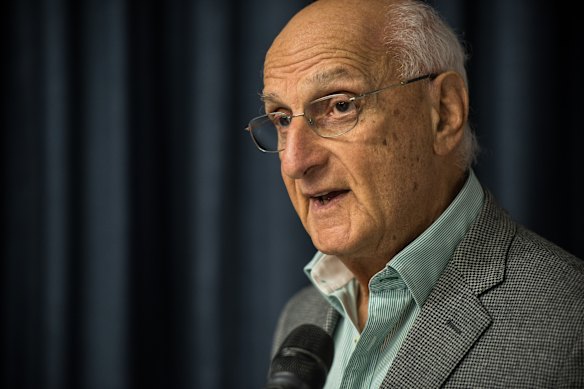
One of Australia’s most celebrated literary figures, David Malouf, has been remembered as a gentle, generous man and a writer who reshaped the country’s literary imagination.
The Brisbane-born novelist, poet and essayist died in hospital on Wednesday night, aged 92, and was described by those closest to him as a lasting influence on generations of Australian writers.
Across a career spanning decades, Malouf’s best-known novels include Johnno, Fly Away Peter, Remembering Babylon, An Imaginary Life and Ransom. His work extended to poetry, opera libretti and plays, and was often concerned with memory, place and the inner lives of men.
His longtime publisher, Meredith Curnow at Penguin Random House, said he died in a Gold Coast hospital, in a calm and peaceful setting, after being diagnosed with a “short, aggressive illness” earlier in the week.
Curnow described Malouf as “one of a kind”. “The gentlest of men and the best of friends to so many writers and people,” she said.
Over his career, he won numerous awards, including the Miles Franklin Award, the International Dublin Literary Award and France’s Prix Femina Etranger, and was shortlisted for the Booker Prize.
Curnow said his influence on Australian literature was “absolutely enormous”. His work was pivotal in reshaping how Australian stories of place, history and identity were told.
“His stories are led by men and he was never afraid to burrow into both their minds and their hearts, and they were always very human. There were human interactions always at their core.”
Born in Brisbane on March 20, 1934, Malouf studied law at the University of Queensland before teaching literature in England, where he lived for a decade. He later returned to Australia to teach at the University of Sydney, before leaving academia in 1977 to write full-time.
Always a poet first and foremost, Malouf published his debut collection, Bicycle and Other Poems, in 1970. His first novel, Johnno (1975), a semi-autobiographical portrait of Brisbane and a restless friendship, was the first of nine. His final novel, Ransom (2009), reimagined a moment from Homer’s Iliad, and focused on grief, storytelling and father-son relationships.
Across his career, his work ranged widely, spanning novels including Fly Away Peter (1982) and The Great World (1990), opera libretti – including an adaptation of Patrick White’s Voss – as well as short stories, essays, reviews, poetry and plays.
His agent, Jane Novak, described him as gentle and generous.
“I think everyone is going to talk about the work and his awards but the thing I will remember is his generosity to other writers. He taught a lot of writers and mentored a lot of writers and continued to right up until now,” she said.
“He was quiet. He kept a low profile. He certainly wasn’t interested in being the showy great man of literature.”
In his final decades, Malouf concentrated on poetry and essays, releasing the poetry collection An Open Book (reissued with new material in 2025) and the essay collection A First Place to mark his 80th birthday in 2014.
His poetry publisher, Madonna Duffy at the University of Queensland Press (QUP), said he continued writing until the end of his life.
“Since UQP published David Malouf’s first volume of poetry in 1970 we have enjoyed a continuous and rewarding publishing relationship with him. His poetry remains in print and is still being admired and appreciated by readers everywhere. He was writing poetry and productive to the very end of his life. I personally published his poetry for the past 20 years and will feel his loss greatly.”
In a statement, Penguin Random House said it plans to hold a memorial later in the year.
The Booklist is a weekly newsletter for book lovers from Jason Steger. Get it delivered every Friday.
From our partners
Disclaimer : This story is auto aggregated by a computer programme and has not been created or edited by DOWNTHENEWS. Publisher: www.smh.com.au