
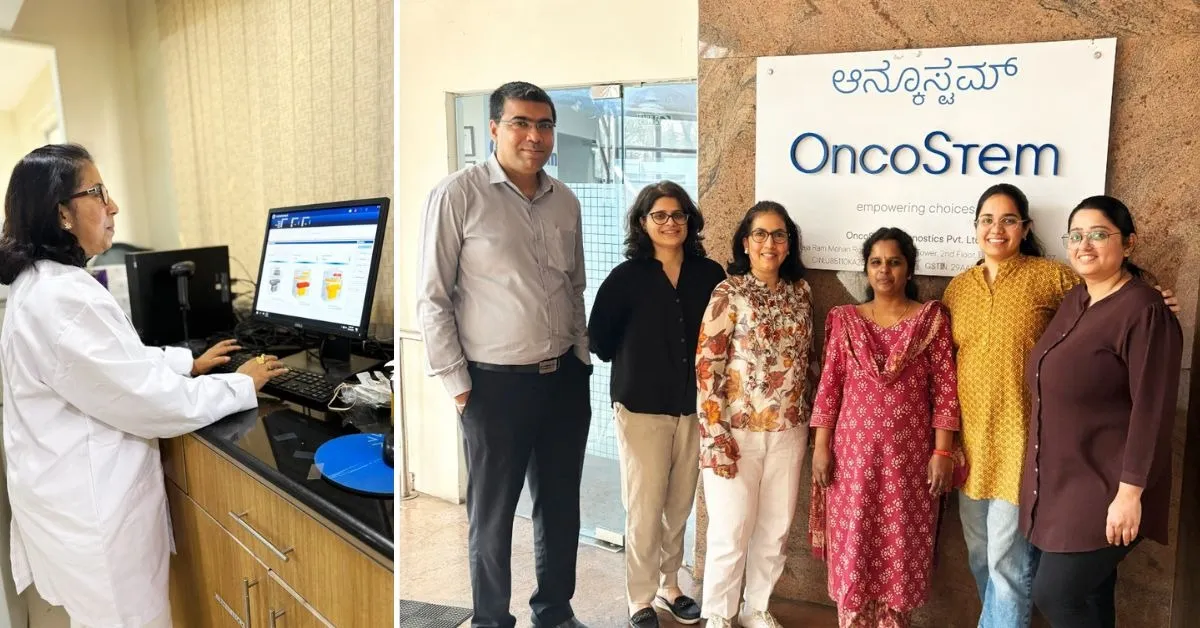
The Oncotype DX test analyses a breast cancer tumour sample to predict the likelihood of cancer recurrence.
The test helps the oncologist conclude if the patient should undergo chemotherapy or not, and costs a few lakhs.
But a PhD alumnus from IISc (Indian Institute of Science), Manjiri Bakre, has innovated an Indian variant of the test, CanAssist Breast (CAB), that can essentially achieve the same objective and is priced around Rs 65,000.
In 2011, when Manjiri started her company, OncoStem, she was keen on developing a cost-effective, accurate, and simple-to-perform prognostic test to help determine which early-stage breast cancer patients genuinely need chemotherapy and who can safely avoid it.
She explains, “The test uses an AI-based algorithm to generate a recurrence risk score from 1 to 100, categorising patients as low risk or high risk for cancer recurrence over five years.”
Manjiri continues, “For patients identified as low risk (~70 percent), chemotherapy offers little clinical benefit and can often be avoided, sparing them from long-term physical and emotional side effects, as well as monetary drain. High-risk patients, on the other hand, receive clear, evidence-backed guidance to proceed with chemotherapy and other treatments.”
‘Can we tell how aggressive a cancer may become?’
A personal loss led Manjiri to develop the test.
She recalls, “While I was pursuing my PhD, I had a friend who felt a small lump in her breast. Further tests revealed she had breast cancer. She had the tumour removed and started undergoing treatment; she soon moved for her postdoctoral research fellowship abroad. But the cancer was aggressive and kept recurring. Within a few years, she passed away.”
Manjiri continues, “It made me wonder, when tumours are small, can we predict how aggressive they are?” Thus began Manjiri’s quest to develop a test that was capable of doing precisely this.
And is the test efficient? Dr Garima Daga, a breast cancer surgeon who has used the test in over 300 breast cancer cases, affirms this. While she was previously deploying the Oncotype DX test and other foreign alternatives in her practice, she says these were expensive. “Fewer people could afford these tests,” she shares.
In addition to this, she says one of the pros of the CanAssist Breast (CAB) test is that it can be applied to the premenopausal group and the postmenopausal group. “Because the test categorises patients as low-risk and high-risk, there is no intermediate group. If you are in the low-risk group, you can totally avoid chemotherapy, and if you belong to the high-risk group, you proceed with chemotherapy.”
There’s no room for doubt.
The molecular basis of the CanAssist Breast (CAB) test
Studies indicate that a significant number of patients, particularly in advanced or early stages of certain cancers, receive chemotherapy that may not be necessary, with some estimates suggesting up to 10–40 percent of patients with cancer are overtreated in their final weeks of life.
Many oncologists find themselves walking a tightrope while deciding whether a patient needs chemotherapy following the removal of the tumour. This is where Manjiri figured an AI (artificial intelligence)-based test would bring in accuracy. “It took us two years to develop the AI-based algorithm (2014-2016). When we started, AI was not a buzzword; we looked at it as something that would help us identify risks accurately, provided the data fed in is good.”
But ensuring that the algorithm was accurate was a challenge.
/filters:format(webp)/english-betterindia/media/media_files/2026/04/20/breast-cancer-test-2026-04-20-14-24-33.jpg)
“The competing tests look at the expression of certain genes. But we were keen that our test looked at the interaction between proteins, and as we know, these interactions are not linear because one protein does not interact with just one other protein; it interacts with many others. So, we needed to incorporate all these interactions into our algorithm,” Manjiri explains.
Simply put, the CanAssist Breast (CAB) test is performed on the breast tumour tissue that is removed during surgery. It is used for early-stage breast cancer patients, whose tumours are less than five centimetres in diameter.
/filters:format(webp)/english-betterindia/media/media_files/2026/04/20/breast-cancer-2026-04-20-14-28-36.jpg)
‘So, how does the test work?’
Manjiri explains that every pathology department looks at three biomarkers — estrogen receptor (ER), progesterone receptor (PR), and HER2/neu receptor — present on the breast cancer cells.
“Only those patients whose tumours have ER and PR present and HER2/neu absent can take the test, because when ER and PR are present, the patient can be given endocrine therapy (orally), which is very beneficial. The absence of HER2/neu receptor indicates that the tumour is less aggressive. If HER2/neu receptor is present, it indicates that the tumour is aggressive, and such patients get anti-HER2 therapy along with chemotherapy,” she adds.
Manjiri points out that there are five important biomarkers that the OncoStem lab looks at while studying the immunohistochemistry of the tumour.
“We look at these proteins because they play a key role in enabling the cell to acquire properties that allow it to metastasize. Once the tumour tissue comes to our lab, we perform staining for the five biomarkers, then our oncopathologists grade it and enter that into the AI-based algorithm along with that particular patient’s tumour size, tumour grade, and lymph node status,” she shares.
/filters:format(webp)/english-betterindia/media/media_files/2026/04/20/breast-cancer-2026-04-20-14-31-05.jpg)
Then, the algorithm calculates the risk score between 1 and 100. If the risk score is 15.5 or lower, the patient is classified as low risk for breast cancer recurrence. If the risk score is 15.6 to 100, the patient is classified as high risk for breast cancer recurrence in the next five years from diagnosis. “If the risk is high, patients are advised to undergo chemotherapy,” she adds.
The combination of biomarkers was patented globally, and the efficacy of the test has been validated in India, the US, Spain, Germany, Italy, Austria, the Netherlands, and recently in Turkey. The impact of the test stands at over 800 doctors who are currently using it across India, Sri Lanka, Bangladesh, Turkey, UAE, etc.
One of them is Dr Praveen Kumar Dadireddy, chief breast onco-surgeon at Continental Hospitals, who has been using the test since 2019 in his practice. Calling it a “messiah”, Dr Praveen says the test reduces the dependency on foreign alternatives and genomic testing. “Earlier, the turnaround time with samples going out of the country was eight to 10 weeks. Now, it’s around 20 days.”
The way Manjiri sees it, the test and the many innovations that OncoStem is yet to come up with will pave the way for a breakthrough in the way cancer remission is approached in India.
All pictures courtesy Manjiri Bakre
Sources
‘A taxonomy of the factors contributing to the overtreatment of cancer patients at the end of life. What is the problem? Why does it happen? How can it be addressed?’, Published in ESMO Open in January 2025.
Disclaimer : This story is auto aggregated by a computer programme and has not been created or edited by DOWNTHENEWS. Publisher: thebetterindia.com



