
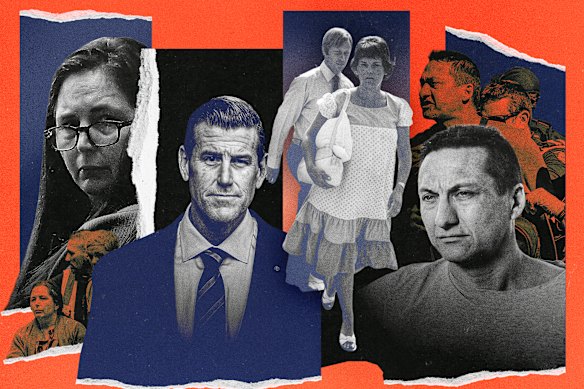

There are some crime cases that simply go rogue. These are the ones that excite such passion in the public they can no longer be corralled in the courts. Everyone, it seems, has an opinion, and feel compelled to express it, even if the matter is yet to be heard by a jury.
Once upon a time these opinions would be expressed over kitchen tables and laminated public bars, lost moments after they were uttered.
Now they are posted online to be read by randoms who may well one day be selected on a jury.
These are the cases where battle lines are drawn and so many posters are convinced of the guilt or innocence of an accused long before, or in some cases, long after, the trial is conducted.
Ben Roberts-Smith
The case of war hero and accused war criminal Ben Roberts-Smith could not be more polarising. The VC recipient, ingrained with the instinct to counter-attack when threatened, took on a disastrous libel action against this masthead.
He refused an out-of-court settlement that he could have publicly declared as vindication, choosing to charge into a public defamation hearing, only to lose.
Since his high-profile arrest there are countless “I stand by Ben” posts, from many who couldn’t find Afghanistan on a map. There are others who have him guilty without bothering to wait until the evidence is subjected to open scrutiny.
It will be admissible evidence, not online support that will decide his future. When he stands in the criminal dock, he will stand there alone.
Dezi Freeman
One case that will not be decided in a criminal court but in the coroner’s is that of Dezi Freeman, a man supported by a ragtag group of strangers and widely disliked by most who knew him.
A conspiracy theory nut job with a hatred of authority, he murdered two police in Porepunkah last August.
On March 30, members of the Special Operations Group surrounded him at Thologolong and shot him dead after, police said, he fired shots from a police-issue handgun he stole from one of the officers he killed.
Proof that we are surrounded by the unhinged, there are people who suggest Freeman was innocent, that police shot themselves accidentally and that he was finally murdered to silence him.
And these people have the right to vote.
Jaidyn Leskie
The mystery of the 1997 murder of Moe toddler Jaidyn Leskie will never be answered.
Greg Domaszewicz, who was assigned to babysit Jaidyn on the night he disappeared, was charged with murder and acquitted by a jury.
His barrister Colin Lovitt told me, “The case against him was terribly weak, but I thought there was every chance he would be convicted because of the pre-trial publicity. Everyone seemed to think he was guilty as sin, but if you asked them why they didn’t have a clue.”
Years later, Domaszewicz became a friend of drug boss Carl Williams and his wife, Roberta.
In a tapped phone call Roberta complained with Carl in jail, she couldn’t get out of the house because of parenting duties.
When Domaszewicz generously offered to babysit Roberta paused and responded, “You’ve got to be f—ing joking”.
Lindy Chamberlain
Nine-week-old Azaria Chamberlain went missing in August 1980 on a family camping holiday, sparking a mystery lasting decades.
At first, a dingo was blamed and then her mother Lindy, who was eventually convicted of murder until the baby’s matinée jacket was found near a dingo’s lair.
It was a case where everyone had an opinion, but the trial was botched with key scientific evidence found to be just plain wrong.
Eventually, an inquest exonerated Lindy and found the child was indeed taken by a dingo.
Erin Patterson
Like the Chamberlain case, the Erin Patterson (I forgot I loved foraging for wild mushrooms) saga gained worldwide attention.
Patterson made individual beef Wellingtons for four in-laws for a July 2023 Leongatha lunch. All but hers were laced with deadly mushrooms, killing three of her guests and leaving one lucky to survive.
Patterson was clever – too clever. She gave evidence in her own case, illustrating a razor sharp memory with the capacity to recall the testimony of other witnesses, but conveniently forgetting key facts that didn’t suit her story.
If she had admitted she had foraged for mushrooms that turned out to be deadly at the beginning she may well have been in the clear. But her version was so bizarre and her sobbing seemingly so bogus the jury could not believe her. She was sentenced to a minimum of 33 years. Patterson is appealing her conviction.
Ronald Ryan
Ronald Ryan escaped from Pentridge in 1965 with Peter Walker where prison officer George Hodson was shot dead. Ryan was hanged in 1967 – the last execution in Australia.
Even now, there are those who think the fatal shot was fired by a fellow prison officer from a jail tower who was aiming at Ryan but missed.
His last words to the hangman were, “God bless you. Make it quick.”
Jean Lee
The trial of Jean Lee remains clouded in controversy with doubts about her confession.
It was alleged that she and two men, Robert Clayton and Norman Andrews, tortured and killed William “Pop” Kent in a Prahran hotel.
After a trial of five days, a jury deliberated for three hours before finding them guilty.
The Court of Appeal quashed the decision, but it was reinstated by the High Court.
They were hanged in Pentridge in February 1951 despite Clayton confessing that he and Andrews were the killers and Lee was innocent.
She was sedated and placed in a chair apparently unconscious. She was the last woman executed in Australia.
Carl Williams
When drug boss Carl Williams finally pleaded guilty to three murders in the Supreme Court in 2007 it was the end of the underbelly war. In one hearing, Carl’s wife Roberta was doing a line of coke in the gallery, even generously offering some to the father of one of the detectives who had locked up Carl. The older man declined.
A few years in prison knocked the bravado out of Carl, and he was keen to do a deal with police.
His bargaining chip was he said he knew who killed and who paid for the 2004 hit on police informer Terence Hodson and his wife Christine in their Kew home.
But before he could testify in 2010 he was battered to death inside his secure Barwon Prison unit by fellow inmate Matthew Johnson.
The mystery is how prison officials didn’t move him to protection, see the build-up or witness the fatal attack.
No one has been convicted for the Hodson murders.
Gun Alley murder
Fascination with mysteries is nothing new and dashing detectives have always made headlines.
Fred Piggott joined the police force in 1888 with a grade four education and a first-class brain. Piggott understood the value of forensic science, learned to study blood splatters and demanded crime scenes be photographed.
Piggott and fellow detective John Brophy became the go-to team on the big cases and headline news. Piggott, the dapper detective, was tall and slender, wore a bowler hat, a white rose in his lapel and carried a gold-top cane.
Brophy was a short, heavy, knockabout Irishman with an eye for evidence and pretty women. One would get him promoted. The second would get him shot.
Their success rate was so impressive they inspired the chant, “Ashes to ashes, dust to dust; If Piggott doesn’t get you, then Brophy must.”
They always investigated the big mysteries and there was none bigger than the 1921 Gun Alley rape and murder of 12-year-old Alma Tirtschke.
Colin Campbell Ross was convicted despite his constant denials. He said a girl matching the victim’s description had walked past his wine bar but did not enter. He was hanged in April the following year.
A key piece of evidence was “golden” hairs found on two rugs owned by Ross that were identified as belonging to the victim.
In 1995, researcher Kevin Morgan traced the exhibit to an archive and pushed for the hair to be re-examined using modern technology. In 1998, a test by the Victorian Institute of Forensic Medicine found the hairs were not from the victim’s scalp. A second test by Australian Federal Police confirmed that the key evidence was wrong.
In May 2008, then-governor David de Kretser signed a posthumous pardon for Ross.
The pardon followed an unprecedented inquiry by Victorian Supreme Court judges Bernard Teague, Phil Cummins and John Coldrey, which found Ross was the victim of a miscarriage of justice.
The formal re-examination of the case began three years earlier when relatives of Alma Tirtschke and Colin Ross signed a petition of mercy after learning that fresh evidence showed the executed man was wrongly convicted.
Fourteen years after the innocent Ross was hanged, Brophy, then the superintendent in charge of the CIB, was shot three times while parked in a car in Royal Park with two women.
The truth was covered up with chief commissioner Sir Thomas Blamey claiming that Brophy had accidentally shot himself with his own revolver, then that he had been shot by bandits while meeting an informer about hold-ups. The scandal resulted in a royal commission, and Blamey’s forced resignation.
It could have been a case of “liar, liar pants on fire”, except Brophy was not wearing any at the time his weapon discharged.
Start the day with a summary of the day’s most important and interesting stories, analysis and insights. Sign up for our Morning Edition newsletter.
From our partners
Disclaimer : This story is auto aggregated by a computer programme and has not been created or edited by DOWNTHENEWS. Publisher: www.smh.com.au


