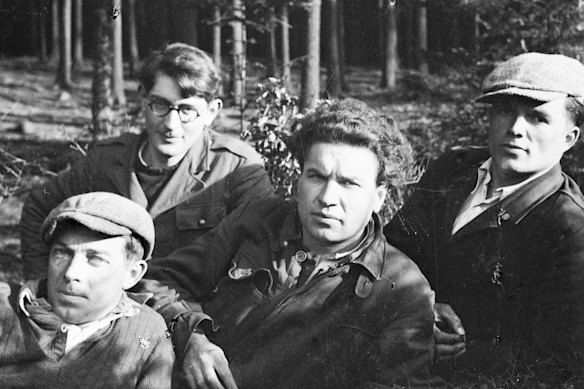
Long after the young Australian was shot on the last day of the war, those he met recalled how he came to their village and helped the local partisans rise up against the Nazis.
Lawrence Saywell was in hiding after escaping a German prison camp in January 1945, and he found food and shelter from Czech families who took him into their homes.
Vladislava Koutna, who was 14 at the time, spoke years later about the “handsome man” who hid in the woods and emerged at night for meals.
“He played with us and made jokes; he knew that we were short of food, we had no sweets,” Koutna said. “And so he joked that as soon as he would get home, he would send us a shipload of chocolate and wool.”
A German soldier put an end to that hope in the final phase of the war in Eastern Europe, eight days after Adolf Hitler killed himself in a bunker in Berlin. It was May 8, 1945, the day Germany’s unconditional surrender took effect.
Saywell knew the war was ending, but a callous act of cruelty cut his life short at the very moment he might have begun his journey home.
Now he lies in a war grave in Prague, a reminder of the sacrifice of so many Australians who sailed away to fight. He will be honoured on Anzac Day by Czech and Australian officials who know his extraordinary story of escape from prison and tragic death.
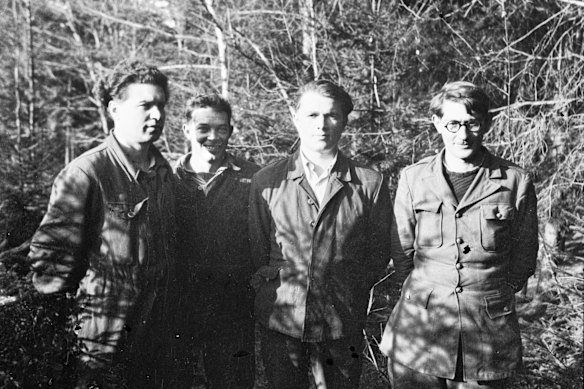
In photographs taken in his final months, Saywell looks at the camera with an easy smile and an air of confidence. One image shows him in a forest with three other escapees; he is the one smiling. He seemed ready to help the Czechs in their moment of liberation.
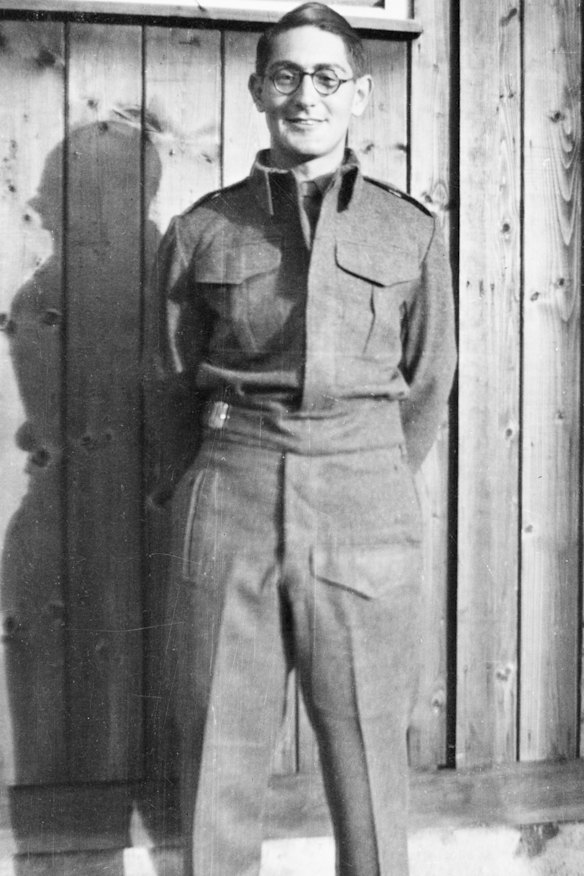
He could not have predicted his journey to Eastern Europe. Saywell enlisted within weeks of the outbreak of war in September 1939, turning up at a Marrickville centre for new recruits in Sydney in the third week of October. He was 19; the army thought he was 20.
Born in Neutral Bay and educated at The Scots College, he had spent time as a jackeroo on his uncle’s sheep station in Queensland before returning home to work as a wool buyer. By January 1940, he was aboard a troop ship bound for Egypt.
In all the paperwork for his enlistment and voyage, one part of his family background was hidden. He was born into a Jewish family in Sydney and had his bar mitzvah at the Great Synagogue, opposite Hyde Park, in 1932. He and his brothers were raised by their mother, Gertrude, after their father died when they were not yet in school.
While he was not a practising orthodox member of the faith, his Jewish background was a part of his life – and he kept it secret before heading to war. His army papers said he was Church of England.
Saywell moved between Egypt and Palestine in the first year of the war, as a clerk in the Australian Army Service Corps, sending notes home to his mother at her flat in Manning Road, Double Bay. Then, in March 1941, his unit sailed for Greece as part of the Allied attempt to halt the powerful German advance – only for the troops to be besieged in Crete.
Saywell was driving an ambulance in Crete when he was captured by German forces. He was sent to Stalag VIIA at Moosburg, Germany, then to Stalag VIIB at Lamsdorf, Poland, while making at least two escape attempts.
Finally, in January 1945, he succeeded in escaping near Pardubice, in what is now the Czech Republic, with a New Zealand prisoner, Sydney “Mac” Kerkham. The pair headed south and hid in the forests near Zderav, about 150 kilometres east of Prague, where villagers discovered them in the woods.
The boy who had come of age at the Great Synagogue was now in the death zone of the Reich in the final months of the holocaust.
We know some of his story thanks to the Saywell family records, the memories of the Czechs and the work of two researchers. At the Australian Jewish Historical Society, Peter Allen wrote an account of Saywell’s journey as part of Operation Jacob, which pursues the correct commemoration of Jewish Australians who died serving their country. At the Australian War Memorial, Peter Stanley wrote a detailed account when he was the institution’s principal historian.
Thanks to Stanley, we have the recollections of Koutna, who spoke to him when he visited the Czech Republic in January 2006, and the memories of Ludmila Splichalova, who was 18 in those final days of the war. Her father had found the Australian and his friend in the woods along with two escaped Russians.
“We liked Larry very much,” Splichalova told Stanley. “I remember that he marked 9 May in our calendar as the day of the end of the war. And this was in April. He predicted it.“ She remembered Saywell as an intellectual: when a new friend gave him a copy of the Bible in Czech and English, he started learning the language.
“He spoke German and Russian well,” said Splichalova. “But he was so amusing that we even understood his jokes.” One day, she told Stanley, the young man came for dinner at her house and hugged her mother because he was so happy with the food and company. “He did not want to be sent to other people’s places for meals any more,” she said.
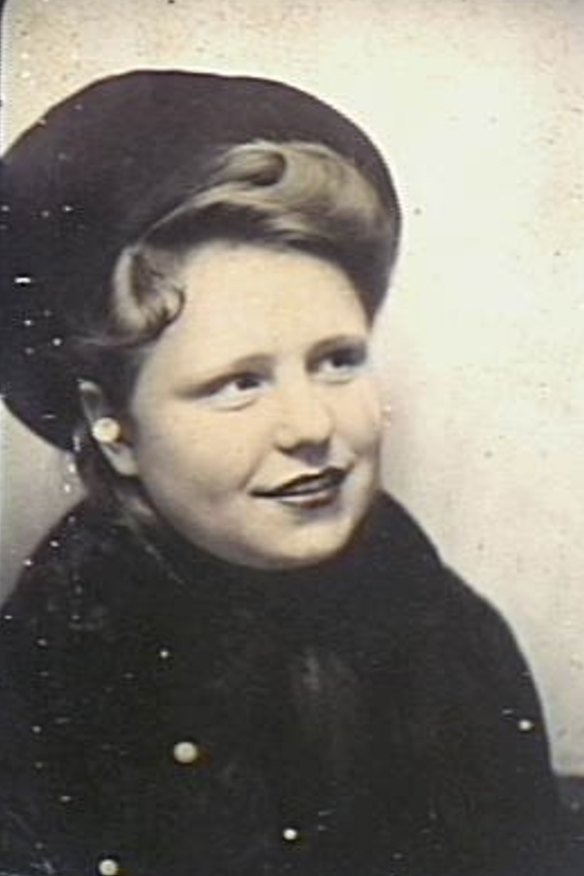
He also had a sweetheart. Among his papers, gathered after the war, was a photograph of a young woman with fair hair beneath a dark beret. Her name was Maria, she was Ukrainian, and she was just 18 – a prison worker in a separate part of his camp. They talked in secret while working the night shift, he told his mother in a letter home.
When he was transferred from Poland to a Czech camp, he chose to escape.
The Czech families befriended the Australian despite the dangers. The village pub was a stopping point for German soldiers during the day, making it essential for Saywell to visit only at night. The Czechs listened to the news from London on hidden radios, knowing that any sign of disloyalty to the Reich left them exposed to execution.
Then came the horror and chaos of the final phase of the war. Allied forces crossed into Germany in March, but Hitler demanded the total sacrifice of his soldiers to slow the advance. Marching from the east, the Soviet Red Army encountered the same resistance and fought bloody battles in the Czech countryside on its way to Prague.
The village chronicle, a formal document written at the time of events, records the fighting as German soldiers fled westward in the hope of surrendering to the Americans rather than the Russians. One account, gathered by the Czech Military History Institute and sent to Stanley for his research, describes the landing of Soviet paratroopers in the area in March 1945.
A local mill owner, Frantisek Pravec, said the paratroopers were joined by the Czech partisans and the escaped prisoners-of-war, forming a group of about 100 members. In early May, they managed to disarm the Hungarian troops in the area, who had fought alongside the Nazis. Meanwhile, in the capital, the Prague uprising began on May 5 when resistance leaders and citizens fought German soldiers on the streets.
Saywell might have remained safe in hiding in the woods, but he emerged to join the village partisans at this moment of confrontation.
Into this fluid situation came a retreating column of Germans from Organisation Todt, a part of the Reich that was notorious for running factories with slave labour, including Jews sent to concentration camps. In the account left by Pravec, this group was halted by partisans at the village of Miretin and disarmed. The Germans were held captive in the local school.
Then, within a day or two, came a development that put the entire village under threat. A division of German soldiers arrived, heavily armed, on their retreat west. They learned of their captured compatriots – an escaped German woman is said to have let them know – and they surrounded the village. They took hostages and beat one man to death.
‘Saywell’s story held a great and poignant symbolism … he came from far away, and died among Czechs he had known. That he died at the moment the war ended added a particular pathos to the story’.Peter Stanley, historian
Local man Joseph Senkyr, who was 10 at the time, gave Stanley his account in 2006 of how the Australian was drawn into this stand-off. “At that time, Lawrence Saywell came to Miretin, and he spoke German well,” said Senkyr, according to the translated notes of his interview. “He acted as an interpreter between the captured German officers and partisans.”
Another local witness said the Australian was anxious to beat the Germans. Marie Kadlecova, a doctor of philosophy, gave her account in a letter to Saywell’s mother soon after the war.
“On the 8th of May he finally got a rifle and joined Czech and Russian partisans who were prepared to fight against retreating Germans in Miretin,” wrote Kadlecova.
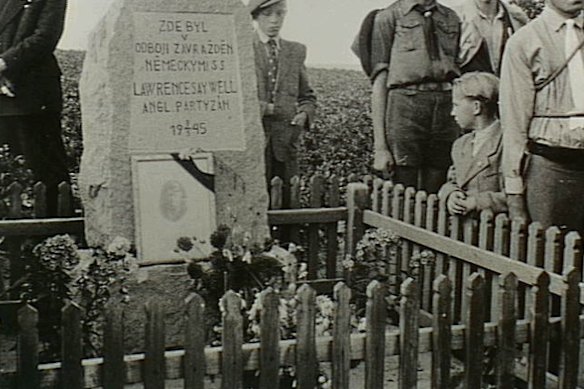
Saywell now had his chance to fight with the partisans. In helping as a translator, however, he became known to the Germans in Organisation Todt – and he was exposed to danger when they were freed from the school.
“The fact is that he found himself in an area of Miretin where the German command was stationed,” said Senkyr. “At that time, the German officers set free from the school were already there with the German command, and they most probably recognised Larry because he had interpreted for them earlier.”
Senkyr later spoke to a witness who saw the Australian in those final moments. “The fact is that one of the German officers shot Lawrence in the head,” he said. When villagers found his body later, they saw a wound to the temple, rimmed by a burn. He was shot at close range. The German did not fire in self-defence.
Kadlecova, in her letter to Gertrude Saywell six months after these events, said Saywell was not armed when he died. “It was a murder,” she said.
On a rainy day in Miretin, after he had survived so much of the war, the young Australian lost his life in a cold act of violence. To this day, a stone memorial stands in the village to remember the man who helped the partisans in those final days of the war.
A poignant legacy
When Stanley visited in 2006, he found a community that was still honouring Saywell.
“What struck me was how important the Czechs felt this episode to be,” he said in an email to this masthead. “Saywell’s story held a great and poignant symbolism to them: he came from far away, and died among Czechs he had known. That he died at the moment the war ended added a particular pathos to the story.”
Saywell is not widely known in Australia, but he was never forgotten by the Czechs. The ceremony on Anzac Day will include Czech and Australian representatives at the Commonwealth War Graves in Prague, a resting place for 237 who fought for the Allies.
Many events in Saywell’s story will never be known. Officials in Prosec, the base for the government area that includes Miretin, told this masthead that nobody who met him there is still alive. Koutna’s son, Pavel Koutný, said his mother passed away in 2022. Saywell’s fellow prisoner, “Mac” Kerkham, never talked much about the war.
But when so much is lost to time, it’s even more important to tell of what we know.
Splichalova spoke of Saywell as a man who made friends easily. She wept when she heard of his death. “I cried terribly, I was so upset,” she said, six decades later. “He was like a family member to us.”
Get a note directly from our foreign correspondents on what’s making headlines around the world. Sign up for our weekly What in the World newsletter.
Disclaimer : This story is auto aggregated by a computer programme and has not been created or edited by DOWNTHENEWS. Publisher: www.smh.com.au