
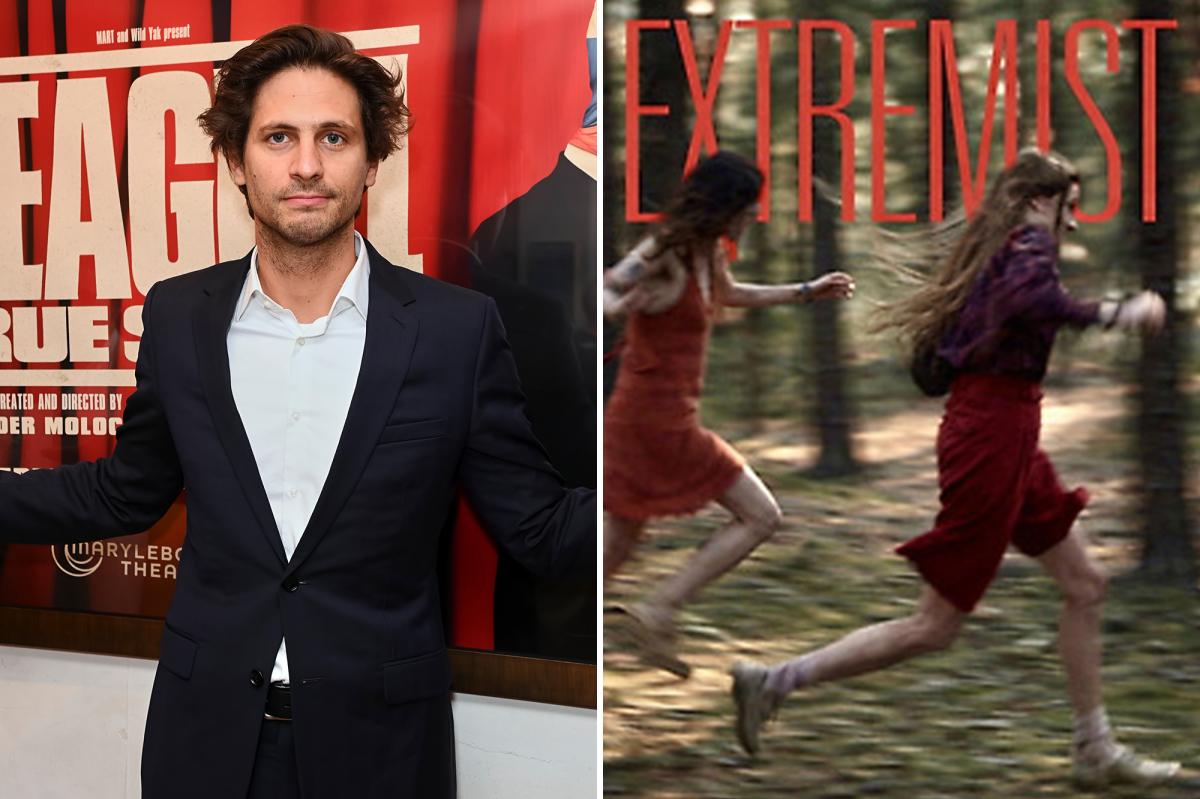
Exiled from Russia for defending Ukraine, a rising director expected freedom when he fled for the Big Apple – but instead found crippling censorship eerily similar to life under the eye of the Kremlin.
Sasha Molochnikov ventured to New York City to start anew in August 2022 — enrolling at Columbia University and pursuing a master’s in fine arts — after fleeing Russia following its unpopular invasion of Ukraine. But he quickly encountered stifling limitations in free speech that brought back vivid nightmares of Russian tyrant Vladimir Putin’s iron rule.
After building a decade-long career in Russia’s elite theatre circuits – putting on productions at the famed Bolshoi and the Moscow Art Theatre – Molochnikov, 34, posted a Ukrainian flag on his Instagram page as a sign of support for the war-torn country.
In the outbreak of Putin’s invasion of Kyiv – having even spent time in Ukraine as a kid – he said it was “impossible to stay silent.”
But it quickly cost him his career. Molochnikov was fired for his anti-war Instagram posts.
Then, those who dismissed him were also replaced by “fanatical Putin supporters,” the director told the Post about life during the war.
The Kremlin will get you at some point, he warned.
By not pledging allegiance to the blind patriotism demanded by Putin’s war machine, Molochnikov’s plays were swiftly ripped from him – cited as “Directed by Director,” by the murky censorship of Moscow, he said.
Today, the directorial attribution is left completely blank, Molochnikov said, as if the artist never existed.
Expecting to find a new home for artistic freedom, he fled to the United States. But the director said he encountered a similar kind of pressure at Columbia University.
When he found himself slipping up, and saying something politically incorrect, Molochnikov described a heart-dropping feeling.
“Suddenly some sweat drips down your back,” he said.
“Maybe this is already gonna be put in an email and sent to the head of Columbia.”
While the systems may look different — one enforced by the Kremlin, the other by woke-driven ideology — for Molochnikov, the result felt eerily similar.
“That feeling of being reported on is very similar to Russia,” he said about his time at the university.
Several Ivy League institutions came under fire over inaction to campus antisemitism which spiked dramatically in the aftermath of the Hamas-led Oct. 7, 2023, terror attack on Israel.
The Trump administration cut $400 million of federal funds earmarked for Columbia – while GOP lawmakers railed against some of the nation’s top academic institutions.
President Trump slammed Princeton, suspending research grants totaling $210 million and recently demanded $1 billion from Harvard over its failure to protect Jewish students.
While at Columbia, Molochnikov said he confronted a new set of “radical problems” – with students telling him during a writing class “you’re a white straight male you cannot understand this script.”
In an institution meant to foster the discussion of ideas, Molochnikov instead called it out as an environment fostered by fear.
“It’s good to think about what you say,” he said, “but is it good to control every word that comes out of your mouth because you are afraid somebody will report on you?”
Instead of honesty in class discussions, students were “scared to say anything.”
While critiquing the Kremlin could land you behind bars today, political differences never impacted workplace practices before the war, Molochnikov explained.
In liberal spaces across the US, the director said leftists want a certain decorum used – an attitude and mindfulness to speech that makes collaboration exhausting.
“If you don’t feel that way … it’s just very hard to work actually,” he argued.
And that tension — of an uninhibited freedom sits at the center of “Seagull: True Story” Molochnikov’s Off-Broadway play.
Split in two acts, the first set in Russia and the second in New York City, the play suggests that while the consequences may differ, the instinct to police speech exists in both places.
“It seems very easy that there’s a Big Brother you can complain to,” he said.
“And your problems will be solved.”
But, Molochnikov warned, that instinct comes with a cost: You “lose control.”
Disclaimer : This story is auto aggregated by a computer programme and has not been created or edited by DOWNTHENEWS. Publisher: nypost.com



