
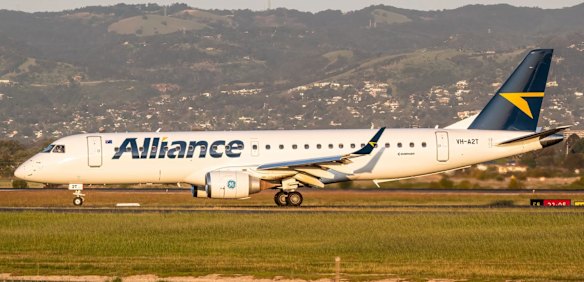

A Brisbane-bound passenger plane climbed out of Cairns with its landing gear down, as cockpit distractions led the autopilot to steer the aircraft toward mountainous terrain.
The flight crew earlier missed a standard call during take-off and became distracted by unexpected cockpit alerts, an aviation safety investigation has found.
An Australian Transport Safety Bureau report, released on Friday, found the Alliance Airlines Embraer E190 had its landing gear retracted above the aircraft’s maximum permitted speed during a night departure on July 24 last year.
The aircraft was not damaged and landed safely in Brisbane.
The incident occurred as the aircraft climbed out of Cairns Airport on a scheduled passenger flight to Brisbane, with 90 passengers and four crew on board.
According to the ATSB’s final report, the aircraft became airborne at 6.51pm local time and began turning left to follow a terrain-avoidance departure path shortly after take-off.
“Both crew members then became focused on the aircraft’s flight path,” ATSB director of transport safety Stuart Macleod said.
“This likely meant the captain did not have time to verify the aircraft’s positive rate of climb before a terrain avoidance turn was needed as part of the standard instrument departure being followed.”
During take-off, the captain – who was not controlling the plane – called out “pitch rate” to draw the pilot’s attention to a slower-than-normal nose-up movement.
The ATSB found the call came about the time a standard “positive rate” call – the usual trigger for landing gear retraction – would usually be made to confirm the aircraft was climbing.
That call was not made, and the gear remained extended as the aircraft continued its climb.
As the flight followed the departure procedure, the crew was presented with radio altimeter warnings and unexpected flight director commands, which increased cockpit workload.
At one point, the autopilot began turning the aircraft toward higher terrain before the captain intervened and directed the crew back onto the required track.
“These distractions increased the flight crew’s workload and delayed their recognising the landing gear was still extended,” Macleod said.
The issue was eventually noticed five minutes after take-off when cockpit noise increased and an alert indicated the gear remained extended. By then, the aircraft was accelerating through 243 knots.
The captain retracted the landing gear without first checking airspeed, and the retraction sequence was completed at 252 knots – 17 knots above 235-knot limit.
The aircraft continued without further incident and landed in Brisbane at 8.44pm. A post-flight inspection found no damage.
The ATSB also found unexpected alerts from the aircraft’s avionics system further increased workload and narrowed the crew’s attention, delaying recognition of the extended landing gear.
Following the incident, Alliance Airlines accelerated system upgrades to its Embraer E190 fleet – a process the ATSB said had been completed.
The newer system includes electronic checklists designed to ensure required actions, such as landing gear retraction, are completed before checklists can be closed.
“This incident highlights the impact a combination of omitted actions and distractions can have on aircraft operations, during what is often a high workload period,” Macleod said.
“Such situations can create challenges in responding to the unexpected with potential for a reduction in safety when pilots act rapidly and reflexively.”
Start the day with a summary of the day’s most important and interesting stories, analysis and insights. Sign up for our Morning Edition newsletter.
From our partners
Disclaimer : This story is auto aggregated by a computer programme and has not been created or edited by DOWNTHENEWS. Publisher: www.smh.com.au


