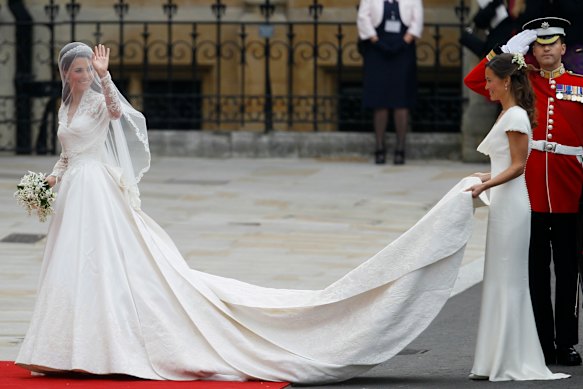

On Wednesday, it will be 15 years since Kate Middleton walked down the aisle of Westminster Abbey towards Prince William, and left a princess.
In all aspects of life, it’s important to dress for the job you want. On the morning of the wedding, Middleton, now Catherine, Princess of Wales, emerged from Queen Elizabeth’s 1977 Rolls-Royce Phantom VI looking every inch a future queen, in a dress designed by Sarah Burton in her first year as creative director at British luxury label Alexander McQueen.
Since 2011, there have been other memorable royal wedding dresses: Meghan Markle’s Givenchy dress; Princess Beatrice’s vintage Norman Hartnell gown originally worn by Queen Elizabeth to the premiere of Laurence of Arabia in 1962; and the Peter Pilotto dress worn by Princess Eugenie which dipped at the back to reveal her scar from scoliosis surgery. Catherine’s dress remains the gold standard.
“Designers are still making replicas and dresses inspired by Kate’s dress,” says Patricia Pallozzi, manager of Raffaele Ciuca Bridal in the Melbourne suburb of Brunswick. “Fifteen years later it’s still an iconic dress.”
With its lace sleeves, V-neck, fitted torso, flared skirt, 270-centimetre train and 58 gazar and organza-covered buttons with rouleau loops, the dress and its veil was loaded with meaning by embroiderers at the Royal School of Needlework at Hampton Court Palace.
Pallozzi remembers every detail – her team spent 24 hours after the wedding recreating the dress for their store window.
“That dress went from bride to bride,” Pallozzi says. “We auctioned it to raise money for cancer for about $10,000.” A bargain compared to the reported £250,000 ($472,000) price tag of Catherine’s dress, paid for by the Middleton family.
“Kate’s dress changed the way people wanted to look on their wedding day. Before then, they were still after the puffy Princess Diana look.”
For Shona Joy Thatcher, founder and creative director of the Sydney-based label Shona Joy, which introduced wedding dresses into their collections in 2019, it’s the starring role of lace on the Alexander McQueen dress that inspires modern brides.
“There is a level of refinement in the way lace is used – intricate, but not overly ornate – which contributes to the dress’s enduring relevance,” Thatcher says. “While there has been a shift towards lighter, more fluid bridal silhouettes, elements of Kate’s gown, particularly the use of lace as a framing device, continue to influence modern bridal aesthetics.”
Megan Ziems from Gold Coast-based bridal brand Grace Loves Lace, which now ships to 80 countries, says that the timeless nature of Catherine’s dress has as much to do with the bride as designer Sarah Burton.
“What struck me then, and what I still believe now, is that she looked entirely like herself,” Ziems says. “The dress didn’t wear her. There was no performance of royalty, no sense of a woman disappearing inside a silhouette designed to signal status.”
“Catherine looked comfortable, confident; at ease-qualities that are far harder to achieve on the global stage than any amount of couture craftsmanship. That ease was the power.”
When it comes to influential wedding dresses that rival the Alexander McQueen dress, which is now part of the Royal Collection, and was viewed by more than 600,000 people when it was placed on display in London in 2011 with the Cartier Halo Tiara worn by Catherine, Ziems looks to another princess.
“Where Catherine’s genius was in restraint, Grace’s was in courage,” Ziems says. “Her Helen Rose gown, designed by the MGM costume department, constructed from antique Brussels rose-point lace, was the work of a woman who understood exactly who she was and refused to leave that at the door.
“A Hollywood actress becoming a princess could have tried to erase herself, to become acceptably regal. Instead, she brought her full, glamorous, cinematic self to the altar. That sense of adventure, of individuality, of style as identity has never been matched.”
Thatcher prefers the streamlined approach of the Narciso Rodriguez wedding dress worn by US royalty Carolyn Bessette Kennedy, recently celebrated in Love Story, currently streaming on Disney+.
“It represents a very different approach to bridal,” Thatcher says. “It’s grounded in simplicity, confidence and a distinct minimalist approach that was popular in the ’90s.
“The clean lines, the bias cut, and the absence of embellishment allow the woman wearing it to be the focus.”
Streamlined dresses without detail also take less material to make, with Catherine’s dress constructed over months by a 50-strong team.
For Pallozi, there’s only one gold standard for white dresses.
“I do love the Grace Kelly dress, but my favourite has to be Kate’s,” she says. “Meghan’s was also beautiful, but Kate’s was the fairytale with a happy ending.”
Make the most of your health, relationships, fitness and nutrition with our Live Well newsletter. Get it in your inbox every Monday.
From our partners
Disclaimer : This story is auto aggregated by a computer programme and has not been created or edited by DOWNTHENEWS. Publisher: www.smh.com.au