
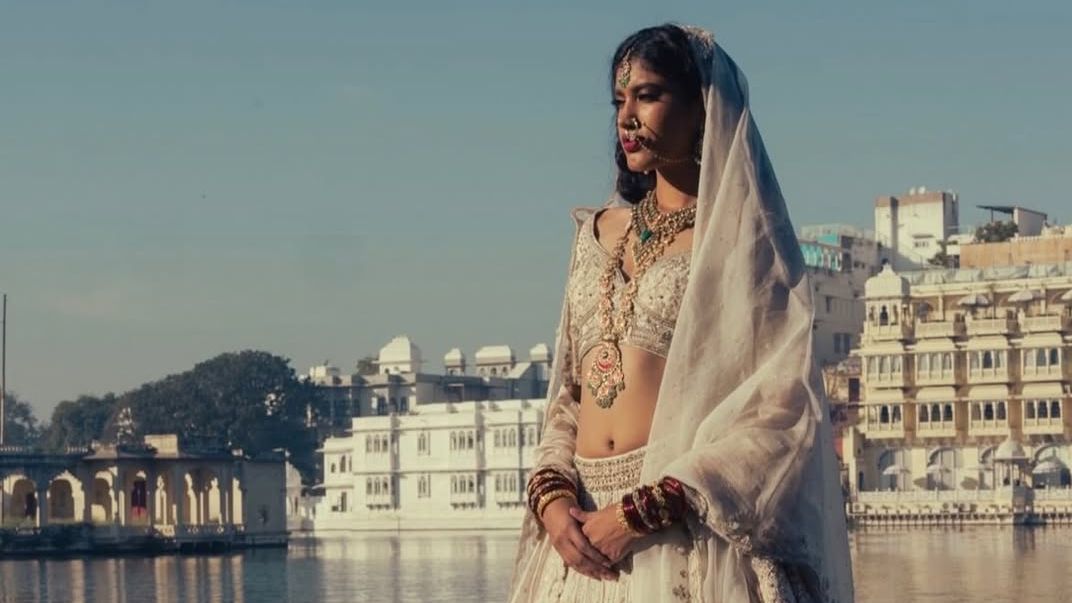
White has become so familiar in the Indian bridal wardrobe that it has a problem of its own. Across lehengas, veils and tonal dupattas, it now feels so regular that, without character or point of view, it can begin to fade into sameness.
The appeal is easy to understand. White photographs beautifully, travels well across cultures and carries a certain aesthetic that slips seamlessly into destination weddings. What began as a point of difference, however, can quickly look templated.
As Shubhika Sharma, founder of Papa Don’t Preach, puts it, “When every reference starts looking the same, when you feel like you’ve seen it a hundred times, it begins to feel less like a choice and more like a formula.”
That formula is what designers are now trying to interrupt. White can strip away the immediate impact that colour brings to Indian bridalwear, so every other decision has to work harder. Fabric, embroidery, jewellery, blouse shape, dupatta placement and even the lining begin to carry more weight. “Individuality has to come from everything beyond colour,” says couturier Rahul Mishra.
In a country where white has long carried associations with mourning in several communities, its bridal rise carries cultural tension. At the same time, designers are quick to point out that white is not an imported idea. “It’s important to remember that white is not alien to our textile history,” says Mishra. “Wearing kora, unbleached or undyed fabric, was never unfamiliar. The idea of the undyed textile has always been deeply rooted in our visual culture.”
That tension, between inheritance and imitation, is where the conversation becomes interesting. Sharma recognises the pull, but also the risk. “White feels effortless, modern and there’s a certain confidence to it,” she explains. “But weddings are also the one moment to really indulge in our heritage and colour is such a big part of how we express ourselves in India. That’s where it starts to feel like a missed opportunity.” Mishra frames the choice through another lens: “When a bride chooses white today, she is expressing something both deeply personal and historically resonant… a return to something intrinsic to our history.”
For Sharma, the first answer is depth. “White can be incredibly striking, but it can also fall flat very easily,” she says. And then there is the bride herself. “Is she romantic, dramatic, understated, playful? That energy has to come through somewhere.”
Mishra approaches the same idea through material. “Texture reveals itself beautifully in whites,” he says. “We work with handwoven silks, organza, chanderi and finely woven khadi, each bringing its own character and lightness.” White, then, is rarely just one shade. Ivory, pearl, kora, ecru and pale silver can all change the mood of a garment, especially when layered through fabric and handwork.
Texture becomes essential–chikankari against zardozi, matte embroidery against sheen, tone-on-tone threadwork and fabrics that catch light differently can stop a white lehenga from looking flat in photographs or in motion. Silhouette carries its share of the work too: volume, blouse shape, veil placement and the way a dupatta is styled can bring in personal statements.
Disclaimer : This story is auto aggregated by a computer programme and has not been created or edited by DOWNTHENEWS. Publisher: vogue.in



