
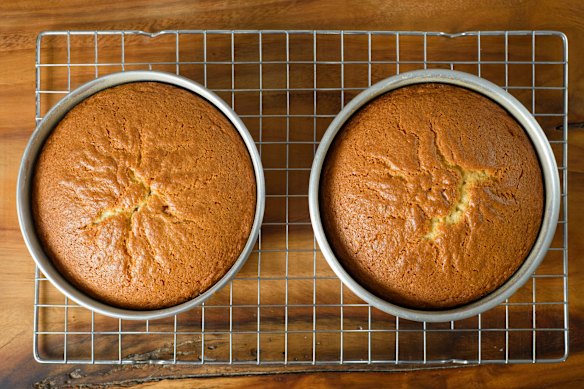
If you’ve struggled with dry or dense cakes, here are nine potential issues to troubleshoot.
Becky Krystal
Regardless of whether there’s an actual occasion to mark, a cake is always a cause for celebration. That is, unless something has gone awry in baking it. We’ve all been there, and I can tell you based on personal experience that a botched cake is just as powerfully disappointing as a successful one is thrilling.
As with any kind of baking, I’m convinced there’s no such thing as a bad cake baker. Bad recipes? Yes. Bad habits? Surely. But no one is destined for permanent cake failure.
If you’ve struggled with dry or dense cakes, I can help. Here are some potential issues to troubleshoot, as well as a few bonus tips to solve other common cake problems.
Oven temperature
The built-in thermometers on ovens are notoriously inaccurate. If your cakes are consistently coming out dry, there’s a good chance they are overbaking, so this would be the place to start. Verify with a standalone oven thermometer that the appliance is running true to temperature. (Keep in mind that the oven may cycle on and off, so you’ll want to check it at various points and look for the average.) If not, adjust the temperature setting accordingly. You can also recalibrate the oven or call in a professional to help.
The best recipes from Australia’s leading chefs straight to your inbox.
Bake time
Size may be part of the problem, especially since recipes are generally written for 20cm tins. If you choose to change the size of the tin called for in a recipe, you may need to make other modifications, including scaling down the ingredients, using fewer (or more) tins and altering how much batter you pour into them.
Changing the bake time − but not temperature − is on the table as well. You may need to reduce the bake time, depending on how much the original recipe was scaled down, and start checking for doneness five or even 10 minutes earlier.
Tin colour
Dark tins tend to bake things faster, which can quickly spiral into overbaking. I prefer light-coloured tins, such as anodised aluminum. If you are using dark tins, try reducing the oven temperature by 15C and, again, start checking for doneness sooner.
While we’re on the topic of tins, I don’t recommend glass dishes for baking. They, too, can lead to overbaking, not to mention underdone centres.
Ingredient amounts
Measuring ingredients by weight is the most accurate option for baking. If you’re only going by volume, you may be using too much flour or not enough sugar, which can both lead to dry cakes. The amount of ingredients that can fit in a measuring cup can vary not only by the baker, but also by the cup itself, as the dimensions aren’t standardised.
Insufficient creaming
Most people underdo the crucial step of creaming, which introduces air into the cake batter, and that scenario can lead to dense cakes. Ensuring the butter and eggs are at room temperature − the butter should be soft, but not too soft − is key to proper creaming, too.
Overmixing
My colleague Fenit Nirappil, a frequent baker, makes an excellent point. “In the final stage of adding flour/dry ingredients, it’s easy to keep going and … you should really stop once incorporated. A helpful tip I learned is to switch to a spatula for the last few streaks of flour and fold it into the batter.”
This doesn’t just apply to cakes. You’d be well served to do the same thing whenever you’re baking cookies, banana bread or any other recipe that uses a stand or hand mixer.
Expired baking powder or bicarbonate of soda
While many baking ingredients have a long shelf life or won’t ever really expire, that doesn’t apply to chemical leaveners, i.e. baking powder and bicarbonate of soda. As another insightful reader chimed in, “Be sure that baking powder, if called for, has not expired. That can really make a difference.”
If you’d like to verify that your leavener is still viable, it’s easy: Mix ¼ teaspoon baking powder into ½ cup very hot water, or ¼ teaspoon baking soda into ½ cup very hot water mixed with ¼ teaspoon white vinegar. If you see fine bubbles, you’re good to go.
Cakes sticking to the tin
There are few things more dramatic (and traumatic) than having your carefully baked cake refuse to come out of the tin or come out in pieces. Most cake recipes do best when the tin is greased and floured − and, depending on the shape, lined with baking paper as well. Cooking oil spray is another option for greasing the tin. Or try making a paste of equal amounts of flour and shortening (such as Copha), or flour, shortening and vegetable oil, that can be spread into a thin layer on the inside of the tin.
As a bonus, paying attention to the sides of the cake can help you determine when to pull it out of the oven. Many recipes for layer cakes will note that, among other cues, the cake is done when it starts to pull away from the edges of the tin.
Picking the wrong recipe
Of course, you can set yourself up for success by choosing a good recipe from a reliable source. These recipes are all great cakes to try with the proper adjustments.
Washington Post
From our partners
Disclaimer : This story is auto aggregated by a computer programme and has not been created or edited by DOWNTHENEWS. Publisher: www.smh.com.au


