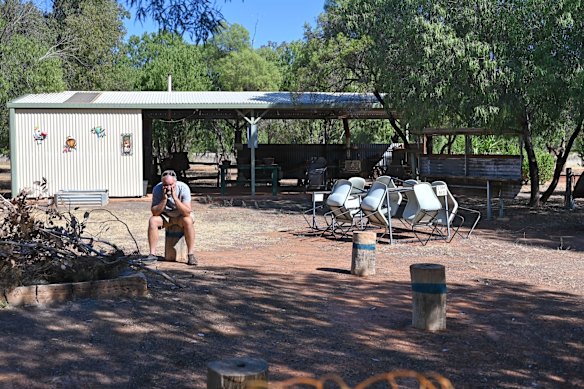
People are just cancelling, caravan park operator Kathryn Doyle says. “Left, right and centre. It’s just so sad out here.”
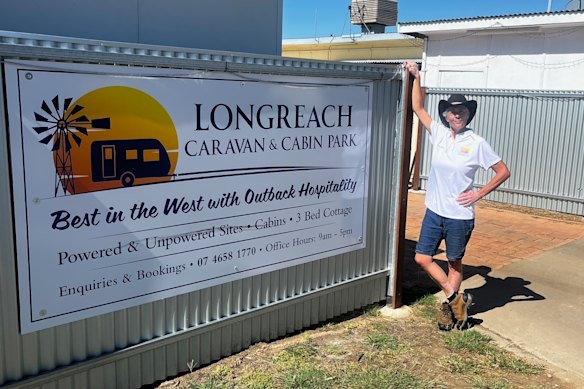
It is 11am when Doyle answers the phone at Longreach Caravan Park, 13 hours north-west of Brisbane, in the heart of outback Queensland.
Doyle is upbeat but steeling herself when she picks up the line – already that morning, three people had called to cancel their bookings.
The global fuel crisis is hitting this year’s peak tourism season in outback Queensland even before it gets under way.
The scenario is in stark contrast to the post-COVID boom, when international travel ground to a halt and Australians answered a rallying cry to support tourism operators in their own backyard. Australians in their droves jumped in caravans and headed to the outback. An industry that had its biggest moment in one crisis has been brought to its knees in the next.
Australia’s cooler months, from April to the end of September, are peak season for outback tourism operators.
Southerners fleeing the colder capitals, and Brisbaneites alike, travel north in pursuit of adventure and temperatures in the mid-20s. Easter typically kicks things off.
But not this year.
On April 1, two days before Good Friday, Prime Minister Anthony Albanese addressed the nation, encouraging people to conserve fuel.
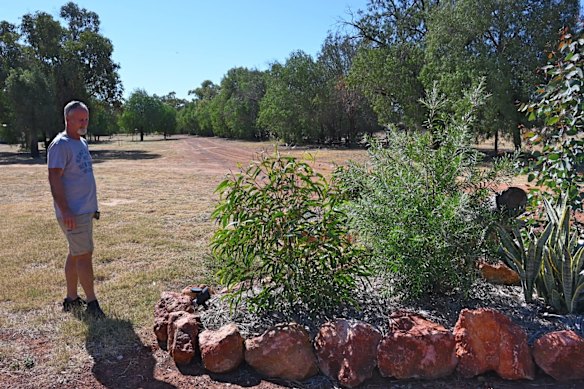
Matthew Bom, 66, spent the summer planting 380 trees and hauling tonnes of bush rock to re-landscape 25 garden beds in preparation for this year’s peak outback tourism period.
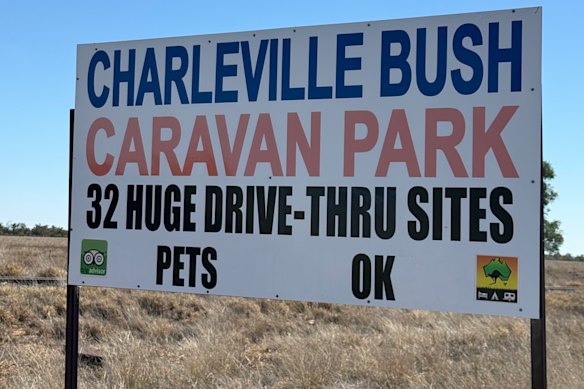
“But I’ve got no one here,” the Charleville Bush Caravan Park manager says.
Bom fears the strain of the fuel crisis will wipe out more outback businesses than the pandemic had.
“It’s going to be a catastrophe out here,” he says.
“There are stores – not just here in Charleville, but all throughout west out here, all the way up to Longreach and Winton and all that – that are stocked up ready for the peak season because this is the time when we get busy.
“Everyone’s invested a lot of money. And now we’ve got nothing. The roads are dead.”
The first sign of trouble came with the record-breaking rain in February and March – parts of outback Queensland copped a year’s worth of rain in two days – which forced the cancellation of July’s Birdsville Big Red Bash.
At least 30 bookings have been cancelled at Doyle’s Longreach Caravan Park since the Big Red Bash was scrapped, and she says occupancy is now the lowest it’s ever been.
“Hardly anyone’s booking in,” Doyle says.
“Guests are just saying, ‘We can’t come all the way out there when we don’t know what the fuel shortages are going to be like.’ So, unfortunately, there are more cancellations than there are bookings. Everyone’s suffering.”
Mixed messaging from federal and state governments urging Australians to keep their travel plans but also conserve fuel has been frustrating at a time when Queensland’s outback is uncharacteristically green and vibrant.
“To paint a picture,” says Winton Shire Mayor Cathy White, “the landscape is absolutely a vision splendid after the recent flooding – the wildlife is incredible, and the wild flowers are blooming. The country’s never looked so beautiful.
“But unfortunately, due to this fuel crisis, and the mixed messaging … it’s putting doubt in people’s minds.”
Every accommodation site this masthead spoke to said there was no shortage of fuel in their town, but no one to buy it.
Winton, the birthplace of Qantas, is the home of the Australian Age of Dinosaurs Museum and the Waltzing Matilda Centre.
“I just want to get the message out there loud and clear … We’ve got fuel. You are not taking it from locals. We want you to come out and visit our beautiful part of the world,” White says.
White was preparing for an emergency brainstorming meeting with Winton tourism operators this week to discuss ways to promote special accommodation and tour deals and entice people to “recharge, refuel and linger longer” in the outback.
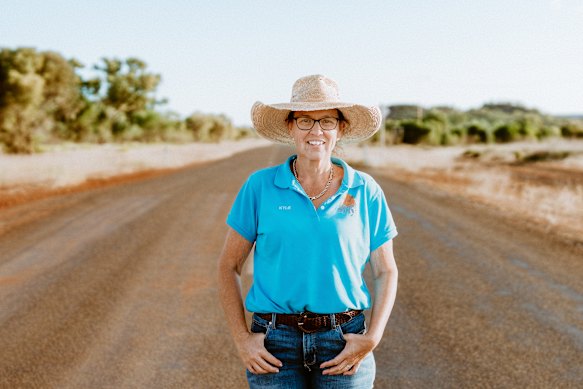
About six hours north-west, in Mount Isa – the city famous for Australia’s largest rodeo – Kylie Rixon has operated the Sunset Tourist Park for the past six years.
She did not appreciate the prime minister’s message.
“We’re only busy six months of the year and that one little comment … from the prime minister telling people to be conservative … it puts a knife in our hearts,” she says.
“It’s really cruel. We rely on tourism as our backbone. It’s our bread and butter. It’s our livelihood. So to hear someone on such a big platform and with his authority to say ‘limit travel’ … that’s shithouse.”
Rixon has recruited guests to star in promotional videos for Facebook and Instagram to encourage people to travel to Mount Isa, and stay a little longer.
“You know what we’ve got?” she asks in one video. “Heaps of fuel.”
Avid outback traveller Lyle Cowan, 59, has been making trips out west for the past 30 years. He usually makes at least two trips a year. This year, he might take none.
“This is the tipping point,” he says of the fuel crisis.
Cowan was planning a road trip to Charlotte Plains near Cunnamulla, about nine hours west of Brisbane, on Queensland’s Labour Day long weekend. But he has decided not to go.
“I’ve got a Landcruiser and I tow a caravan – fuel would have doubled. We were already talking about trying to fill the car and not take the van, share costs, but it all just got too difficult, so we bailed,” Cowan says.
“I look forward to every trip, and I was really looking forward to this one. I love my outback trips.
“I often go from here [in Brisbane] out to [Uluru] and back, and around Lake Eyre, and the price differential on a trip like that for four or five weeks would be $1000.”
Of 300 operators who responded to a survey from the Queensland Tourism Industry Council, 3 per cent said they were considering closing their doors, while another 20 per cent said they were under pressure to close.
“Just a small number of closures equates to around $943 million in lost economic contribution and represents 7000 jobs,” says the council’s chief executive, Natassia Wheeler.
“We are at a critical tipping point.”
She says soaring fuel prices have driven many operators to the brink in a decade of cumulative pressure from the pandemic, cyclones, floods and escalating insurance, energy and labour costs.
“Winter in Queensland is exceptional, and it goes from the south-east all the way through the outback, up to the north,” Wheeler says.
“It has such a big impact – that drive market – on our whole state. It affects butchers, bakers, mechanics, you name it, everyone benefits from this time of year in Queensland.
“But with that basically dried up for 2026, we’re going to see a significant amount of pressure, not just on immediate tourism businesses, but the flow-on effect to service businesses.”
Before the global fuel crisis, the Queensland and federal governments had mounted a $2.14 million tourism recovery program in the wake of the 2025 floods.
Country music star Lee Kernaghan was recruited to perform outdoor concerts, while the government launched an advertising campaign with the slogan, “Outback Queensland. It’s something else”.
But the peak industry body has written to both state and federal governments, calling for more intervention to stabilise the visitor economy.
Doyle says the government should be doing more.
“They should be offering anything that they possibly can to support these outback towns and to get people out,” she says.
“It’s starting to get very depressing for a lot of people. It’s a domino effect, you know, it’s worse than COVID.”
A spokesperson for the prime minister’s office said the tourism industry was being supported through recently announced relief measures, including measures to support businesses unable to meet their tax obligations and extending the Small Business Responsible Lending Obligation exemption for a further 10 years.
“The Albanese government will continue to take every action we can to shield Australians from the impact of this war – including halving the fuel excise, cracking down on petrol companies price gouging, getting more fuel into the market, and working with international partners to secure our fuel supply,” the spokesperson said.
Disclaimer : This story is auto aggregated by a computer programme and has not been created or edited by DOWNTHENEWS. Publisher: www.smh.com.au