
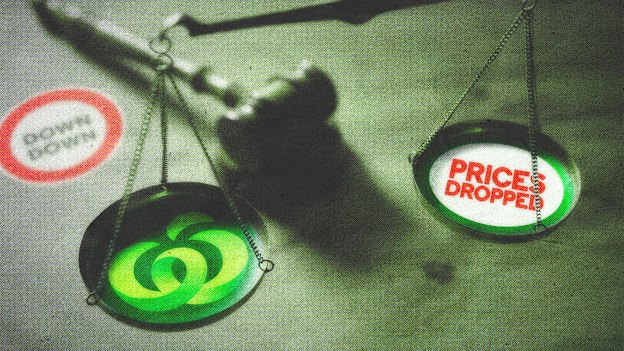
The supermarket chain argues that its suppliers were demanding it raise prices as inflation spiked, and it then offered shoppers genuine specials.
What exactly goes through a shopper’s mind as they walk down a supermarket aisle and spot tickets advertising a discount?
Are they enticed and then misled, as the Australian Competition and Consumer Commission argues in its case against Woolworths, by specials claiming a discount when the previous price of Oreos was only around for a week or two and the biscuits were actually cheaper before that? Is that too intellectual an approach, as the judge overseeing the case, Michael O’Bryan, suggested, before propounding a multifactor test of whether the previous price was genuine or not? Or is a few weeks enough to set a base price to discount from when inflation is rising, as Woolworths’ highly paid barristers argued in courtroom 1 on the 21st floor of the Federal Court this week?
One thing is clear: none of those questions will be answered by ordinary people. The case is a civil one in the Federal Court, where trials are heard by judges alone. But across a range of interviews on the street, these customers have a clear opinion.
“I don’t think we’re getting a deal,” Nicolas Pena, who lives in Sydney’s Ultimo, said after seeing the stickers at the centre of the cases. Robert Dunn, of Balmain, put it more bluntly: “Totally ripped off.”
Whether their opinions are representative of the elusive ordinary, reasonable shopper is at the heart of two landmark legal cases against the nation’s twin supermarket giants, the most recent of which – against Woolworths – got under way this past week.
The regulator has accused the retailers of misleading customers by artificially jacking up prices for a brief period so they can truthfully say its new price is a reduction on its previous one, when in fact it is higher than just a few weeks before.
Central to the ACCC’s case is analysis of hundreds of items sold across the $30 billion grocery giant Coles and its $46 billion rival Woolworths, and timelines showing how those prices changed. Their lawyers, both this past week and at Coles’ hearings in February, break this down into three stages: price one, or an item’s initial price; price two, the allegedly artificially increased price typically only available for a few weeks; and then price three, the newly discounted price.
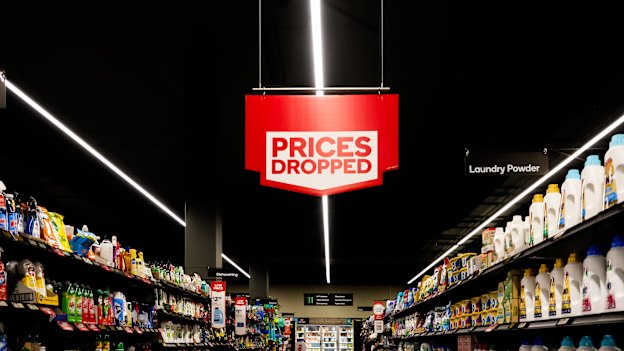
As part of the trials, the Federal Court has examined the exact labels for prices of dog food, Tim Tams, baby cereal and Kleenex tissues, advertised with either on Coles’ “Down Down” or Woolworths’ “Prices Dropped” labels on store shelves.
While the proceeding, lodged in 2024 about discount tickets from years ago, plays out in court, the issue of high inflation has reared its head again for Australians.
Grocery prices are set to rise due to war in the Middle East and flow-on shocks. Just this week, both companies upped prices for own-brand milk by about 10 per cent. Against this backdrop, Coles continues to run its Down Down program, unlike its competitor, which retired the Prices Dropped scheme shortly after learning of the legal action.
The central allegation is that the discounts were false and misleading. But as opening remarks in Woolworths’ case were made on Tuesday, the focus turned not to the markdowns themselves but whether the temporary white-ticket shelf prices – typically held for mere weeks – were real.
This “price establishment period”, or how long a price should be held before it can be feasibly described as a “was” price, has emerged as a legal grey area.
Each side has told Justice O’Bryan what they think the stickers communicate to shoppers.
When the ACCC’s lead barrister, Michael Hodge, KC, laid out the watchdog’s case on Tuesday, he pointed to the “subtle magic” of the red-and-white Prices Dropped tickets that drew shoppers in.
O’Bryan interjected: “Consumers wouldn’t over intellectualise these tickets.”
Shoppers “wouldn’t be thinking in the terms that you put to me”, O’Bryan said, but “at a much more general level”. The judge was concerned that Hodge and the watchdog’s lawyers were placing too much weight on a hypothetical thought process about how long previous prices had lasted, and not simply whether the “was”, or establishment price, was genuine.
Instead, O’Bryan suggested, what a customer believes is that “what was flagged on that ticket was some kind of genuine discount”.
On Sydney’s busy George Street thoroughfare on Friday, this masthead showed passersby reproductions of the exact Woolworths and Coles’ allegedly misleading shelf stickers that have been filed with the court as evidence, with the added explanations of their respective products’ pricing trajectory.
“Whenever you see these kinds of tags, you automatically think that you’re getting a better deal than normal,” remarked Maddy O’Connor from Sydney’s Kogarah of the prominent use of red in each ticket and the eye-catching words and typeface.
In response to the sticker Woolworths used to advertise a family pack of Oreos (priced at $3.50 for nearly two years, then hiked to $5 for 22 days before being placed on the Prices Dropped program at $4.50), O’Connor said the sticker was “pretty rude”.
“If you don’t normally get Oreos, you might be like ‘oh, I’ll treat myself this time since it’s on sale’, so it definitely pushes you subconsciously to want to buy it more,” she said.
Of a Coles sticker for Karicare baby formula (which had been $18 for more than two years, increased to $24 for 23 days, and then dropped to $21 as a Down Down special), O’Connor, who was with her baby in a pram during the interview, said the label felt misleading.
“It feels very deceptive, especially when they’re claiming it’s a sale when realistically it’s actually still just a price increase from not too long ago.”
Mitchel Jones, who lives in an inner-city suburb and regularly shops at Coles, said the short-lived second prices – or establishment periods, as they’re referred to in supermarket internal guardrail policies – of about 20 days felt too short. But as for how long is a fair period for it to be compared to as a previous price when demonstrating a discount? “I have no idea,” Jones admitted.
O’Bryan too has not expressed a definitive view, and in his eventual judgment may still not give the supermarkets the certainty they crave. At present, the law doesn’t stipulate how long this period should be.
What did become clear, though, is that one day is certainly not enough. O’Bryan, early in the week, noted that in 2018, the online electronics store Kogan emailed and texted millions of customers to tell them about a 10 per cent “TAXTIME” discount code. The online appliance retailer had, in fact, lifted prices by 10 per cent the day before the promotion began. In 2020, the ACCC claimed a victory after the Federal Court found Kogan had misled consumers, and fined the company $350,000.
Making an entrance
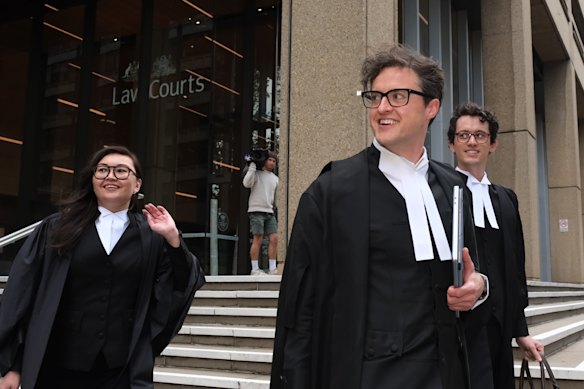
The witnesses making their way to Justice O’Bryan’s courtroom above Queens Square in the Sydney CBD this week would have been forgiven for thinking that interest in their testimony was white-hot.
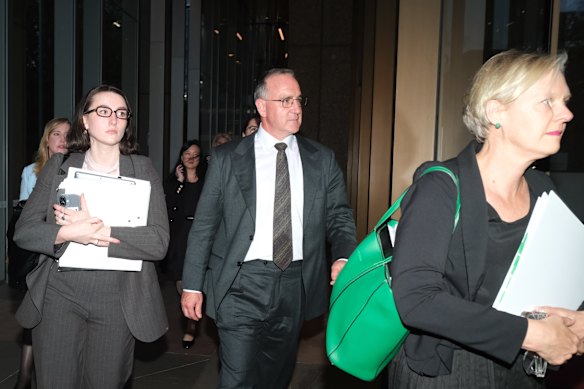
Supermarket chain head office employees with titles such as manager of “impulse and snacking” and “breakfast cereals, muesli bars and spreads” were confronted by dozens of journalists, photographers and cameramen arrayed around the courthouse, especially on Friday.
But the media weren’t there for the supermarket functionaries. Instead, the photographers ran to capture Rebel Wilson as she attended hearings to defend a defamation case. Meanwhile, fallen radio kingpin Kyle Sandilands was mobbed as he arrived for his wrongful termination case against ARN media.
When the Woolworths witnesses got into the courtroom, everything changed.
They were grilled by Hodge on topics from internal rules for how long prices need to exist, before changing to how suppliers request price hikes and subsequent pricing decisions in the same proposal. Former chief commercial officer Paul Harker appeared at times impatient and frustrated, huffing and folding his arms while being cross-examined by Hodge.
“No, no, no, no. Stop,” said Hodge at one point, interrupting Harker and directing him to answer his question. This prompted O’Bryan to jump in. “Let’s turn the temperature down,” said the judge.
Woolworths’ lead barrister, Robert Yezerski, SC, asked fewer questions of the witnesses. But he did ask one senior Woolworths manager, Sam Woodcock, what would happen if the chain did not comply with requests for a price rise.
“Essentially, if a supplier proposes a cost price increase to be effective from a certain date and we don’t accept that as a retailer, there’s a risk that if we haven’t accepted and actioned it in our system that a supplier will choose not to supply us that product any more,” Woodcock said.
“And I have to say, in Woolworths at that point in time, ensuring that we had product on the shelf was an absolute requirement,” Woodcock said.
Rapidly rising inflation has been the foundation of the supermarket’s defence. In his opening remarks, Yezerski relayed the inflationary environment gripping shoppers and the broader economy at the time. “They know what is happening in the economy, and they are indeed expecting prices to rise,” he said.
At times, the watchdog seemed to struggle to land its punches. Hodge’s softly spoken, slow-burn style of questioning appeared to occasionally lose its thread, prompting interjections from Justice O’Bryan to steer him back on course.
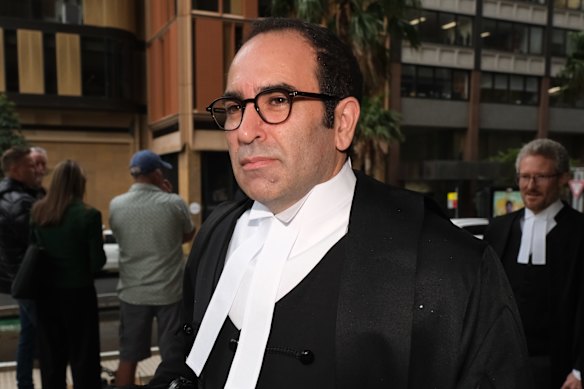
“We’re now following a path, I’ve got no idea where we’re going or why we’re going there,” O’Bryan said to Hodge when he was quizzing Harker on the supermarket’s internal rules for how long prices should last.
O’Bryan voiced his concerns at the ACCC’s case as early as Tuesday, during Hodge’s opening remarks, when he suggested the watchdog was setting up a “straw man” and not directly responding to Woolworths’ case.
Yezerski seized on O’Bryan’s concerns, saying that the regulator was relying purely on what the tickets implied, not what was explicitly written on them. “The ACCC does not suggest that any information on the Prices Dropped ticket was inaccurate,” Yezerski said.
Evidence read out in court revealed how “resting periods” – in other words, a ban on products from returning to the Prices Dropped program if prices had to rise – contracted from nine months to as little four weeks.
Woolworths’ defence has been straightforward, pointing to inflation and what Harker said was an “absolute tsunami” of applications from suppliers as the reason why prices went up.
If the court finds that Coles or Woolworths did mislead consumers, the consequences will be significant – not least because of the major supermarkets’ sheer reach.
And thousands of consumers stand to get cash if the specials tickets were misleading. A class action against both Woolworths and Coles by Carter Capner Law has gathered 30,000 signatories and is waiting in the wings. “Our estimates suggest that households could claim between $2000 and $5000, depending on the amount spent and the impact of the deceptive pricing,” said the law firm’s director, Peter Carter. The class action claim would be launched pending the judgment of the cases.
The Woolworths case continues next week.
The Business Briefing newsletter delivers major stories, exclusive coverage and expert opinion. Sign up to get it every weekday morning.
Disclaimer : This story is auto aggregated by a computer programme and has not been created or edited by DOWNTHENEWS. Publisher: www.smh.com.au


