
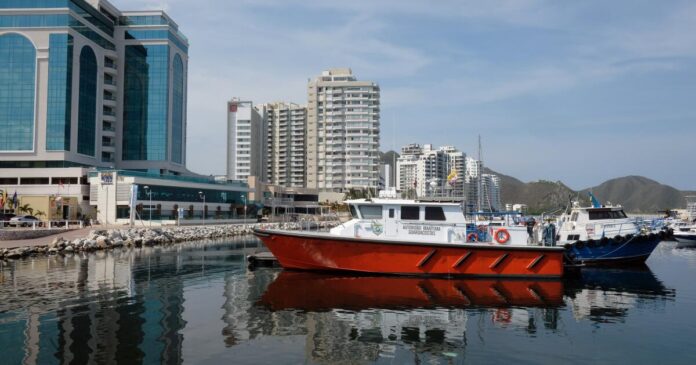
Just across the road from the site of the first international conference on transitioning away from fossil fuels, in Colombia, oil tankers routinely unload at the Pozos Colorados terminal, with its large tank farm.
The tension between climate ambition and fossil-fuel dependency is at the heart of the meeting, which began Friday in the Caribbean city of Santa Marta. It has drawn more than 50 countries — from oil producers such as Nigeria to big consumers such as Germany, plus the European Union — in a bid to break the stalemate of United Nations climate talks.
The gathering reflects mounting impatience with the slow pace of global negotiations. Countries first agreed at COP28 in Dubai in 2023 to “transition away from fossil fuels,” but made little progress on it. At last year’s COP30 in Brazil, about 80 countries backed a road map to phase out oil, gas and coal, but it was dropped from the final document for lack of consensus, angering many delegates.
That frustration helped spur Colombia and the Netherlands to gather this “coalition of the willing” in Santa Marta. The effort has gained momentum in recent weeks as the Iran war disrupts energy markets and highlights the risk of continued reliance on carbon fuels.
“Countries are going into Santa Marta with the energy crisis at the top of most of their minds. They have a visceral reminder of just how volatile, unpredictable, and unstable it is to rely on fossil fuels,” said Natalie Jones, senior policy advisor at the International Institute for Sustainable Development, a think tank.
“We need to shift now from the overarching objective of transitioning away from fossil fuels to actually how we go about it,” said David Waskow of the World Resources Institute, describing Santa Marta as taking “initial steps” on the practical challenges.
One important step, Waskow said, is a global road map. Brazil’s COP30 presidency has proposed one and is expected to deliver it at COP31 in Turkey in November. The Santa Marta conference aims to discuss how national and international road maps can be developed. Brazilian delegates told negotiators gathered in Berlin this week for a separate pre-COP meeting that they aim to produce a plan in time for the U.N. General Assembly in September, according to people familiar.
Decision-making will be less formal than in U.N. climate talks, using a participatory process involving governments, scientists and civil society that informs a high-level segment. The meeting’s outcomes will be consolidated into a final report rather than a binding agreement.
“My expectation is not that this is going to deliver huge results after one conference,” EU climate commissioner Wopke Hoekstra said in an interview at the Berlin meeting. “But it is important to have this process with this coalition of the willing.”
Yet the limits of the effort are visible in who is not in the room: the world’s three largest greenhouse gas emitters, China, the U.S. and India. Nor are key oil producers Saudi Arabia, Russia and neighboring Venezuela present. Saudi Arabia has long blocked any reference to phasing out fossil fuels during international talks.
For policymakers, the crisis caused by the Iran war poses a dilemma. High oil prices strengthen the case for renewable energy and reduce dependence on volatile supply routes. But they also trigger short-term responses such as more drilling and more subsidies.
The result is a global landscape in which hydrocarbon markets are both under pressure and generating windfall profits, even among Santa Marta participants. Amid rising energy prices, France announced it will help households and businesses switch to electric power instead of handing out short-term fuel aid. In Norway, oil and gas revenues lifted the trade surplus to its highest since January 2023.
Colombia, the meeting’s host, showcases how fractious the transition could be. Since taking office in 2022, leftist President Gustavo Petro has positioned Colombia at the forefront of the movement to wind down fossil fuels. He has pushed for a ban on fracking and halted new oil and gas exploration, in a country where oil and coal still account for roughly half of exports. He also backed the Fossil Fuel Non-Proliferation Treaty, helping elevate a movement that until then had been largely driven by vulnerable island states.
But contradictions are palpable. At the Pozos Colorados terminal, which handles most of the country’s fuel imports, a subsidiary of state-controlled Ecopetrol SA unveiled Colombia’s largest storage tank in June, expanding capacity for refined products.
More recently, a growing domestic gas shortage — exacerbated by the halt in new drilling and worsened by the Iran war — has revived demand for Colombia’s own coal.
The country is also heading into elections. A recent poll shows both conservative presidential candidates holding leads over leftist Sen. Iván Cepeda in a potential runoff, signaling a possible shift to the right when voters go to the polls on May 31, with a second round scheduled three weeks later.
If Petro’s allies lose, Colombia’s energy policy could make a U-turn. “There’s a consensus among opposition candidates to expand oil and gas exploration, even through fracking,” said Adrián Correa, an electrical engineering professor at Francisco José de Caldas University. “There could be a strong push to increase fossil fuel activity.”
Global warming is on track to overshoot the goals set under the Paris Agreement. Even if countries fully implement their current climate pledges, temperatures are projected to rise by 2.3C to 2.5C this century, according to the U.N.’s 2025 Emissions Gap Report, while existing policies point to a trajectory closer to 2.8C. That is far above the 1.5C threshold scientists say is needed to avoid the worst impacts of climate change.
Emissions continue to move in the wrong direction. Carbon dioxide emissions from fossil fuels reached a record 38.1 billion tons in 2025, rising 1.1% over the previous year, according to the Global Carbon Budget.
“The mere fact that the conference is happening is already a success,” said Claudio Angelo, senior policy adviser at Brazil’s Climate Observatory, a network of environmental, civil society and academic groups. “We’ve known since at least the 1960s that fossil fuels cause climate change, and yet there has never been a gathering of countries specifically to discuss how to deal with that.”
Maisonnave writes for Bloomberg. Andrea Jaramillo and John Ainger of Bloomberg contributed.
More to Read
Disclaimer : This story is auto aggregated by a computer programme and has not been created or edited by DOWNTHENEWS. Publisher: latimes.com







