
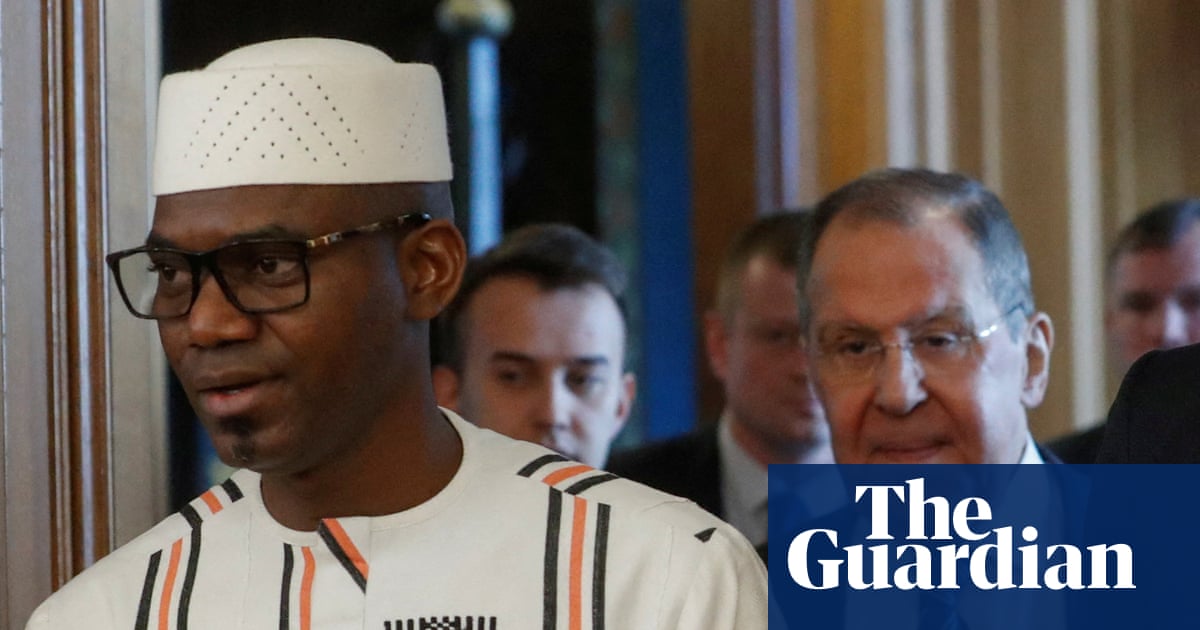
Mali’s defence minister was killed in an attack on his residence, the government said on Sunday, a high-profile fatality during coordinated assaults staged the previous day by insurgents including the West African affiliate of al-Qaida.
A car laden with explosives driven by a suicide attacker drove into Sadio Camara’s residence in the town of Kati, the spokesperson, Issa Ousmane Coulibaly, said in a statement read out on state television. A firefight ensued, and Camara sustained injuries from which he later died in a hospital, Coulibaly said, adding that Mali would observe two days of mourning.
The statement followed media reports earlier in the day that Camara had been killed during the operation in Kati, roughly 9 miles (15km) north of the capital, Bamako, where the army’s main base is located.
The regional al-Qaida affiliate, Jama’at Nusrat al-Islam wal-Muslimin, known as JNIM, cooperated with a Tuareg-dominated rebel group to carry out more than half a dozen simultaneous attacks across the country, according to claims by both groups.
The government has not provided a death toll. Coulibaly expressed condolences for “all civilian and military victims who died” without providing a number.
Analysts and diplomats described Saturday’s insurgent operation as one of the largest coordinated attacks in the country in recent years.
The UN called for an international response to violence and terrorism in West Africa’s Sahel region.
“The secretary general is deeply concerned by reports of attacks in several locations across Mali,” a UN spokesperson posted on X. “He strongly condemns these acts of violence.”
In addition to Kati, Saturday’s strikes hit near Bamako airport and in localities farther north, including Mopti, Sevare and Gao.
The fate of the strategic city of Kidal, a former stronghold of the Azawad Liberation Front, or FLA, the Tuareg-dominated group that partnered with JNIM, was unclear on Sunday.
The FLA said in a statement that Kidal had fallen, and a spokesperson for the group said on X that a deal had been struck to let Russian mercenaries leave a besieged camp outside the city, where Malian armed forces were still entrenched.
But Mali’s army chief of staff, General Oumar Diarra, told the state broadcaster that the military had tactically repositioned forces in Kidal and that operations were continuing in the area.
Ulf Laessing, the head of the Sahel programme at the German-headquartered Konrad Adenauer Foundation, said the attack was a setback for Russia, which backed the military-led government after it kicked out French, US and other western forces.
“For Russia the attack has been a disaster,” Laessing said. “They were unable to prevent the fall of the highly symbolic Tuareg stronghold of Kidal and now need to leave this northern city.”
The Russian state-run broadcaster Vesti reported on Sunday that Russia’s Africa Corps was repelling a large-scale militant attack on Mali’s government.
According to Vesti, Russian personnel were responding along with units of Mali’s presidential guard and armed forces, preventing the presidential palace from being seized.
Vesti said some members of the Africa Corps were wounded, without providing further details.
Saturday’s attacks are the latest sign that Mali’s government has not delivered the greater security it promised. In September 2024, JNIM attacked a paramilitary police training school near Bamako’s airport, killing about 70 people. More recently, it carried out a fuel blockade that has starved the capital’s residents and businesses of power and supplies.
The government has recently pursued closer ties with Washington, which has sought to rebuild cooperation on security and explore mining opportunities.
Mali’s foreign minister told Reuters last week that neighbouring states and foreign powers were backing terrorist groups, but declined to name the countries.
Disclaimer : This story is auto aggregated by a computer programme and has not been created or edited by DOWNTHENEWS. Publisher: theguardian.com



