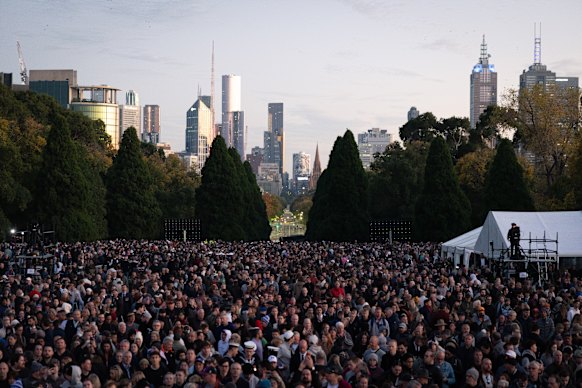
I heard the booing that broke out during the Welcome to Country at Melbourne’s Shrine of Remembrance on Anzac Day. Reports suggest similar scenes occurred in Sydney. On the day Australians gather to honour sacrifice, service and national unity, some in those crowds chose to direct hostility at Aboriginal people doing nothing more provocative than acknowledging Country.
It is hard to know what is more dispiriting: the behaviour itself, or the fact that it now feels grimly familiar. First Nations people are repeatedly asked to be patient, to educate, to participate generously in the national project of reconciliation, and then, when they stand to speak in moments of public ceremony, they are jeered and told in one form or another that they are unwelcome. Once again, Aboriginal people are expected to absorb the insult, steady the national mood, and move on.
Let us be clear about what occurred. This was not a defence of tradition. It was not a principled objection to ceremony. Booing an Aboriginal elder at a solemn public commemoration is racial hostility, however people may wish to sanitise it. The language of those booing, or trying to justify it, may change each year, usually couched in complaints about politics or “division”, but the message remains the same: Indigenous presence is acceptable only when it does not unsettle the dominant national story.
That is why the irony is so striking.
Anzac Day is one of the few occasions on which Australians speak with real seriousness about values. We invoke courage, dignity, sacrifice, mateship, service and a shared sense of nationhood. We ask for silence. We ask for respect. We insist that those who fought and died for this country deserve nothing less.
But do people seriously believe those men and women went to war, fought tyranny, defended democratic ideals and in many cases lost their lives so that they might leave behind a country still comfortable with public racism? Is this really the Australia their sacrifice was meant to secure?
It is a question worth asking because so much of the performative patriotism on display each Anzac Day seems to evaporate the moment Indigenous people are visible within the national ritual. Respect is demanded for the dead, but withheld from the living. Reverence is insisted upon for military symbols, but not for the oldest continuing culture on earth. Apparently, the sanctity of remembrance is robust enough to survive military flyovers, politicians’ speeches and media fanfare, but not an Aboriginal welcome.
The contradiction becomes even sharper when one remembers that Aboriginal and Torres Strait Islander servicemen and servicewomen fought in these wars too. Many enlisted for a nation that denied them citizenship, denied them equality and denied them full belonging. They wore Australia’s uniform abroad and returned to discrimination at home.
There is a deeper issue here than offensive behaviour by a few individuals. Incidents like this expose how conditional Australia’s commitment to inclusion still is. First Nations people are invited to contribute to national ceremonies, but too often only on the understanding that they do not make the nation uncomfortable. They may stand on the stage, but they must not disturb the script. They may be acknowledged as part of Australia, but they must not remind Australia that its story did not begin with Gallipoli.
This is why these moments cannot simply be dismissed as unfortunate interruptions by a fringe minority. They are symptoms of a larger refusal, still present in Australian public life, to accept that truth telling and patriotism are not opposites. Mature nations can hold both military remembrance and colonial honesty in the same frame. In fact, they must.
A Welcome to Country does not diminish Anzac Day. It asks us to situate remembrance within the full story of the land on which remembrance occurs. And if that remains intolerable to some Australians, then they need to take a long hard look in the mirror because the measure of what we honour on Anzac Day is not found only in wreaths, bugles and minute silences. It is found in whether the values we claim to commemorate, dignity, shared humanity, respect, can be extended beyond ritual language into the living present. If they cannot, then what exactly are we commemorating?
Jessa Rogers is associate professor in Indigenous education at the University of Melbourne.
The Opinion newsletter is a weekly wrap of views that will challenge, champion and inform your own. Sign up here.
 Jessa Rogers is Associate Professor of Indigenous Education at the University of Melbourne.
From our partners
Disclaimer : This story is auto aggregated by a computer programme and has not been created or edited by DOWNTHENEWS. Publisher: www.smh.com.au