
Australia’s fuel stockpile would be doubled under an $800 million Coalition proposal that comes as Foreign Minister Penny Wong flies to China, Japan and Korea to scour the region for diesel and petrol deals.
Oil prices rose again after US-Iran peace talks stalled over the weekend, raising the prospect that the Strait of Hormuz is blocked for even longer as alternative sources of fuel run down.
Speaking with this masthead two weeks ago, Energy Minister Chris Bowen flagged bigger reserves could be announced in the budget on May 12, as Australia still relies on imports for 90 per cent of its fuel.
The many hundreds of millions of dollars required for new storage would deliver an unwelcome hit to the May budget, but this is shaping as the only option open to the government.
Bowen has already ruled out upgrades to the nation’s two remaining fuel refineries, due to the expense involved. Similarly, funding a new refinery would cost tens of billions of dollars and fuel industry experts state there are no private companies that would fund construction.
One Nation, which is battling with the Coalition in a looming byelection in NSW, has been campaigning widely on social media about fuel sufficiency.
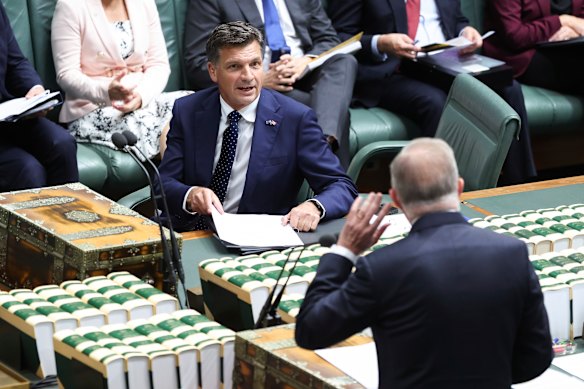
Opposition Leader Angus Taylor is hoping to come out with his own fuel resilience plan ahead of Labor’s budget plan. He has announced the Coalition, should it win government at the next election, would increase to 60 the number of days’ worth of fuel firms are required to have on hand. The rule would come into effect from 2027, with a view to bumping up reserves by 2030.
A new $800 million Fuel Security Facility would provide financial help to companies building large-scale storage; private storage is where Australia’s reserves are held, rather than government facilities. Neither party is proposing to build new refineries, which would cost billions.
“This is a plan the prime minister should pick up today. No excuses, no delays,” Taylor said. “If fuel stops, Australia stops. It’s that simple.”
When Taylor was energy minister in 2020, the Morrison government spent $94 million to establish a stockpile of 1.7 million barrels of oil in the US, with plans to increase storage domestically at a later date.
In 2022, the Morrison government sold the fuel in this stockpile for about $230 million as part of a global effort to calm the world’s oil markets after Russia’s invasion of Ukraine.
Current rules mandate that firms hold 27 days of petrol and 32 days of diesel. The government has spent billions to underwrite purchases of expensive cargoes over recent weeks and, in doing so, has increased holdings to 44 days of diesel, 33 of diesel and 30 of jet fuel.
The Coalition has completed modelling showing that the average price of petrol would increase by about 1¢ per litre if the nation had 60 days in reserve because firms would pass onto consumers the cost of building new storage.
The blockade in the Strait of Hormuz has choked off about 20 per cent of global oil exports, sparking a crisis in Asian nations that rely disproportionately on Middle Eastern crude oil when making liquid fuels in Asian refineries. Australia has started to buy tankers full of fuel from far-flung countries including Algeria and Argentina.
Wong this week will travel to Japan, South Korea and China to seek agreements to give Australia preference should the war become prolonged.
Albanese claimed to have secured similar commitments in trips earlier this month to Singapore, Brunei and Malaysia. China is a major supplier of aviation fuel while Japan and Korea house some of the region’s largest refineries.
“We want to remain a reliable supplier and we want to see Australia prioritised when it comes to diesel, petrol and fertiliser. That requires face-to-face engagement,” Wong told reporters on Monday.
The prospect of Australia introducing a new tax on gas exports, as pushed by Greens, Labor backbenchers and independent senator David Pocock, has alarmed Japanese and Korean trading partners, but Albanese has dismissed the campaign all month while promising “no surprises” as he tries to lock in fuel deals overseas.
Pocock says Albanese has adopted the misleading arguments of the gas firms, who pay minimal tax on the resources they extract but contribute more than $20 billion in company tax and state royalties.
Japan, Malaysia and South Korea depend on oil and gas imports to ensure security of gas supply, which is crucial to their electricity grids. Each nation made massive public investments decades ago to help build Australia’s gas export industry.
Cut through the noise of federal politics with news, views and expert analysis. Subscribers can sign up to our weekly Inside Politics newsletter.
 Paul Sakkal is Chief Political Correspondent. He previously covered Victorian politics and won a Walkley award and the 2025 Press Gallery Journalist of the Year. Contact him securely on Signal @paulsakkal.14.Connect via X or email.
 Mike Foley is the climate and energy correspondent for The Age and The Sydney Morning Herald.Connect via email.
From our partners
Disclaimer : This story is auto aggregated by a computer programme and has not been created or edited by DOWNTHENEWS. Publisher: www.smh.com.au


