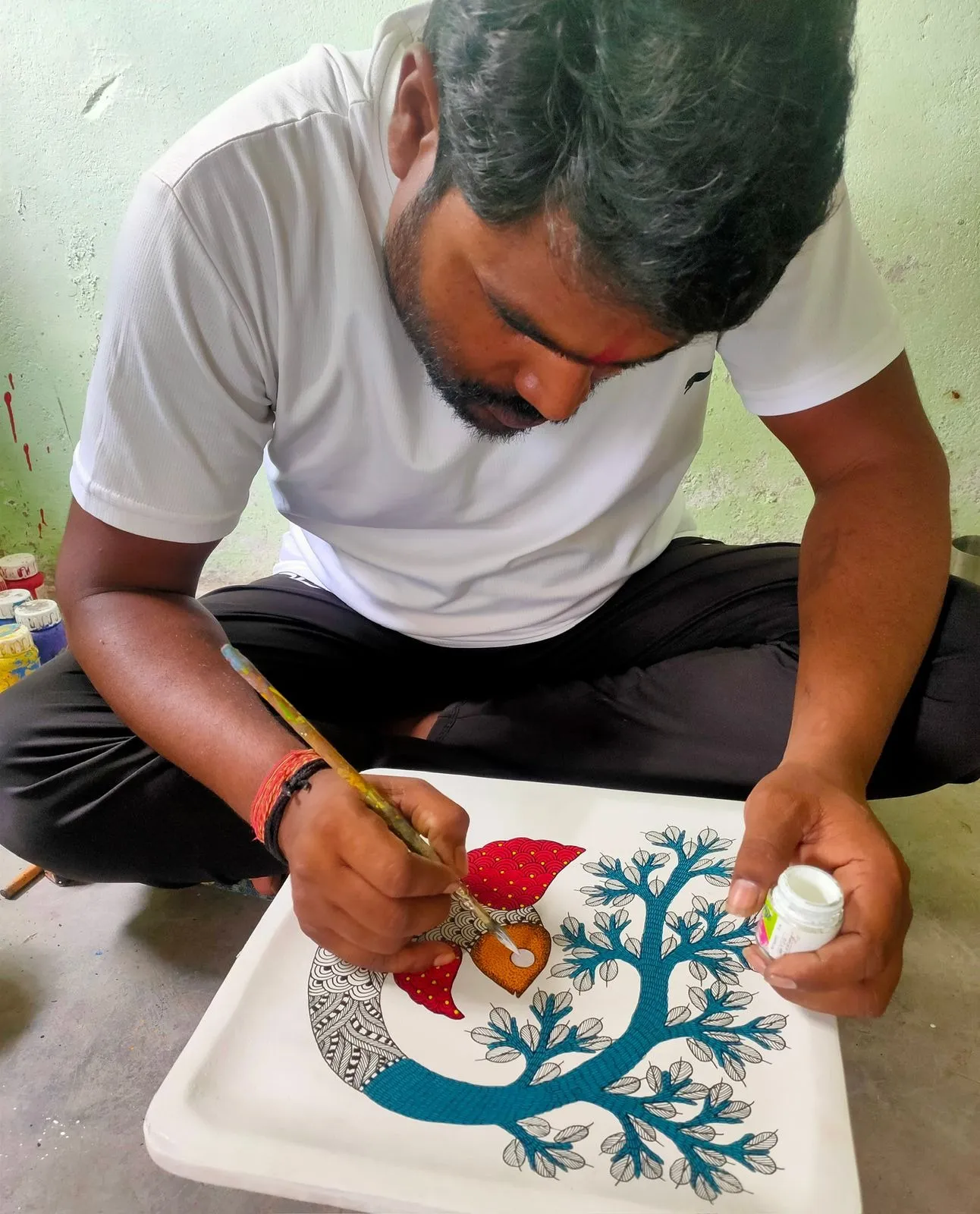
Santu Tekam lives in Patangarh, a small town in Madhya Pradesh where Gond tribal painting is as ordinary as farming. In his village of about 1,000 people, nearly 100 practise the art. Some are still learning. His wife helps him with the painting. His parents tend to their fields.
For years, the income from his craft was seasonal and uncertain. The monsoon meant no painting. Galleries came and went. During COVID, the work dried up entirely.
Then someone called.
“During COVID, when I did not have any work, Didi gave me work,” he says. “Now, I get regular work throughout the year. On an average, I earn Rs 10,000 to 30,000 a month. More people recognise our art these days.”
That ‘Didi’ is Shambhavi Pandey, the founder of Folkstroke — a women-led artisanal brand from Raipur, Chhattisgarh, that has spent the last six years trying to answer a question most people in the craft world had stopped asking: why does traditional Indian art so rarely make it into people’s everyday lives?
Art that nobody took home
Shambhavi grew up moving. As the daughter of an Army officer, she lived across West Bengal, Manipur, Jammu and Kashmir, Haryana, and Punjab, among other states. Each place left something behind. West Bengal was colour. Manipur was craft. Punjab and J&K were people — their warmth, their way of telling stories.
Adapting was not a skill she developed. It became her nature.
“My sensitivity to various cultures and people helped me in college and my workplace. I could get along with almost anyone by the time I was in middle school. I had no hang-ups,” she says.
That ease with people, with difference, with walking into unfamiliar rooms — it would matter more than she knew.
/filters:format(webp)/english-betterindia/media/media_files/2026/04/27/product-market-fit-design-intervention-2026-04-27-20-14-37.jpg)
Shambhavi graduated from Sophia Girls College, Ajmer, and went on to complete an MA in human resources management from the Faculty of Social Work, MS University, Vadodara. She built a career as an HR professional, managing diverse workforces of up to 3,000 employees across international geographies. She won the ‘Simply Excellent – Platinum’ award of excellence during her tenure at AC Nielsen.
But something was missing.
“I was looking for an identity beyond a corporate role. I would not have wanted to have retired as the VP of a company. I wanted to do something grounded in purpose,” she says.
Her first attempt was a health-tech startup called Healted Tech, incubated and funded by IIT Kanpur, which offered second medical opinions to patients in remote villages of Chhattisgarh. Her husband Ritam, a management professional, now runs Healted. The venture is stable.
Shambhavi moved on to the question she kept returning to.
/filters:format(webp)/english-betterindia/media/media_files/2026/04/27/shambhavi-2026-04-27-20-14-44.png)
Traditional Indian folk art existed in abundance. It was alive, skilled, and extraordinary. It was also mostly sitting on gallery walls, in craft fairs, in the category of ‘things to admire and move on from.’
“I realised that there is a need to contemporise traditional Indian folk art such that it suits modern tastes and regains its lost lustre,” she says. “That is why I set up a venture to create decor products which are hand-painted in traditional Indian folk art but at the same time are quirky, aesthetic and modern.”
In 2019, she began working with artisans through a small proprietorship. The first artisan she worked with was a teenager. By November 2021, the venture was registered as a private limited company — Hasthkala Curators — with Folkstroke as its trademarked brand.
‘Something people could actually use’
The products Folkstroke makes are not meant to be looked at and left alone.
Animal heads mounted on walls. Folding side tables. Tabletop decor. Corporate gifts — wooden mobile holders, tab stands, pen stands, trays, hand-painted calendars, coasters, foldable stools. Kalamkari wooden trays in two colours that a Delhi customer named Ranjana Chauhan ordered as wedding return gifts for her son.
“I wanted something artistic and authentic. The products were delivered in time. The Hasthkala team also made cards to insert in the gifts. I am happy both with the quality of products and the service,” says Ranjana.
/filters:format(webp)/english-betterindia/media/media_files/2026/04/27/an-example-of-fusion-art-1-2026-04-27-20-14-44.jpg)
Products are priced between Rs 150 and Rs 7,000. Around 90 percent of the materials are wood, with Dhokra products, hand-cast iron from Uttar Pradesh and Chhattisgarh, and metalwork from Moradabad also forming part of the range.
The art forms include Tholu Bommalata, Gond, Warli, Pichwai (a devotional painting tradition from Rajasthan), Kerala Mural, and Cheriyal — painted by artists from across India.
Today, Folkstroke works with more than 200 artisans across seven states — Rajasthan, Madhya Pradesh, Andhra Pradesh, Uttar Pradesh, Chhattisgarh, Telangana, and Karnataka. Of those, approximately 48 are actively engaged at any given time, depending on the order volume. More than 50 percent of the artisans are women. Many are based in Naxal-dominated areas and face security challenges in their daily lives.
/filters:format(webp)/english-betterindia/media/media_files/2026/04/27/from-chhattisgarh-to-the-world-2026-04-27-20-14-44.jpg)
The products are sold on large platforms like Amazon, through channel partners including Jaypore and Flourish, through small home decor stores in India and abroad, and are exported to Malaysia, the UK, the US, and Australia.
Folkstroke has received incubation support from IIM Udaipur and Catalyst AIC, whose mission is to support craft entrepreneurs. It has also received a crafts pilot grant from CIIE — the Centre for Innovation Incubation and Entrepreneurship — at IIM Ahmedabad, now called IIMA Ventures.
Splitting the work, sharing the gain
The way a Folkstroke product gets made is different from how craft products have traditionally been produced — and that difference is where much of the impact lives.
Earlier, production was sequential. One artisan would complete their section of a piece before it passed to the next. If someone was unwell, away for a harvest, or simply unavailable, everything waited. Income followed the same stop-start rhythm.
Shambhavi changed the structure.
Folkstroke now fuses two or more art forms in a single product. Different artisans work on different components at the same time — parts made across clusters in different states — which are then brought together for assembly and finishing at the Raipur processing unit.
/filters:format(webp)/english-betterindia/media/media_files/2026/04/27/folkstroke-2026-04-27-20-14-44.jpg)
Folkstroke works with 200+ artisans across 7 states in India
“We usually fuse two or more art forms in our products. The advantages are that there is ease of production, as we are not dependent on one artisan or cluster of artisans. Production time is reduced by 60 percent. Also, fusion products are traditional, yet unique,” says Shambhavi.
The result is a product that carries the imprint of more than one hand. A single purchase generates income for more than one artisan. And the brand has a USP that mass-produced craft products cannot replicate.
Artisan incomes, which earlier ranged between Rs 8,000 and Rs 15,000 a month, have seen an average increase of 30 percent over the past six years. The cumulative revenue so far exceeds Rs 1.5 crore, 37 percent of which has gone directly to artisans as payment.
/filters:format(webp)/english-betterindia/media/media_files/2026/04/27/an-example-of-fusion-art-2-2026-04-27-20-14-44.jpg)
“The reasons for this are that we are determined to give them a fair wage. Also, our products are mostly handcrafted, though machinery is used to process wood,” says Shambhavi.
As for the artisans themselves, Shambhavi is careful about where her role ends, and theirs begins.
“I am not a designer by profession. Artisans are creative people and very sensitive. We cannot teach them. We have to act as facilitators. If we tell them they have made a mistake, they would get upset and sulk. We have to deal with them very gently,” she explains.
‘Didi gave me work’
Santu Tekam’s Gond paintings depict tribal stories — animals and figures built from patterns of lines and dots, in bold flat colours. He paints wooden objects, and sometimes sarees. Natural colours, he notes, do not find favour with customers today, who prefer brighter ones.
During COVID, when markets collapsed and orders stopped, Shambhavi kept sending him work.
/filters:format(webp)/english-betterindia/media/media_files/2026/04/27/santu-tekam-at-work-1-2026-04-27-20-14-44.jpg)
“Now, I get regular work throughout the year,” he says. During the monsoon, painting slows down — it always has. But the unpredictability that once defined his income has eased considerably.
Santu’s story is one of hundreds in the Folkstroke network, but it carries something that statistics about income increases cannot fully hold: the texture of what it means to have someone call when the work runs out.
The artisan who almost lost his craft
During the pandemic, Shambhavi received a message from Shiva Shinde, an artist from Andhra Pradesh who had trained in Tholu Bommalata — a centuries-old tradition of leather shadow puppetry. By the time he reached out, he was working as a farm labourer. The craft was still in his hands. There was just no one to sell it to.
Shambhavi created a Facebook page for him to promote his work.
“He was able to sell 100 plus pieces in three months! But this could not sustain for too long,” she says.
/filters:format(webp)/english-betterindia/media/media_files/2026/04/27/artisan-family-2026-04-27-20-14-37.jpg)
It was Shambhavi’s husband, Ritam, who suggested the next step. “My husband suggested that we send him a railway ticket to come and meet us. Through collaboration with us, he managed to re-establish his craft business,” she adds.
Shiva’s story pushed Folkstroke to think differently about what it was building — away from one-off sales and towards something that could keep artisans earning across months and years.
Not long after, the venture made its first move into export. In 2022, at the EPCH annual export fair, Hasthkala clinched its first international order — 200 wooden ram heads, a product they had designed themselves, shipped to a buyer in the UK. It was the first time they had exported at all.
It opened a door.
How to scale without losing the artist
In the two years since that first export, the business has shifted significantly. Today, approximately 80 percent of Folkstroke’s sales come from B2B orders. Companies including NOVA IVF, TCS, SAP Labs, Thermax, and VNR Seeds Pvt. Ltd have bought from the brand. The corporate gifting range includes everything from wooden mobile holders to hand-painted calendars to foldable stools.
The most significant milestone came recently. Hasthkala partnered with BharathCloud, a sovereign AI cloud services provider, for a corporate gifting mandate — 2,500 handcrafted gifts sourced from tribal artisans across India, including decor items, artwork, and artisan hampers rooted in regional art from Rajasthan, Uttar Pradesh, Andhra Pradesh, Chhattisgarh, and Madhya Pradesh.
It is the largest single order Folkstroke has fulfilled.
/filters:format(webp)/english-betterindia/media/media_files/2026/04/27/corporate-gifts-and-direct-artisanal-payment-2026-04-27-20-14-44.jpg)
“Our collaboration with BharathCloud helps bring traditional Indian crafts to a wider corporate audience while creating sustainable income opportunities for tribal artisans. By connecting handcrafted products with responsible corporate gifting, we aim to preserve heritage art forms and empower the communities that keep these traditions alive,” says Shambhavi.
For BharathCloud, the choice was deliberate. “We chose Hasthkala not just for gifting, but because we value collaborating with organisations that give life to communities and preserve Indian heritage,” says Rahul Takkallapally, Co-Founder of BharathCloud.
“At BharathCloud, we believe technology-led companies have a responsibility to create meaningful social impact. This partnership also allows us to support sustainable livelihoods for tribal communities while bringing handcrafted stories from across the country to our clients and partners.”
For Shambhavi, the significance of the order goes beyond its size.
“This is the first time we have fulfilled a single order of such magnitude with a corporate. It builds trust in our brand in the corporate gifting space and shows we can operate at scale — even though we are an artisanal, social impact venture,” she says.
Inside the workings of an all-women team
Through all of it, the operations team at the Raipur unit has remained entirely women — seven members, including Shambhavi. Artisan payments go directly into bank accounts. For many of the women in the network, this is the first time money has arrived in their name, in an account they control.
“We have an all-women operations team in Raipur. We understand the challenges women face and have created a safe, empathetic, congenial, and supportive environment for them. For instance, we pay the women artisans in their bank accounts so that they have financial independence and security,” says Shambhavi.
/filters:format(webp)/english-betterindia/media/media_files/2026/04/27/the-all-women-operations-team-at-raipur-2026-04-27-20-14-45.jpg)
Shambhavi is also currently pursuing a PhD in entrepreneurial leadership from Symbiosis International University, Pune, and holds a UGC JRF — Junior Research Fellowship — awarded to top candidates of the UGC-NET exam.
In 2022, she received the National Women Recognition Award for Entrepreneurship from FM Tadka, Rajasthan Patrika, and SBI, and was recognised as a ‘Top Business Mom’ by LBB (Little Black Book). She was also featured in the EPCH bulletin that year for novel craft interpretation.
The plan for the next five years is to deepen exports and the B2B segment, and to focus on lesser-known art forms. There is also an idea taking shape: embedding microchips in products to layer digital elements into traditional craft, making them more accessible to younger buyers.
“We also want to focus on lesser-known art forms. Another idea is to mix technology and digital media with traditional art forms by putting microchips in the products. This would appeal more to Gen Z,” she says.
In Patangarh, Santu Tekam still paints through the monsoon lull, waiting for the season to turn. His wife paints alongside him. His parents farm. And the work, for now, keeps coming.
Some businesses describe what they do in terms of scale, turnover or market reach. Folkstroke’s version of that is simpler: Santu still has his craft. Shiva Shinde still has his.
That, Shambhavi would say, is what the whole thing is for.
Disclaimer : This story is auto aggregated by a computer programme and has not been created or edited by DOWNTHENEWS. Publisher: thebetterindia.com