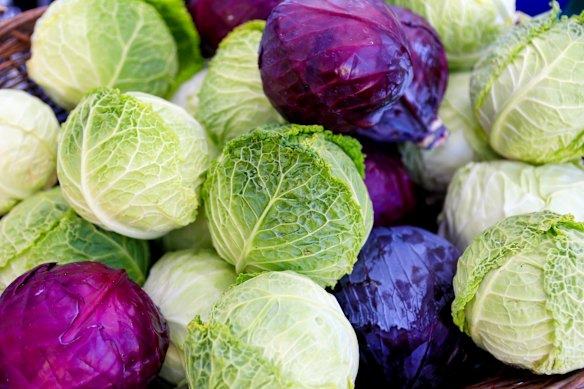
This versatile veg is officially having a moment. Alice Zaslavsky explains why the world is finally falling for the cabbage’s magic.

While finance pages decry the K-shaped economy of 2026, the cultural zeitgeist has declared this a C-shaped year instead – C for cabbage.
What’s fuelling this cabbage comeback is a perfect storm of fad fatigue and economic necessity. After years of cauliflower-everything and superfoods buzzword-bingo, cooks and chefs are collectively turning to the cabbage for its versatility, ubiquity and IYKYK (if you know, you know) fibre-maxxing appeal.
In an era when social media “Explore” pages are dominated by gut health and “cossie-livs” hacks, cabbage bridges the gap, offering a sturdy and nutrient-dense alternative to the more fickle green leafy veg.
The BBC declared cabbage and its insoluble fibre as the health trend du jour. Alissa Timoshkina’s cookbook Kapusta (cabbage in Russian) took out a gong at the prestigious André Simon Food and Drink Book Awards. Even the runways are turning green; Pinterest’s prediction of “cabbage supremacy” has come to life via luxury houses such as Burberry and Alexander McQueen, who have planted their models amid cabbage-themed prints and locales.
It’s the ultimate “C-shaped” solution for 2026: a 4000-year-old staple rebranded as the sustainable, structural and maximalist star of both the plate and the catwalk.
The best recipes from Australia’s leading chefs straight to your inbox.
Why we love it
With its hardy stalk and billowy but robust leaves, cabbage thrives where other vegetables sputter. It’s not just weatherproof, it’s recession-proof: investing in a quarter head, once shredded, will yield several dishes’ worth of sweet, silky strands, crunchy slaw, or funky ferment, depending on how you diversify.
With its hardy stalk and billowy but robust leaves, cabbage thrives where other vegies sputter.
Beyond its newfound chic, this veg is a nutrient powerhouse. From suan cai (Chinese sauerkraut) fuelling Great Wall workers, to Hippocrates hailing kraut as a healing food, its pedigree is unmatched. Even naturopathy forefather Sebastian Kneipp noted that the longest-lived were “diligent cabbage eaters” – proving this humble brassica has always taken the biscuit for health.
Cruciferous vegetables are global heavyweights in the world of nutrition, with endless studies corroborating their antioxidant and anti-inflammatory superpowers.
But during pregnancy and breastfeeding, cabbage becomes a literal wonder-leaf – whether ingested or worn. Those outer leaves, which act as Mother Nature’s cling film to protect the cabbage’s tender heart, are packed with anti-inflammatory properties and a unique capacity for water retention.
Chilled in the fridge and shaped around swollen ankles or used to soothe the first signs of mastitis, this veg is truly magic. Its robust yet pliable shape makes it the ultimate natural cold compress.
Why it’s had a stinky reputation
Part of what makes cabbage so magical for both gardeners and cooks is its sulfuric compounds, known as glucosinolates.
These bitter elements act as a natural pest deterrent while the plant grows. Once activated by cutting or cooking, they convert into sulforaphane, which we harness for both bold flavour and health promotion. The only catch? With great power comes great … pungency.
If you grew up with farty-smelling cabbage, chances are it was over-cooked and under-seasoned. And that’s a hard association to budge. But shaking off the “boiled-to-death” blues starts long before you turn on the stove. It begins with picking the right specimen – because the fresher the cabbage, the sweeter the reward.
What to look for
Sugarloaf is my top pick for its sweetness. But no matter the variety, check the stalk for a juicy, pale base – this indicates it was recently harvested and is still at its peak. Like an artichoke, a good cabbage should squeak when squeezed, a sure sign of hydration and freshness. Don’t be deterred by a bug hole or two, either; if it’s tasty enough for the insects, it’s likely the sweetest of the patch.
How to make it taste good
The secret to cabbage is timing. Keep the heat to a minimum and switch it off as soon as the leaves turn translucent – unless you’re a seasoned pro after the soft comfort of a cabbage roll.
Cruciferous veg also loves being burnt and burnished (as seen in Jessica Brook’s recipe, pictured above). If you’re going this route, treat the cabbage like a prime cut of meat:
- Sear: Preheat a griddle or cast-iron pan. Lightly oil a cabbage quarter, season liberally with salt flakes, and sear each cut surface for roughly five minutes until well-charred and soft enough to peel back the layers.
- Flavour: Finish with something fatty or aromatic – think butter with crushed garlic and chilli, or a salty miso glaze with a lick of honey.
Lucky for us, the sharp bitterness of cabbage has been bred out of conventional styles. Modern varieties are now much milder, sweeter and less fibrous, meaning they require far less cooking than the cabbages of old. Here are some popular, nutrient-packed varieties to try:
A pro-tip for the time-poor
Don’t be afraid to buy ready-shredded bags of slaw if needs must. Just remember to use them right away – or, to get a few extra days out of the mix, transfer it to a bowl and cover with a damp kitchen towel.
 Alice Zaslavsky is a best-selling cookbook author, host of ‘A Bite to Eat with Alice’ on ABC TV and can be found on the socials as @aliceinframes
From our partners
Disclaimer : This story is auto aggregated by a computer programme and has not been created or edited by DOWNTHENEWS. Publisher: www.smh.com.au