
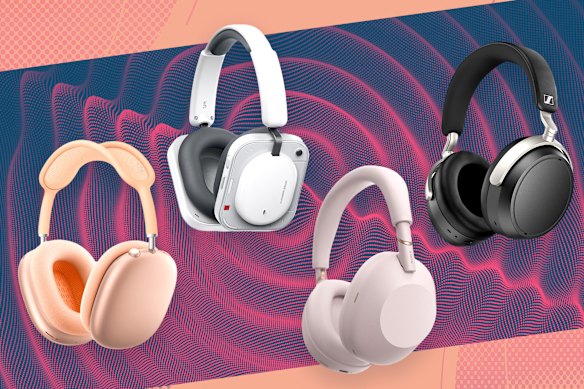

There’s a lot to consider when picking out a new set of noise-cancelling headphones, which should keep you happy in your own personal cone of silence at home, work, commuting and travelling for years.
Here we’ve picked out four, all of which nail the fundamentals: they have to sound good, be comfortable, have powerful noise-cancelling abilities, solid microphones and a thoughtful user interface. An option for wired connections is an important bonus too.
These headphones all have different strengths and weaknesses but if you’re not sure which of the below is right for you, we’re starting off with the model that’s best for most people. Sony’s WH-1000XM6 is the king of noise cancelling, but it also beats almost everything else on the market for comfort, sound quality and longevity too.
Of course if you need something cheaper or smaller, you can check out our list of best noise-cancelling earbuds, or skip to the bottom of this article, where we crown our favourite sub-$400 headphones.
Best for noise-cancelling
While Sony still sells its previous 1000X models for less, the M6 is comfier to wear, the buttons are easier to find at a touch and hinges have returned, so the headset can fold or be worn around your neck without looking and feeling awful. Sound-wise they’re fantastic and full, noticeably crisper on the highs and deeper on the bass, with a broader sound stage.
The most significant change is the noise-cancelling, which is even better than before. Plane, tram and train noise is essentially eliminated, and at home it does a better job with uneven noises such as washing machines and vacuum cleaners. The transparency mode remains stellar, and can optionally activate when the device hears you speak. In Sony’s app you can set the cans to switch to certain modes in certain locations, or adapt as it detects you moving around.
These are very light and comfortable headphones despite the great sound and long 30-hour battery life. They look great in black, silver, blue or pink, even if they’re a pretty safe design. The swipe touch controls work well enough, but I appreciate noise-cancelling modes being on a physical button. They work well for phone calls, with clear voice isolation, and come with a great magnetic travel case. No zips!
Disappointingly, while many new headphones support high-res audio over USB-C, the XM6 does not. They do come with a 3.5mm headphone cable, and will even function as passive headphones if you turn the power off, but you’ll need an adapter or DAC to get them into a phone’s USB-C port.
Best for audio quality
The latest AptX Bluetooth codec supports lossless, high-resolution streaming with low latency, and the ability to shift bitrates in busy areas to eliminate stuttering.
But barely any phones support it. So Sennheiser has taken things into its own hands, bundling its excellent HDB 630 with a dongle that extracts the highest possible quality over USB-C, and sends it via AptX Adaptive. So as long as your phone or laptop supports sending sound over USB, the 630 can give it an audio upgrade.
With the dongle attached to my iPhone, and a high-res track playing from Apple Music or Spotify, the difference over standard Bluetooth is stark. Instruments sound more separated and better imaged, while vocals are cleaner and more detailed. And that’s on top of the excellent balanced sound the 630 produces through any input method. The default may be a little neutral, but thankfully a full equaliser is available in the app.
In terms of noise-cancelling, the Sennheisers are good but not perfect. They successfully lower ambient sound to give you a quieter stage for your music, but it’s not the silence of the Sony model, nor does it block out distracting loud noises that might rise above the droning or a train or tram. Physically the 630 is comfortable, comes in a nondescript black and silver, and has functional touch controls. There are USB-C and 3.5mm cables included, but no passive mode. Maximum battery is 60 hours. I found it was more like 45 if you’re always using AptX, but that’s still great.
One flaw is the massive and heavy travel case, necessary because the headphones do not fold or rotate. It is handy for keeping track of the dongle, but it’s a pain to carry in a backpack. Phone call quality is good, but you’ll sound a bit thin on the other end.
Best for Apple devotees
If you’re already rocking an iPhone and a Mac, and you want your headphones to give their best without needing a separate app, the AirPods Max are an obvious choice. Compared to the previous generation, the Max 2 brings several features from the in-ear AirPods Pro, plus a USB-C port instead of Lightning, and overall better sound.
Most decent Bluetooth cans support multipoint connections to move from your laptop to your phone when you get a call, but the AirPods are next-level assuming all your gear is Apple, and shift seamlessly between devices as you start or stop audio. You can even send sound from an Apple device to two sets of AirPods for shared listening or movie watching. Meanwhile, noise-cancelling is excellent, and the transparency modes might be industry-leading. I especially like Adaptive, which feels airy and natural but still lowers harsh ambient noises.
Quality-wise, the AirPods are as good as you’ll get from Apple’s basic Bluetooth, with a clean and bright sound and just enough bass, though the total lack of an EQ is annoying. You can connect the USB-C cable for much better sound from lossless sources, and Apple sells a 3.5mm cable separately. For controls, I like that there’s a digital crown and a button instead of swipes; it cuts accidental skips essentially to zero.
Oddly for an Apple product, my main quibbles are in design. The tall cups and tight hold of the AirPods make them difficult for people who wear glasses. I don’t have especially thick frames, but I found that adding glasses gave me some discomfort, decreased noise-cancelling performance and creaking noises when I moved my head. Finally, the included case is more like a holster, protecting the cups from scuffs and doing little else. The AirPods do detect the case and go into a power saving mode though, so you will want to use it to save your precious battery; it’s rated at 20 hours.
Best under $400
With impressive sound and noise cancellation, great looks, and battery life that’s basically unheard of at any price, Nothing’s latest is an easy recommendation. Ostensibly a cut-back version of last year’s Headphone (1), these actually sound better, with a wider sound stage but the same energetic bass-forward signature.
Noise-cancelling is powerful, easily configurable and it does what it’s supposed to. The transparency mode isn’t as natural as Apple’s, but it’s not distracting either. Voice quality for calls is top-notch. Visually they’re less contentious than the (1), with less exposed tech and robot greeblies, there are pink and yellow options in addition to black or white, and they’re now plastic. They retain a distinct look, but are more hi-fi than sci-fi. And they still have an IP rating (good enough to survive light rain, not immersion) which is rare for headphones.
Control-wise, Nothing puts all the above models to shame, with a set of excellent physical features and an app that’s easier to use than Sony’s or Sennheiser’s. There’s a tactile roller for volume and playback control, a paddle for skipping and scrubbing and a button you can assign however you like. Press it to talk to your AI, or switch presets from the app’s excellent EQ. And I’ve saved the most impressive bit for last; these headphones last for 75 hours with noise-cancelling on, or 135 hours if you turn the feature off.
I can’t say that dropping $220 versus the Headphone (1) has left these cans with no drawbacks. They no longer detect when you’re wearing them, so they won’t automatically pause and resume. And the band adjustment is a little less smooth. They drop the hard travel case – which is fine with me as the old one was pretty ordinary – and replace it with a plastic drawstring bag that looks like it should have fancy pyjamas inside. For lossless audio your options are USB-C, 3.5mm (both included) or LDAC Bluetooth.
Get news and reviews on technology, gadgets and gaming in our Technology newsletter every Friday. Sign up here.

From our partners
Disclaimer : This story is auto aggregated by a computer programme and has not been created or edited by DOWNTHENEWS. Publisher: www.smh.com.au


