Australia should consider buying a fleet of ultra-modern, long-range bomber aircraft from the United States to ensure the nation can strike far from its shores even if the AUKUS submarine pact hits a hurdle, shadow defence minister James Paterson has argued.
Paterson said that while he was an AUKUS “true believer”, the plan to acquire a fleet of nuclear-powered submarines carries “enormous risks”, meaning contingency planning is needed to ensure Australia is not left exposed.
Paterson’s first major speech since taking on the portfolio came as the government announced a surprise new secretary for the Department of Defence and a British parliamentary inquiry issued a bracing wake-up call about the potential for AUKUS to run into major problems.
Paterson called for the federal government to be more upfront with the public about the rising risk of war in the Indo-Pacific to help make the case for a substantial increase in defence spending.
“If the Australian public knew how likely conflict is in our own region in the near future, and how ill-prepared we were for it, they would be marching in the streets demanding higher defence spending,” Paterson said in a speech to the National Press Club on Tuesday.
“Instead of being honest with the Australian people about the threat and our preparedness, they are being lulled into a false sense of security.”
Paterson said he did not agree with AUKUS critics who say the US will fail to deliver on its promise to sell three Virginia-class submarines to Australia, or that there are easy ways to purchase submarines “off the shelf”.
“There is no special aisle at Aldi where you can just pick up a submarine on a dry dock that was built without an order, just hoping for a buyer,” he said.
“Nor do I believe that we can responsibly and sustainably pursue a ‘plan B’ alternative submarine.
“We are flat out procuring nuclear-propelled submarines as it is – we can’t simultaneously pursue any more alternatives.”
But he acknowledged there were “serious obstacles” standing in the way of acquiring nuclear-powered submarines, including workforce and infrastructure delays.
A British parliamentary inquiry released this week found “cracks are already beginning to show” when it comes to AUKUS funding, warning of “potentially severe consequences” for the UK and Australia’s plan to design and build a new model of nuclear-powered submarine known as SSN-AUKUS.
Given these risks, Paterson called for the government to “consider other supplementary capabilities that could deliver a similar long-range, stealth strike capability” to the defence force.
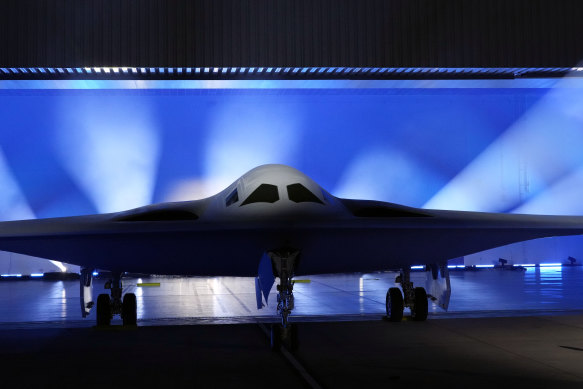
Paterson nominated the B-21 bomber as one stopgap option, noting it is scheduled to enter service next year with the US Air Force.
“Its reported cost, while not cheap, is more affordable than a nuclear submarine. It also requires a much smaller crew to operate,” he said.
“Its reported range is impressive. It can carry a significant payload.”
Defence expert Marcus Hellyer estimated in 2022 that it would cost around $30 billion for Australia to acquire a squadron of 12 B-21s, which resemble flying saucers and can travel more than 4000 kilometres without refuelling.
Paterson said he understood that acquiring another expensive crewed platform from the US seemed incongruous with the growing focus on smaller, cheaper, uncrewed technologies such as drones.
“But Australia’s geography is different,” he said.
“Our primary theatres for potential conflict are thousands of kilometres away.”
Paterson said only the government could ultimately decide whether the B-21 was the right fit for Australia and whether it was possible to buy the technology, but urged the government to take a second look at the bombers.
“I do not want Australia to enter the moment of maximum peril in the late 2020s and early 2030s without this critical deterrent capability,” he said.
Defence Minister Richard Marles on Tuesday announced that Meghan Quinn, who has led the Department of Industry, Science and Resources since 2022, will become the next secretary of the Department of Defence.
Quinn had been mentioned as a contender for the role, but her appointment came as a surprise because of her lack of experience in the defence field.
Former defence department official and ambassador to China Scott Dewar had been speculated as a frontrunner for the position, which opened up when the government appointed former secretary Greg Moriarty to be the new ambassador to Washington.
Quinn will be the first woman to lead the department, following the recent appointment of Susan Coyle as the nation’s first head of army.
Marles said Quinn boasted a wide range of experience across the public sector, including positions at Treasury and the Department of the Prime Minister and Cabinet, as well as in the private sector.
Cut through the noise of federal politics with news, views and expert analysis. Subscribers can sign up to our weekly Inside Politics newsletter.
 Matthew Knott is the foreign affairs and national security correspondent for The Sydney Morning Herald and The Age.Connect via X, Facebook or email.
 Brittany Busch is a federal politics reporter for The Age and Sydney Morning Herald.Connect via email.
From our partners
Disclaimer : This story is auto aggregated by a computer programme and has not been created or edited by DOWNTHENEWS. Publisher: www.smh.com.au