
Look around you for a moment.
The sky is blue. The ocean looks blue.
But when it comes to living things, that colour almost disappears.
Very few plants or animals are truly blue. Most of what we see as blue in nature isn’t even a pigment. It’s light playing tricks on the eye.
Take a butterfly, for instance. Its wings don’t carry blue dye. Tiny structures on the surface bend and scatter light in a way that makes them look blue. The same happens in some birds and fish.
Even among flowers, blue is rare. Less than 10 percent of flowering plants produce blue blooms. So when a flower grows in the wild and shows up in a shade of blue that feels almost unreal, it tends to stay with you.
High in the Himalayas, one such flower does exactly that.
A flower that takes its time
The Himalayan blue poppy, or Meconopsis baileyi, grows in places where survival itself is uncertain.
In parts of Ladakh, Sikkim, and Arunachal Pradesh, the ground stays cold for most of the year. Snow covers the landscape for months, and the window for growth is short.
So the plant grows slowly. It spends years building strength underground, storing energy in its roots. It can take anywhere between two to five years before it is ready to bloom.
It waits for a brief period when the snow melts, the soil softens, and the temperature rises just enough.
And when that moment arrives, it blooms.
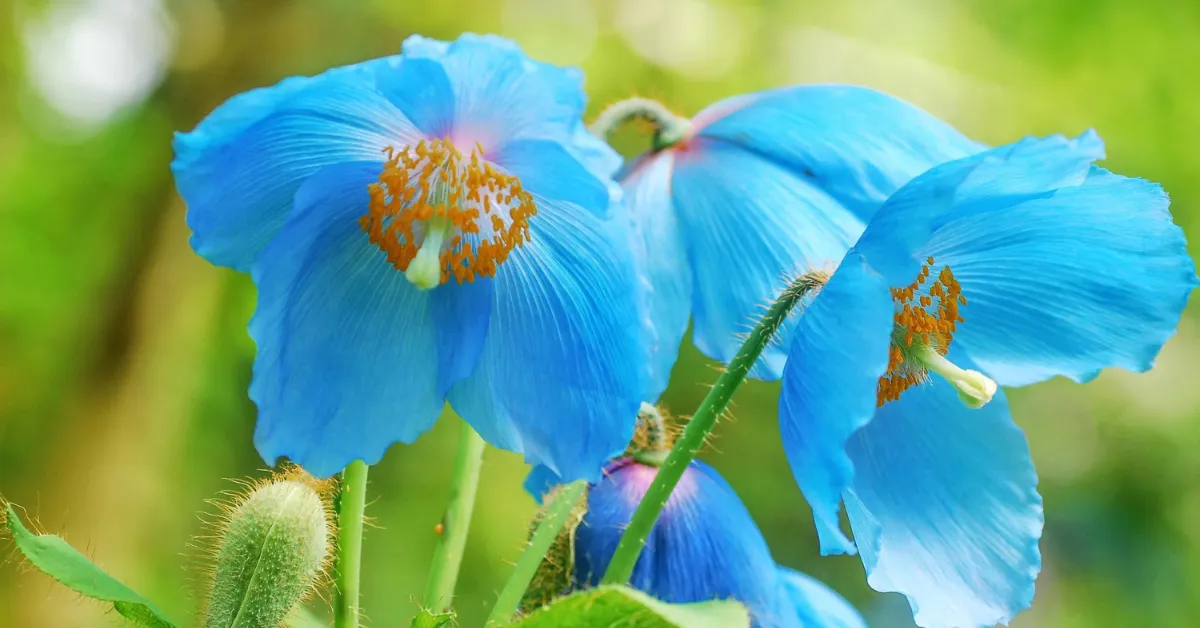
The petals open into a soft, luminous blue, almost out of place against rock, snow, and ice. The bloom lasts only a few days to about a week, shaped by how short that favourable window really is.
In many species, the plant flowers just once before completing its life cycle.
A rare bloom in extreme landscapes
The Himalayan blue poppy belongs to the poppy family and is found across Tibet, Bhutan, Nepal, parts of India, and some regions of southwest China and Myanmar.
It grows at elevations between 3,000 and 4,500 metres, where icy winds, rocky slopes, and low oxygen levels shape how life survives.
Unlike most flowers, it prefers cool, moist, and slightly acidic soil, similar to the alpine meadows and glacial valleys it calls home.
/filters:format(webp)/english-betterindia/media/media_files/2026/04/23/blue-poppy-flower-2026-04-23-13-45-18.png)
Its cup-shaped petals range from pale sky blue to deep violet, surrounding a bright yellow centre. The plant can grow up to a metre tall, with fine hairs along its stems and leaves that help it cope with the cold.
Its colour comes from a rare combination of plant pigments and environmental conditions, which is why true blue flowers like this are uncommon.
Despite how delicate it looks, the flower still plays a role in its ecosystem. During its brief blooming period, it attracts pollinators like bees that move across these high-altitude landscapes.
A flower people went looking for
For centuries, the Himalayan blue poppy bloomed in isolation, seen only by communities living in the mountains.
In 1913, British explorer Frederick Marshman Bailey encountered it in eastern Tibet. The colour stood out immediately. A blue like that felt unexpected in a landscape of stone and snow.
The flower was later named after him, and word slowly spread.
/filters:format(webp)/english-betterindia/media/media_files/2026/04/23/blue-poppy-flower-2026-04-23-13-47-12.png)
Plant hunter Frank Kingdon-Ward followed, travelling across the Himalayas to collect its seeds. These journeys were long and uncertain, but the flower drew people back each time.
By 1926, when it was grown in Europe and displayed at a horticultural show, it caught attention almost instantly. Many had never seen a flower like it.
In the Himalayas, though, it has always carried meaning. In Bhutan, it is the national flower, associated with purity and peace. In Tibetan Buddhist thought, it reflects patience and the slow journey towards something meaningful.
A bloom shaped by its surroundings
The Himalayan blue poppy has also found a place in traditional healing. In Tibetan medicine, some species have been used to ease pain and support breathing, though scientific research on these uses is still developing.
/filters:format(webp)/english-betterindia/media/media_files/2026/04/23/blue-poppy-flower-2026-04-23-13-49-55.png)
What helps the flower survive also makes it vulnerable, as it depends on cold, moist conditions that are becoming harder to find. With rising temperatures, changing snowfall, and drier soil, the environment it relies on is slowly shifting.
These same factors make it difficult to grow outside its native habitat. The plant needs steady moisture, cool air, and protection from heat, conditions that are hard to recreate elsewhere.
Somewhere in the mountains, a plant may still be growing slowly, waiting years for a single bloom.
And when it does, it brings with it a colour that nature rarely chooses to make.
Sources
‘Rainbow nature: life in brilliant blue’: by Natural History Museum
‘Blue, the phantom colour of the natural world’: by European Wilderness Society
‘Himalayan Blue Poppy Care’: by Rhododendron Species Botanical Garden.
‘The resilient Himalayan blue poppy’: by Tenzin Metok for Horniman Museum and Gardens, Published on 10 September 2025.
Disclaimer : This story is auto aggregated by a computer programme and has not been created or edited by DOWNTHENEWS. Publisher: thebetterindia.com



