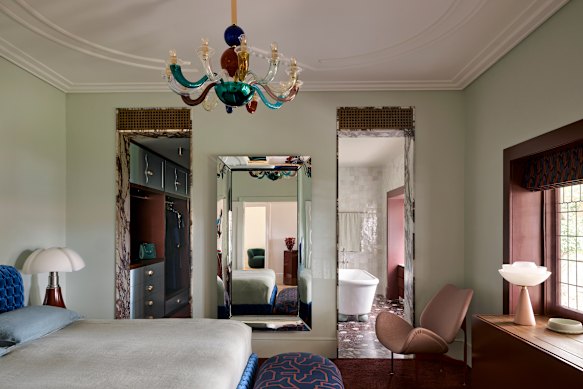

It’s the interior colour wave no one saw coming. Well, almost no one.
Amid the warm tones of mushroom pink, olive green, burnt orange and even flashes of baby blue gracing the walls of the most fashionable interiors, the most consistent colour emerging right now is burgundy.
Whether it’s a leather lounge, velvet cushions, high-gloss tiles, painted walls and joinery, or rosso levanto marble, burgundy is fast becoming the go-to shade to create a sense of depth, sophistication and, above all, design confidence.
Melbourne-based interior designer Ruby Shields of Studio Shields says you don’t have to look far to find the inspiration.
“Gucci did that collaboration with Milan Design Week [in 2024] and burgundy was the key colour,” says Shields. “They did it in a gorgeous gloss finish and mixed it with lime green. Interior designers follow fashion and whatever comes out of that work is usually implemented [in residential design].”
Studio Shields is among 27 finalists in the 2026 Dulux Colour Awards, which are celebrating their 40th year of highlighting Australia’s best interior design.
Shields has two projects for consideration, including her own home, created alongside her husband, carpenter Patrick Shields. Burgundy is the anchoring colour in the study.
“It is such a good foundation,” she says. “I have a burgundy rug and a burgundy sofa, and then muddy brown wall and blues and terracotta and all those colours bounce together.
“It’s a natural colour – soils and clays all have an essence of this. It’s not a chemical colour – it’s a natural earthy tone.”
Sydney-based designer Greg Natale is no stranger to burgundy. He associates it with his favourite international city.
“I have been using burgundy for a while, going back to 2019,” he says. “We were drawn to it because we love Paris and it’s the colour of Paris, so it started from travelling.
“It’s a classic colour and it does work well with everything. It’s another neutral – but it is dramatic.”
In a take-no-prisoners approach, Natale has gone all in on a project in Gordon, where the kitchen joinery is wall-to-wall burgundy with marble benchtops in rosso levanto. The colour and materials are repeated throughout the house in en suite tiles, living room side tables, dressing room joinery and wall-to-wall carpet.
Natale describes it as a classic colour that is surprisingly versatile, but with an undertone of drama.
“It’s cinematic and dramatic,” he says. “It’s very ’70s, like [US fashion designer] Halston’s offices on Fifth Avenue. They were that beautiful burgundy, all those reds. It’s all very ’70s high-end luxe.”
Dulux colour and design manager Lauren Treloar says burgundy is “having a moment” in interior design, whether it is teamed with warm neutrals or it is used “colour drenching” style on walls, skirting boards, architraves and even ceilings.
“It’s all about the berries and cherries, those beautiful colours,” she says. “It is a colour we have seen steadily grow in popularity in the past two or three years.”
Sydney-based interior designer and Colour Awards judge Sarah-Jane Pyke says the rise of burgundy is yet another example of the connection between interior design and the catwalk.
“There has always been a tie between fashion and interiors when it comes to colour,” she says. “We started with the soft purples and lilacs and then we saw the reintroduction of chocolate coming through from fashion, and maroon is the purpling of brown.
“It’s definitely a fashion influence that’s been going on.”
However, she says it is a departure from the more conservative colour schemes typically seen a decade ago.
“I remember when the winning project was all white – there were years of that,” she says. “[Stronger colour] started appearing 10 to 15 years ago, but because it has been so embraced in the past five years, there has been an explosion of colourful interiors this year.
“Now colour drenching has gone from being the exception to almost the rule – there are no feature walls any more, thankfully.”
While shades of blues and greens have dominated in recent years, Pyke says the emergence of burgundy as a more popular colour signals a shift in direction.
“Where we have seen before blues and greens – always soft pretty blues and sage greens and even deep blues have been around for a long time – now we are seeing deep brown and maroon,” she says. “Neutrals are moving into fleshy and biscuit tones.”
While layering harmonising colours is a tried and true method, Pyke says successfully combining different colours, patterns and textures takes another level of skill.
“The criteria [for the awards] is both creativity and mastery of colour,” she says. “[For colours with] some of those yellow undertones, there is a mastery to balance them with the other materials and colours and taking the client along to go somewhere a bit unusual.”
 Robyn Willis is a property reporter and the former lifestyle editor for The Sydney Morning Herald and The Age.
Property listings
From our partners
Disclaimer : This story is auto aggregated by a computer programme and has not been created or edited by DOWNTHENEWS. Publisher: www.smh.com.au