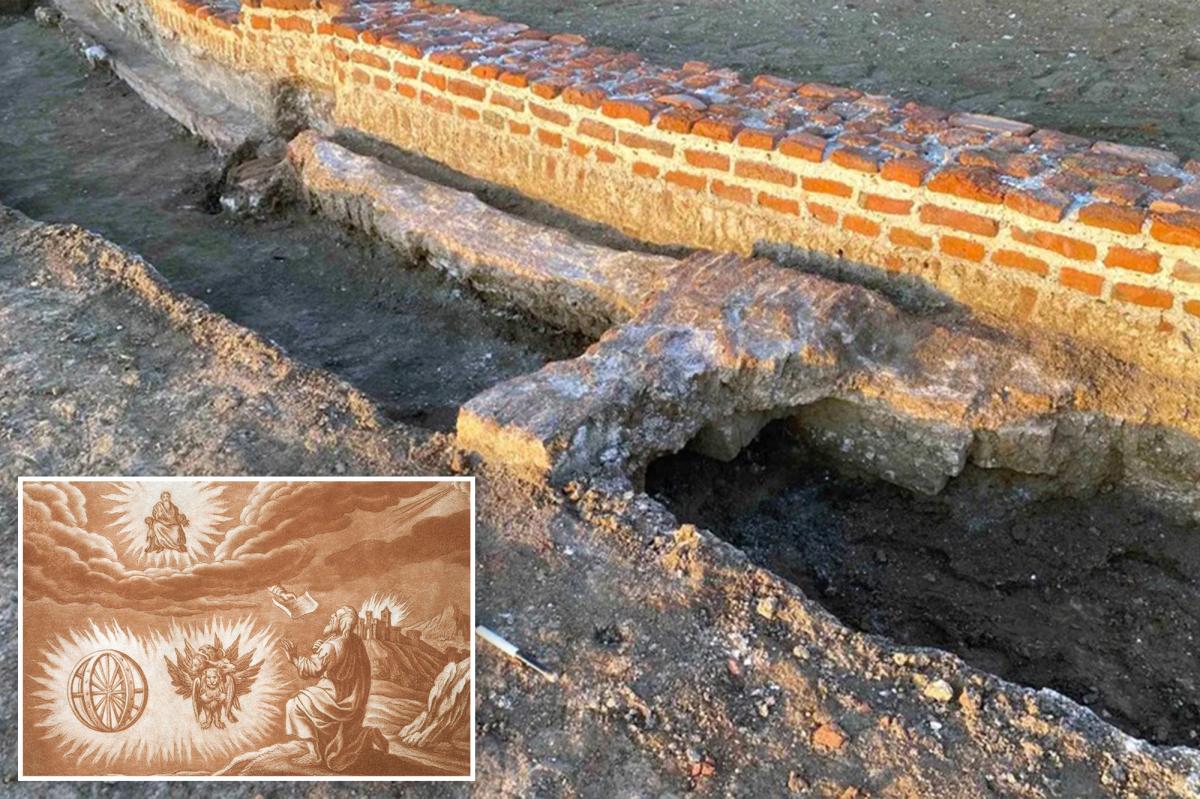
Officials recently unveiled the remains of an ancient religious complex at a site often identified with a biblical city cited in the Old Testament.
The ritual complex, dedicated to the local deity Pelusios, was found at Tell el-Farama in North Sinai.
Tell el-Farama was once the ancient city of Pelusium — and is sometimes identified with a biblical city called “Sin,” mentioned in the Book of Ezekiel.
The recent excavation revealed a massive basin with a diameter of 115 feet, which was once filled with water from the Nile River.
Archaeologists believe the basin was used continuously from the second century B.C. to the sixth century A.D.
“It was filled with water mixed with Nile silt, symbolizing a connection to the god Pelusios, whose name is derived from the Greek word ‘pelos,’ meaning ‘mud,’” officials said in a translated statement.
The basin was “surrounded by channels and water reservoirs, with multiple entrances on the eastern, southern, and western sides, while the northern side suffered significant destruction,” the statement also noted.
The discovery was years in the making.
In 2019, archaeologists uncovered just a fraction of a circular red-brick structure that later revealed the entire complex.
While it was at first believed to be a civic council building, officials recently determined it was a “sacred water installation associated with religious rituals.”
Sin is described in the Book of Ezekiel as a stronghold of Egypt, a characterization that aligns with Pelusium’s location as a key gateway on the country’s northeastern frontier.
In Ezekiel 30:15, God says, “I will pour out my wrath on Sin, the stronghold of Egypt.”
The biblical city of Sin has been identified with Pelusium since early Greek translations of the Bible, with some modern versions still noting the connection in footnotes.
In a statement, Sherif Fathy, the minister of Tourism and Antiquities, said the basin discovery “underscores the strategic and archaeological importance of North Sinai, which is rich in promising sites that still hold many secrets.”
The discovery is one of several notable finds recently announced in Egypt.
Last month, officials announced the discovery of eight rare papyrus scrolls dating back nearly 3,000 years — whose contents still remain unknown.
Egyptian officials also unveiled the discovery of an ancient monastery dating back to the dawn of Christian monasticism.
The site was established between the fourth and sixth centuries A.D.
Disclaimer : This story is auto aggregated by a computer programme and has not been created or edited by DOWNTHENEWS. Publisher: nypost.com