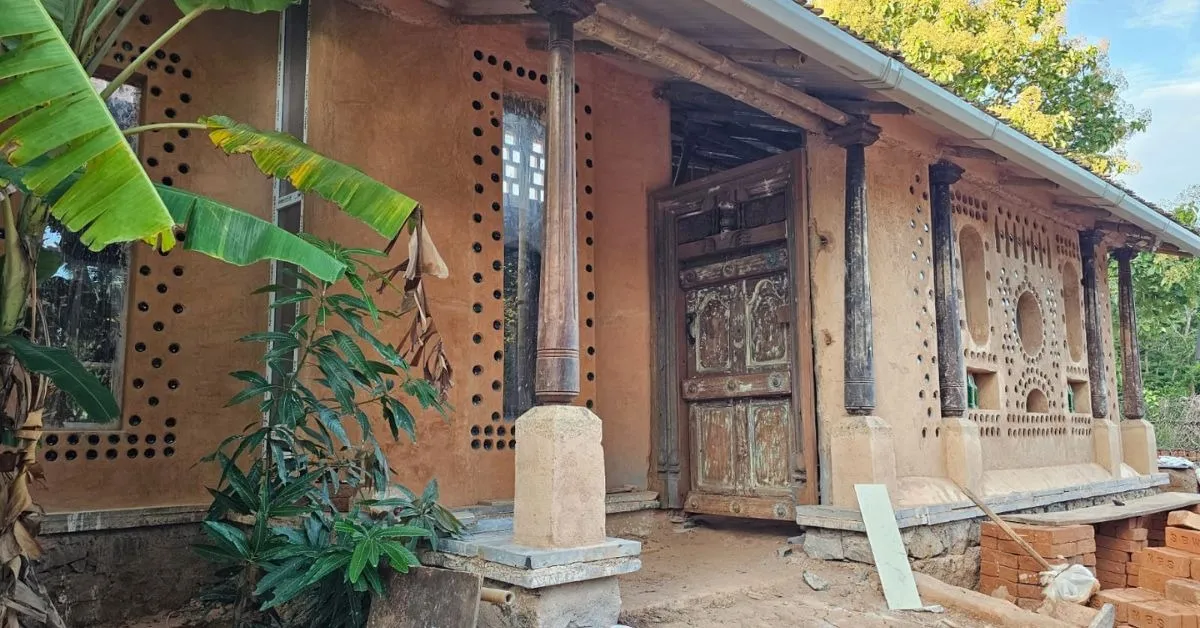
Architects Sridevi Changali and Rosie Paul go to great lengths to ensure a project is sustainable, often even pushing the envelope on the material of choice. Citing one example, Sridevi says it was a project on the outskirts of Bengaluru where the client’s brief was simple: “I don’t want cement to enter the site, not even in the stabilisation.”
She adds, “There was also the added challenge of termites, since it was a farm area. When using mud in a project, you need a lot of binders and fibres, but none of the usual ones would hold against termites. And so, interestingly, we decided to use dog hair instead of natural fibre.”
Today, the client in question, Sindhoor Pangal, isn’t just elated that she’s living in a sustainable home, but also that it has been architectured with nostalgia — literally.
The friendship behind the firm
The ethos of ‘Masons Ink’, the Bengaluru-based sustainable architecture firm helmed by Sridevi and Rosie, lies in ensuring sustainability gets a voice through different projects.
Elaborating on how they bonded over their shared interest in sustainability in architecture, Sridevi says, “Our story goes all the way back to our undergraduate days in college. We were inclined towards heritage conservation and sustainable architecture.”
/filters:format(webp)/english-betterindia/media/media_files/2026/04/12/sustainable-architecture-1-2026-04-12-10-38-05.jpg)
During their postgraduate years, the duo found their calling in the Auroville Earth Institute, which trains individuals to build homes using earthen techniques. “So, everything that we base our practice on is what we have been exposed to, not only as a profession but also as a lifestyle that we led in those formative years while being trained at the institute in mud construction and living in Auroville,” she explains, saying that starting a practice together was a “no-brainer”.
Rosie, too, who eventually took on the role of head architect at Auroville Earth Institute, agrees that the learning was hands-on. “I fell in love with natural building and natural materials. It helped me see the different avenues where these techniques could be applied. It’s amazing to build with the same material that you are standing on without over-engineering or industrialising the material.”
A series of sustainable blueprints
Converting a challenge into an opportunity is the biggest lesson that the projects undertaken by Masons Ink have taught Sridevi. She recalls a certain project in 2014. “Close to the Manchi Reserve Forest in Tamil Nadu, the Raa Maram project was a farmhouse set in a very remote location. It was challenging to find the right materials and labour.”
/filters:format(webp)/english-betterindia/media/media_files/2026/04/12/sustainable-architecture-2-2026-04-12-10-40-01.jpg)
Sridevi elaborates that the client had around 22 acres of an organic farm from which they procured the rock and soil used for the project.
Today, it’s an architectural gem with walls made of stabilised mud blocks and a foundation made of local Sadarhalli stone (popular in South India). The wood for rafters and a false ceiling was repurposed from an abandoned factory nearby, and the land includes systems for wastewater management, rainwater harvesting, groundwater recharge, biogas, and solar energy.
But the most beautiful part of the project, Sridevi says, was engaging with local craftsmen and artisans to build the structure. “So, although challenges were posed by the remoteness of the location, it became an opportunity to build something truly sustainable using materials and skills from in and around the location,” she adds.
/filters:format(webp)/english-betterindia/media/media_files/2026/04/12/sustainable-architecture-3-2026-04-12-10-41-53.jpg)
Conserving the existing beauty of a land is close to Sridevi’s heart. Her passion has always been in heritage conservation, she explains. With a master’s in historic building conservation, she worked with INTACH (Indian National Trust for Art and Cultural Heritage)’s Puducherry chapter.
Rosie, meanwhile, has been involved with several projects executed using earth technologies, both locally and internationally, including in Egypt, Morocco, and France.
The duo is keen that material exploration not be limited to their practice. They want to set a precedent for it to move beyond their projects, too. Rosie explains, “We picked up this model from Auroville Earth Institute. They conduct scheduled workshops, and we adopted those into our system. We conduct workshops for masons, students, and fellow professionals because we believe that this knowledge should be shared.”
She continues, “We want to share the knowledge that we get from artisans, knowledge that we learned from our colleagues, and share our processes openly so that more people can adopt them, and it becomes easier for the general public to accept these techniques.”
‘We want the land to speak to us.’
“One single material doesn’t make anything sustainable,” Rosie says. “What makes a project sustainable is how hyperlocal it is and how little processed and industrialised materials are used. Any overproduction or processing raises the carbon footprint significantly.”
/filters:format(webp)/english-betterindia/media/media_files/2026/04/12/sustainable-architecture-4-2026-04-12-10-46-59.jpg)
She adds, “So, when it comes to different terrains, we first assess the local material. There have been instances where we were thinking of building with earth, but when we got into the area, we realised that stone was prevalent in the region and so using stone made more sense in terms of local availability.”
This is why studying vernacular architecture before beginning a project is very crucial, Rosie shares. “We don’t go in with the thought that we’re going to use this particular material and that will be our signature material. We want the land to speak to us. We check the existing architecture and the climate-responsive techniques used to build,” she explains.
/filters:format(webp)/english-betterindia/media/media_files/2026/04/12/sustainable-architecture-5-2026-04-12-10-49-56.jpg)
She cites the example of a recent farmhouse project in Ratnagiri. Once they analysed local practices, they noticed that the region receives relatively low rainfall, which is why most traditional houses there have flat roofs, with stone slabs simply laid out instead of RCC. “It was fascinating to see the different ways in which stone was used. We also found that there was a strong tradition of using lime in construction,” Rosie says.
But there was a catch. When they spoke to local masons, they realised that while the memory of using lime still existed, the skill of using it correctly was fading. In many places, lime was still being used to waterproof roofs, but incorrectly. Masons were breaking limestone and adding water directly, without slaking it first, a step that makes lime safe and effective to work with.
Rosie goes on to explain that, in this project, earth took a secondary place. “We chose not to use it. Instead, we decided to work with the two materials that were traditionally used, and focused on reskilling local labour to help them rediscover and revive their knowledge of working with stone and finishing with lime.”
Oftentimes, the duo realises that, while they attempt to channel local materials into the project, they end up “converting” people’s mindsets too. And this thrills them.
“We’ve worked with masons who used to build with regular cement; we trained them to build with mud and local materials, and now, they use these. Sometimes, some carpenters begin choosing to work with reclaimed wood during the course of a project,” Rosie shares.
Together, through Masons Ink, they are creating a space where sustainable architecture not only thrives but also leaves a legacy that can be built upon.
All pictures courtesy Masons Ink
Disclaimer : This story is auto aggregated by a computer programme and has not been created or edited by DOWNTHENEWS. Publisher: thebetterindia.com