
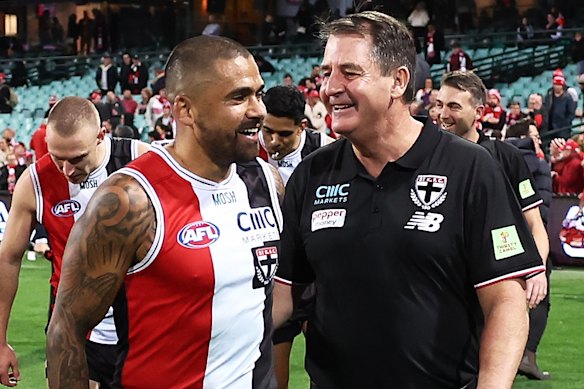
It may have been uncomfortable for those involved, but St Kilda’s handling of Ross Lyon’s throwaway line during training to a group of Indigenous players has provided the industry with a great case study for how to respond well to such incidents.
On the facts we know, Lyon saw three Indigenous players running through a routine together on the track and made the comment: “I love the brother boy connection but we all have to remember we are part of a bigger team here”.
From there the incident could have gone in all sorts of directions.
It was a credit to those involved that it went in the direction it eventually did.
Brad Hill, the most experienced of the seven Indigenous players on the Saints’ list, who has played under Lyon at Fremantle and St Kilda, rang the coach and told him how the comment had been received.
That was a brave first step but testament to the depth of their relationship.
According to reports, Hill rightfully pointed out to Lyon that such a comment would not be made to three white players training together.
Lyon did not react defensively.
He called a meeting of the Indigenous players to hear their views, to listen. He didn’t call the meeting to tell them what he actually meant with his words or that they had misinterpreted what he said or overreacted.
The matter was resolved in an emotional coming together where Lyon conceded he got it wrong when he said what he said, and he had learnt a valuable lesson.
When the incident and subsequent meeting leaked to The Age’s Caroline Wilson who reported it on The Agenda Setters, Lyon explained the issue from his perspective, did not attempt to speak on behalf of the players and let the facts speak for themselves.
It showed me what can happen when people get on the front foot, don’t hide things and are prepared, as leaders, to be vulnerable and willing to learn from the people they are leading.
Lyon was not a victim; he benefited from having a senior player strong enough to say to a senior coach or a senior person within a football club that they felt uncomfortable with what was said.
And he was mature enough to react in an open manner and leave himself exposed.
It’s reasonable to ask whether any player would feel supported or mature enough to challenge behaviour from a senior person in such a way. That’s why I have long advocated for clubs to have a senior Aboriginal person in the building who can support them to have that conversation with a senior person.
It’s best if that person has some experience either playing or within football clubs so they understand the environment and can sort through the situation in a way which doesn’t impact negatively on anyone who comes to interactions with the right intentions and attitude.
It’s also helpful because the player making the complaint or raising the issue can be confident it will be handled in a manner that improves the club environment.
We also need to acknowledge that a power imbalance can exist, but if the conversation is initiated by a senior Indigenous person then that component of the interaction is minimised.
The game and the Saints are lucky to have a person like Hill who can take the lead in navigating these situations.
We must make sure anyone capable of bringing people together as he did to deal with an uncomfortable situation positively is not lost to the game when they retire.
From the outside, I can’t fault the process. Hill has played his role as a senior player who happens to be Indigenous at a footy club and so has his coach and so have his players. Wilson has reported accurately and fairly from the coach’s perspective and the players have responded with support for the coach.
The alternative is a festering dissatisfaction, a lack of awareness by the coach, an unresolved gap that becomes wider and harder to bridge with the passing of time.
Good can come of such unfortunate incidents if you have a mature conversation about feeling discriminated against. It is where our code and society need to get better at having those uncomfortable conversations and the right vehicles to initiate them.
We have seen here the parties reach the other side of the issue realising no one is perfect, and we are going to have slip-ups. As long as a person is genuine about their remorse and the words they used inappropriately, such incidents can become a positive.
“I made an error unintentionally, resolved it with my players; I am thankful for their support,” Lyon said.
So much good can come from such hard conversations, not only with footy but society, if we are open to listening and learning.
Mathew Stokes is a Larrakia man who played 200 games with Geelong and Essendon. He played in Geelong’s 2007 and 2011 premiership teams.
Keep up to date with the best AFL coverage in the country. Sign up for the Real Footy newsletter.
 Mathew Stokes is a Larrakia man who played 200 games with Geelong and Essendon. He played in Geelong’s 2007 and 2011 premiership teams.
From our partners
Disclaimer : This story is auto aggregated by a computer programme and has not been created or edited by DOWNTHENEWS. Publisher: www.smh.com.au


