
Updated ,first published
Treasurer Jim Chalmers is warning price pain on the nation’s consumers will only get worse after new figures revealed the war in Iran has already pushed inflation to a three-year high, intensifying pressure on Reserve Bank to inflict a third consecutive rate rise on mortgage holders next week.
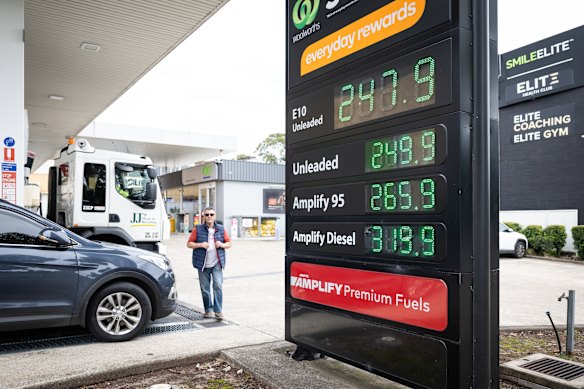
Ahead of a federal budget that will reveal a slowdown across the economy and higher unemployment due to the impact of the war, the Australian Bureau of Statistics revealed a 33 per cent jump in petrol prices helped push inflation to 4.6 per cent in March.
Economy-wide prices jumped by 1.1 per cent last month even before the full impact of higher liquid fuel costs fed into the cost of goods and services such as domestic travel and supermarket staples.
Those price increases would be on top of the Reserve Bank’s own tightening of monetary policy. If the RBA goes ahead with a rate hike next week, it would mean repayments on a $600,000 mortgage will have increased by $300 a month since the start of the year.
Another rate rise by year’s end is expected by economists, depending on how quickly the war against Iran is resolved and whether high-priced oil plunges the global economy into a recession.
Chalmers, who promised his budget on May 12 will be the most ambitious of his five financial blueprints, warned Australians that prices would likely rise further in the short term as the war’s economic impact spread.
“The tick up in the monthly headline data today was driven by the conflict, and this war could drive inflation up even higher before it comes back down again,” he said.
“Treasury’s expectation is that inflation is likely to peak higher than this.”
Without the surge in oil prices through March, overall inflation would have fallen to 3.4 per cent.
Some prices are being pushed up by factors beyond the war. Prices for beef and lamb have increased by 12 per cent and 16 per cent respectively due to strong demand for Australian product by American consumers.
The surge in gold and silver prices has pushed up the cost of jewellery accessories by 20 per cent over the past year.
Shadow treasurer Tim Wilson said the government had contributed to the surge in prices.
“Government needs to stop pouring debt petrol on the inflation fire because they are the core problem around what is driving underlying inflation and the pressure that Australian households are experiencing right now,” he said.
The end of state and federal government power subsidies continues to affect the overall inflation rate, with electricity inflation falling from 37 per cent in February to 25.4 per cent last month.
Housing construction costs are continuing to climb, with inflation reaching 4.5 per cent after lifting to 3.7 per cent in February.
But rental inflation continues to ease, slipping to annual growth of 3.7 per cent. It had peaked at 7.4 per cent in mid-2024.
Chalmers has vowed to push ahead with substantial reforms in areas from tax to productivity in the budget despite the economic headwinds created by the war.
Commonwealth Bank chief economist Luke Yeaman, who was previously a deputy secretary in the federal Treasury, said he expects Chalmers to push ahead with changes to capital gains tax and negative gearing.
He said a package of property tax reforms would generate around $2 billion in extra revenue over the next four years and up to $30 billion over a decade.
“The government will argue that the combined changes reduce the existing tax bias towards housing (allowing capital to be allocated to more productive investments), and take some modest pressure off housing demand, thereby improving affordability, without damaging new supply,” he said.
“These are fair arguments overall, but we judge that the impacts on house prices and productivity are likely to be quite modest — the largest benefit will be higher long‑term government revenue and a stronger budget.”
The overall inflation result was shy of market economists who had tipped it to climb to 4.8 per cent.
Importantly, underlying measures of inflation – closely tracked by the Reserve Bank, which meets next week – showed a “moderate” increase of 0.3 per cent.
Trimmed underlying inflation was at 3.3 per cent, where it had been last month. The Australian dollar, which almost reached US72¢ early on Wednesday, eased on the figures while the ASX200 lifted by almost half a per cent as investors gambled on the RBA holding interest rates steady.
Before the release of the inflation figures, financial markets had put the chance of a rate hike at the Reserve’s May 4 and 5 meeting at almost 90 per cent. That slipped to 70 per cent after the data was released.
AMP deputy chief economist Diana Mousina said while the Reserve Bank had no direct control over oil prices, higher energy costs were important as they had powerful second-round effects across the economy.
She predicted the bank would push ahead with a rate rise next week, even though members of the RBA were likely to be split on the decision as they were in March when it took the cash rate to 4.1 per cent.
“Australia already had an inflation problem before the war began — although it appeared to be coming under control,” he said.
“In that context, the RBA’s only effective lever is to slow broader economic activity and dampen demand‑driven inflation pressures, helping to offset the flow‑on effects from higher energy costs.”
Cut through the noise of federal politics with news, views and expert analysis. Subscribers can sign up to our weekly Inside Politics newsletter.
 Shane Wright is a senior economics correspondent for The Age and The Sydney Morning Herald.Connect via X or email.
From our partners
Disclaimer : This story is auto aggregated by a computer programme and has not been created or edited by DOWNTHENEWS. Publisher: www.smh.com.au