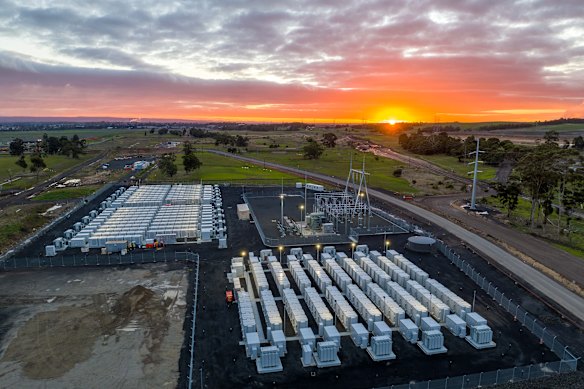
A boom in battery installations across Australia is outstripping the most optimistic industry forecasts, smoothing out volatile electricity price swings and making the grid more resilient to the threat of global shocks as the Iran war pushes up the cost of energy in other countries.
In an update to be released on Thursday, the Australian Energy Market Operator reveals the combined capacity of household and grid-scale batteries across the nation has more than doubled in the past 12 months, giving the technology an increasingly important role in shaping the electricity market.
Because batteries can stash cheap and abundant solar energy that floods the grid during the day to discharge it after sunset, the boom has helped reduce sharp increases in wholesale electricity prices that typically occur from about 6pm, when solar output recedes and demand spikes as millions of people start arriving home to turn on lights and appliances.
The figures from AEMO reveal that the volume of energy that batteries were successfully shifting from daytime to evening peaks had tripled over the past three months compared with the same period in 2025.
This was reducing the grid’s need to call on expensive gas-powered generators or hydroelectric dams to plug supply gaps after dark, pushing down the cost of electricity, AEMO said.
During the March quarter, grid-scale batteries set prices across the grid nearly a third of the time, it said, while gas-powered generation was squeezed to its lowest quarterly average since 1999, and coal-fired power fell to a record-low first-quarter contribution.
Renewable energy, including batteries, supplied nearly half of all the eastern seaboard’s electricity across the quarter.
“The significant increase in large-scale and household battery capacity is changing how electricity is produced, consumed, and priced across the day,” AEMO executive general manager of policy Violette Mouchaileh said.
By displacing higher-cost energy sources, she added, batteries had contributed to “lower year-on-year wholesale prices in most regions”.
Wholesale power prices – what retailers pay generators for electricity before selling it to customers – tumbled 12 per cent to an average of $73 a megawatt-hour compared with the same period last year, AEMO said.
Wood Mackenzie, a global research firm, on Wednesday said growth in Australia’s battery storage capacity and renewable energy were “materially lowering” the nation’s exposure to international fossil fuel markets.
Despite the conflict in the Middle East causing oil prices to surge more than 60 per cent and international gas prices to double, Australian wholesale electricity prices had remained relatively subdued, it said. This was in stark contrast to the 2022 energy crisis following Russia’s invasion of Ukraine, when fuel price shocks sent Australia’s east-coast wholesale power price up 200 per cent to about $250 a megawatt-hour, Wood Mackenzie senior research analyst Natalie Thompson said.
“Australia’s energy transition is now delivering tangible energy security benefits alongside emissions reductions,” she said.
“Battery storage has emerged as a critical factor in this transformation.”
However, experts state that the growth in renewables and batteries does not mean the grid is ready to cope without fossils, which are still needed to back up weather-dependent renewables.
“Today’s batteries are highly effective for short-duration storage, but they cannot sustain the system through multiday low renewable periods.”
The electricity grid is run as an open market and coal, gas, wind, solar and battery power compete to supply power at the best prices.
“[Batteries] increasingly reduced reliance on gas and hydro generation during evening peaks, contributing to lower year‑on‑year wholesale prices in most regions,” Mouchaileh said.
UNSW energy researcher Dylan McConnell said batteries had exceeded expectations as the technology improved swiftly.
“It’s not that long ago that the first mega battery was put in South Australia – the Tesla Hornsdale battery in late 2017 – which was 100 megawatts and way bigger than anyone had envisaged at the time.
“Now we’ve added 4500 megawatts of batteries to the grid in the past 12 months. That is a remarkable increase in the rate of change.”
Grattan Institute energy and climate change director Alison Reeve said the battery uptake “did outstrip my expectations” and the technology’s role as a dominant price setter would contribute to lower power bills.
“That’s partly because you’ve changed who is the price setter, which dictates the overall price as well as how prices are set and hopefully flattening down the peaks in demand at the end of the day.
“This dictates how many poles and wires we need and, if we need a smaller system overall, with fewer transmission lines, that is good news because it saves us money.”
The Albanese government has set an ambitious goal to raise the share of renewables to 82 per cent of the grid by 2030. Experts have questioned if the target can be reached by the deadline, as the rate of installation of new wind farms in particular has slowed due in part to increased construction and labour costs.
However, Energy Minister Chris Bowen said the rapid uptake of home batteries was making a significant contribution to the renewable energy shift.
“We can also see the impact of Cheaper Home Battery revolution – with more than 350,000 household batteries now displacing gas in the evening with cheap solar, helping the grid for everyone.”
Cut through the noise of federal politics with news, views and expert analysis. Subscribers can sign up to our weekly Inside Politics newsletter.
 Mike Foley is the climate and energy correspondent for The Age and The Sydney Morning Herald.Connect via email.
 Nick Toscano is a business reporter for The Age and Sydney Morning Herald.Connect via X or email.
From our partners
Disclaimer : This story is auto aggregated by a computer programme and has not been created or edited by DOWNTHENEWS. Publisher: www.smh.com.au