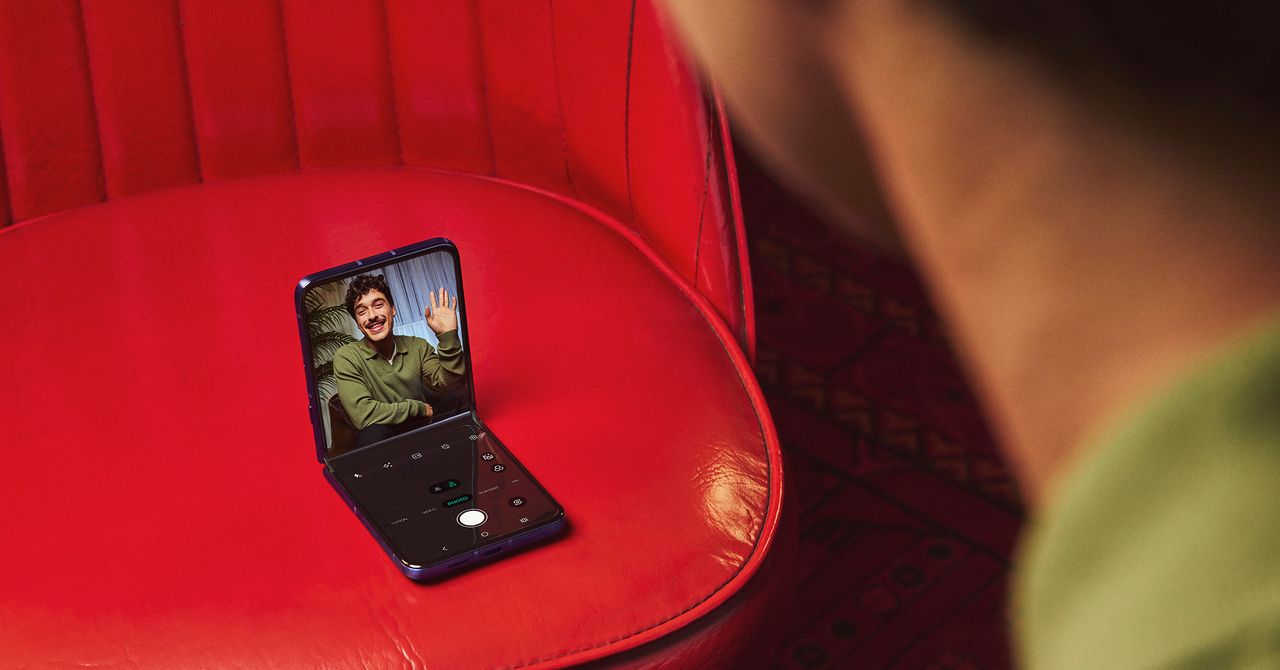
Like clockwork, Motorola is back with a new set of Razr folding flip phones. The formula is the same as last year, with three phones differing in specs and price: the Razr Ultra, Razr+, and Razr. But alongside these models, Motorola is finally launching its first-ever book-style folding phone, the Razr Fold, which it first teased at CES 2026.
The company announced the new handsets at an event in Los Angeles, where it also revealed a new pair of Moto Buds 2 Plus wireless earbuds that look eerily like Apple’s AirPods Pro, but in blue; these will retail for $150 and will be available on April 30. Sadly, all of Motorola’s folding flips are getting price increases, in line with what we’re seeing from competitors like Samsung. The Razr Ultra is $1,500, the Razr+ costs $1,100, and the Razr starts at $800—that’s a $200, $100, and $100 price bump over their predecessors, respectively. The new Razr Fold costs $1,900, landing between the Google Pixel 10 Pro Fold and Samsung Galaxy Z Fold7.
Preorders for all of the phones start on May 14, and they go on sale on May 21. Here’s everything you need to know.
Flippy Razrs
These new 2026 Razr flip phones see very minor spec bumps and no dramatic changes to hardware or design. The Razr Ultra’s inner display is now a bit brighter, hitting a peak brightness of 5,000 nits. Motorola is also touting a new “Extreme AMOLED” display panel for these Razrs, though it seems largely a marketing term. Barring improved screen brightness on the Ultra, these phones still feature 10-bit screens with HDR10+ and Dolby Vision support and hit 100 percent of the DCI-P3 color gamut like their predecessors.
There is one durability improvement with the Razr Ultra: it’s the first phone to use Corning’s Gorilla Glass Ceramic 3 on the outer display, which Motorola claims delivers over “75 percent better drop performance” over prior devices. The Razr+ and Razr have Gorilla Glass Victus on those outer screens, same as last year. The phones still have only an IP48 water-resistance rating, so they’re not as dust-proof as standard smartphones. Motorola says the base Razr is the only folding phone with a MIL-STD 810H rating, meaning it was tested to meet a specific set of durability standards, such as high altitudes and extreme temperatures.
Motorola isn’t shy to play around with textures and colors, though this year’s crop of Razrs doesn’t seem to have the same breadth of options as the 2025 models. The Razr Ultra has an embossed Alcantara texture in Orient Blue, or you can grab it in Cocoa with a natural wood veneer. The Razr+ has a simple woven-inspired jacquard finish, and the base Razr adds to that with leather-inspired and acetate finishes.
| Razr Ultra 2026 | Razr+ 2026 | Razr 2026 |
|---|---|---|
| Outer display: 4 inches, 165-Hz, Extreme AMOLED, HDR10+, 3,000 nits peak brightness | 4 inches, 165-Hz, Extreme AMOLED, HDR10+, 2,400 nits peak brightness | 3.6 inches, 90-Hz, Extreme AMOLED, HDR10+, 1,700 nits peak brightness |
| Inner display: 7 inches, 165-Hz, Extreme AMOLED, HDR10+, 5,000 nits peak brightness | 6.9 inches, 165-Hz, Extreme AMOLED, HDR10+, 3,000 nits peak brightness | 6.9 inches, 120-Hz, Extreme AMOLED, HDR10+, 3,000 nits peak brightness |
| Glass quality: Corning Gorilla Glass Ceramic 3 (outer glass) | Corning Gorilla Glass Victus (outer glass) | Corning Gorilla Glass Victus (outer glass) |
| Processor and RAM: Qualcomm Snapdragon 8 Elite and 16 GB of RAM | Qualcomm Snapdragon 8s Gen 3 and 12 GB of RAM | MediaTek Dimensity 7450X and 8 GB of RAM |
| Storage: 512 GB | 256 GB | 128 GB |
| Battery: 5,000 mAh. 68-watt wired charging; Qi wireless charging | 4,500 mAh. 45-watt wired charging; Qi wireless charging | 4,800 mAh. 30-watt wired charging; Qi wireless charging |
| Cameras: 50-megapixel primary camera, 50-MP ultrawide, 50-MP internal selfie camera | 50-megapixel primary camera, 50-MP ultrawide, 32-MP internal selfie camera | 50-megapixel primary camera, 50-MP ultrawide, 32-MP internal selfie camera |
| Software updates: 3 Android OS upgrades and 5 years of security updates | 3 Android OS upgrades and 5 years of security updates | 3 Android OS upgrades and 5 years of security updates |
| Extras: IP48, reverse wireless charging | IP48, reverse wireless charging | IP48, reverse wireless charging |
| Colors: Pantone Orient Blue Alcantara Finish, Pantone Cocoa Wood Finish | Pantone Mountain View | Pantone Hematite, Pantone Violet Ice, Pantone Sporting Green, Pantone Bright White |
| Price: $1,500 | $1,100 | $800 |
Despite price bumps, the Razr Ultra and Razr+ have the same Qualcomm Snapdragon processor and RAM as their predecessors (Snapdragon 8 Elite for the Ultra and Snapdragon 8s Gen 3 for the Razr+). This is a playbook we’ve seen with some cheaper phones from Motorola and even Google’s Pixel 10a this year, allowing them to stay the same price in this challenging economic environment without having to remove features. It feels especially disappointing here with the new Razrs, since they still cost more.
At least the base Razr is getting a small bump to the MediaTek Dimensity 7450X; however, it offers only slightly better efficiency and AI performance, with no major changes to CPU or GPU performance.
More bad news on the storage front: the base Razr no longer comes with 256 GB, but with just 128 GB. Motorola also cut the 1-TB storage option from the Razr Ultra, so your only choice is 512 GB. One bright spot is that Motorola has increased the battery capacities of the lineup, so the Razr Ultra sits at the top with 5,000 mAh, thanks to silicon-carbon battery technology. The Razr follows at 4,800 mAh, and the Razr+ has 4,500 mAh. While there’s standard Qi wireless charging, Motorola hasn’t bothered to upgrade it to Qi2 magnetic wireless charging here.
Where Motorola really seems to have spent the most time with upgrades is the camera department, specifically on the Ultra. The main 50-MP camera on the Razr Ultra, for example, supposedly can capture up to six times more dynamic range than the 2025 Ultra, which should mean better performance in high-contrast scenes. Improved image processing should also mean better colors, exposure, and detail, even for cameras that remain the same as the older models, like the 50-MP ultrawide.
On the software front, you’ll be happy to learn that Motorola is extending security updates from four to five years, though these Razrs will only receive three Android OS upgrades. Samsung and Google promise blanket seven years of updates for their folding phones, so this is disappointing to see. There’s still a hodgepodge of AI assistants onboard, including Google’s Gemini, Perplexity, Microsoft’s Copilot, and Moto AI, which houses the company’s own suite of AI features, like “Catch Me Up” if you want a summary of your notifications.
There is one new exclusive Google Photos feature—at least for now—on these Razrs: Google Photos Wardrobe. This identifies your clothing items from your Google Photos library (pulling them from all those fit pics) and lets you craft an outfit virtually, mixing and matching to find the look you want without having to put anything on.
A Bigger Razr
Motorola already gave us a glimpse of the Razr Fold at CES 2026, then divulged more spec details at MWC 2026. This is the company’s first try at a folding phone that isn’t a flip, joining the ranks of Samsung and Google’s book-style folds. Naturally, it commands a higher price at $1,900.
You’re treated to a 6.6-inch outer screen and a massive 8.1-inch inner screen when unfolded. It’s not as slim and svelte as Samsung’s Galaxy Z Fold7, coming in at 4.55 mm thick when open and 9.89 mm when closed (versus Galaxy’s 4.2 mm and 8.9 mm thickness, respectively). It matches Samsung’s phone on IP rating at IP48, which means Google’s Pixel 10 Pro Fold still has one of the best IP ratings in the category at IP68.
Unlike its peers, this phone still doesn’t use the flagship chipset you’re expecting. The Snapdragon 8 Elite Gen 5 is the top-end processor in most Android flagships this year, and the Snapdragon 8 Gen 5 used here is a slight rung below. The battery size is impressive at 6,000 mAh, and it’s nice that Motorola starts you with 512 GB of storage.
| Razr Fold 2026 |
|---|
| Outer display: 6.6 inches, 165-Hz, pOLED, HDR10+, 6,000 nits peak brightness |
| Inner display: 8.1 inches, 120-Hz LTPO, pOLED, HDR10+, 6,200 nits peak brightness |
| Glass quality: Corning Gorilla Glass Ceramic 3 (outer glass) |
| Processor and RAM: Qualcomm Snapdragon 8 Gen 5 and 16 GB of RAM |
| Storage: 512 GB |
| Battery: 6,000 mAh. 80-watt wired charging; 50-watt Qi wireless charging |
| Cameras: 50-megapixel primary camera, 50-MP ultrawide, 50-MP 3X telephoto, 32-MP external selfie camera, 20-MP internal selfie camera |
| Software updates: 3 Android OS upgrades and 5 years of security updates |
| Extras: IP48/49 |
| Colors: Pantone Blackened Blue, Pantone Lily White |
| Price: $1,900 |
Unlike the other Razr models, this phone has a triple-camera system, with a 50-MP 3X optical zoom camera joining the 50-MP ultrawide and 50-MP primary. There’s a 32-MP external selfie camera and a 20-MP internal selfie camera to round it out. The Razr Fold also supports Motorola’s new Moto Pen Ultra stylus; it’s a separate accessory that doesn’t slide into the phone like on Samsung’s Galaxy S26 Ultra or the Moto G Stylus.
Overall, there’s nothing groundbreaking with Motorola’s new handsets. It’s great that there’s now a third option to choose from for folks interested in a large-form folding phone, besides Google and Samsung, but the flip-style Razr models barely move the needle, and many may find the price bumps off-putting at a time when gas prices are sky high and the general economic uncertainty.
Disclaimer : This story is auto aggregated by a computer programme and has not been created or edited by DOWNTHENEWS. Publisher: wired.com