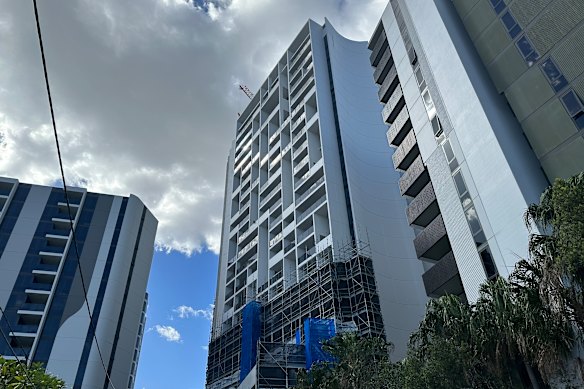
The cost of the typical Brisbane unit has jumped almost $40,000 in three months, smashing through the $800,000 barrier.
Brisbane’s median unit price rose 4.9 per cent over the March quarter to $800,500 – a record, Domain’s latest House Price Report, released on Thursday, shows.
Prices are closing in on those of Sydney, where the median unit costs $848,227 as entry-level demand, tight supply and worsening affordability rapidly reshapes the market.
Over five years, Brisbane’s median unit price nearly doubled – a stark contrast to wage growth of just 15 to 18 per cent.
Brisbane house prices also hit a fresh peak, climbing $49,311 (or 4.2 per cent) over the quarter to $1,212,195.
This represents a more than $200,000 year-on-year rise, with house prices nearly doubling over five years.
The result is a market being reshaped in real time by affordability pressures, with buyers pushed further out and down the price ladder in a desperate scramble to secure a foothold within 40 kilometres of the CBD.
Even the city’s prestige sector has felt the shift, with traditionally cheaper suburbs neighbouring some of the priciest patches recording the biggest gains.
In the Logan area, the Springwood-Kingston SA3 median unit price increased $74,000 in three months, jumping 13.6 per cent to $620,000 – a 37 per cent jump year on year.
At a suburb level, Redcliffe units were among Queensland’s top annual performers, skyrocketing 42 per cent to $980,000, while Auchenflower houses climbed 34.7 per cent to $2.1 million.
“The core read is units are continuing to outperform houses and that’s a trend we’ve seen for the past two years now, which is quite unusual,” said Domain chief of research and economics Dr Nicola Powell.
“And the unit price gap between Sydney and Brisbane is the lowest we’ve ever seen. ”
Sydney units rose just 0.6 per cent over the quarter, while Melbourne units fell back 0.4 per cent. Both cities had a dip in house prices over the March quarter.
But while Brisbane remains one of the strongest performing capitals, Powell said momentum had eased.
”So we are seeing some loss of momentum, but the issue is there’s still demand and there’s still a lack of stock.”
Domain’s report showed the sharpest growth was concentrated at the lower end of the market, with smaller homes leading the charge. One-bedroom units rose 27.5 per cent in a year to $670,000.
“Even smaller dwellings for houses saw significant growth and that’s really telling me that borrowing capacity is really being squeezed, and it’s funnelling demand to a lower price point,” said Powell, adding it may also reflect the federal government’s first home buyer schemes that allow low-deposit purchases.
Despite ongoing supply constraints, Powell expected price growth to further moderate.
Place managing director and principal of One Group, Paul Curtain said the market had cooled in recent weeks, with the next quarter likely to give a clearer read on conditions.
He said a strong start to the year had all but screeched to a halt in early April amid a mix of global uncertainty, interest rate pressures and the Easter slowdown, though he expected conditions to stabilise.
“The underlying challenge we all have is a lack of stock and while days on market have increased, we are still lacking places to live,” he said.
“And that’s ultimately only going to put more stress on the market. But right now, we do have a short-term opportunity to get in, and I expect we’ll get a breather on growth.”
Curtain said one-bedroom units had emerged as standouts, while a lift in prestige listings could start to weigh on prices at the top end.
“I think the thing that the market will have to react to most will be interest rates … and if we see three to four or five, that might take buyers out of the market,” he said.
Despite signs of cooling, the city’s top end still collected strong gains over the year, with 11 suburbs now recording median house price at or above $2 million.
New Farm remains the most expensive, with house prices rising 14.9 per cent over the year to $3.35 million, while Ascot jumped 26.4 per cent to $2.55 million.
Auchenflower outperformed both, driven by a wave of high-end development tapping into the suburb’s long-overlooked appeal and pushing it ahead of neighbouring Paddington, where the median house price sits at $2,054,500.
Ray White Collective’s Josh Brown set a new suburb price record in March for 58 Thomas Street, which sold to a local buyer for $6.5 million. He said Auchenflower’s growth had been years in the making.
“This is a suburb underpinned by great transport, a high-level of amenity in adjacent suburbs,” he said.
“And the confidence in the market and suburb has hit a point where developers have been happy to spend the money there.”
In Redcliffe, Ray White agent Ben Campbell said downsizers had been a key driver of the unit boom.
But while the peninsula’s growing appeal has brought in more buyers from other parts of the city, Campbell admitted the price hikes still stunned him.
“I bought a unit here three years ago and paid $470,000 for it then, and now it’s worth close to $800,000,” he said.
“Our first quarter of the year was one of our strongest yet … we’re seeing more buyers from the north of Brisbane too, and they’re drawn here by the lifestyle.”
Property listings
From our partners
Disclaimer : This story is auto aggregated by a computer programme and has not been created or edited by DOWNTHENEWS. Publisher: www.smh.com.au