
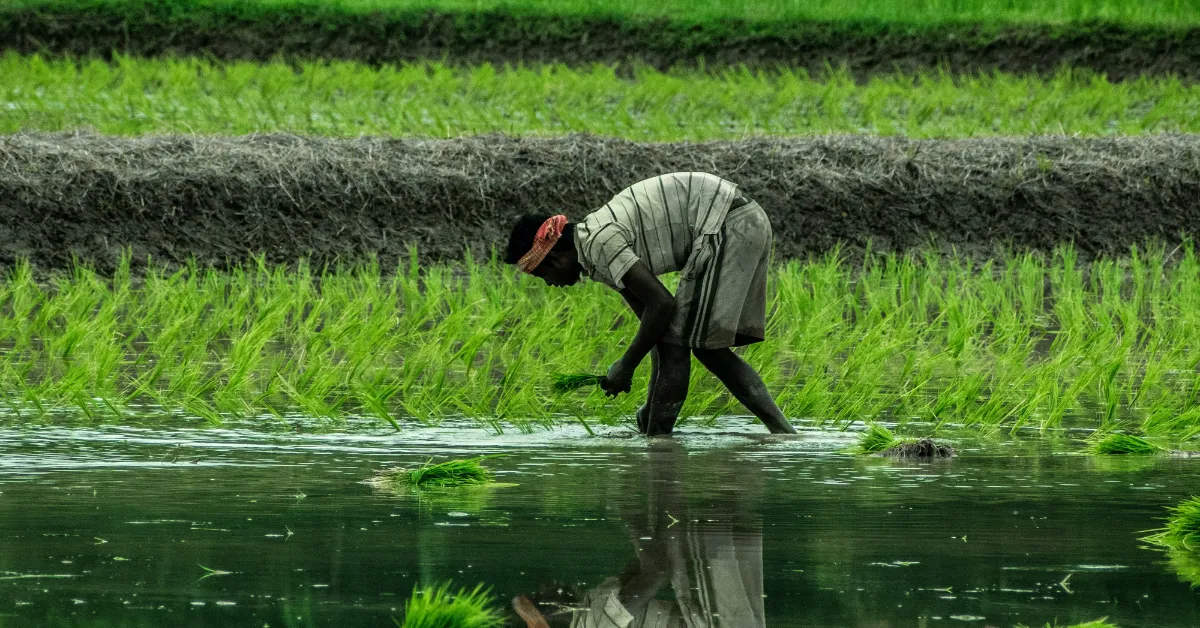
A soft mist hangs over the hills of Nagaland as the first light of day filters through dense forest canopies. Water trickles down the slopes, collecting quietly in hand-dug ponds before making its way to terraced fields below. Every drop is guided, every layer of land has a role, and nothing is left to chance.
Here, farming is not imposed on nature; it follows its rhythm.
Did you know? In Kikruma village of Nagaland, a centuries-old tribal practice has been doing exactly what the world is now striving for: conserving water, preventing soil erosion, and growing food sustainably, all at once.
A system born from understanding nature
Long before sustainability became a global buzzword, Naga farmers were already practising it. In Kikruma village of Nagaland’s Phek district, communities developed the Zabo (or Zabü) farming system, a method rooted in observing how water, soil, forests, and livestock interact.
The word Zabo itself translates to ‘impounding runoff water and using it wisely.’ But it’s more than just water conservation. It is a holistic farming approach that combines forestry, agriculture, fishery, and animal husbandry into one interconnected system.
Unlike many modern farming methods that isolate processes, Zabo thrives on integration — where every element supports the other.
How the three-tier system works
At the heart of Zabo farming lies a carefully designed three-tier structure that mirrors the natural slope of the hills.
At the top are protected forest areas. These are not just patches of greenery, but they also act as natural water catchments. The community strictly regulates their use, ensuring that resources like fruits, leaves, and timber are collected only in certain seasons. This conservation helps maintain soil stability and water flow.
/filters:format(webp)/english-betterindia/media/media_files/2026/04/27/zabo-farming-2026-04-27-13-27-07.png)
The middle tier is where the village sits. Here, farmers construct water-harvesting ponds known as Rüza. Dug by hand, these ponds collect rainwater during the monsoon. The process is meticulous — pond surfaces are puddled, sides are compressed using simple tools like jute sacks tied to bamboo poles, and mud plastering ensures minimal seepage.
Even rice husk is used to strengthen bunds, showing how nothing goes to waste.
At the lowest level lie the agricultural fields. Water flows naturally from the ponds down to these fields, irrigating crops like paddy. Along the way, it also carries nutrients from cattle yards and organic matter, enriching the soil without chemical inputs.
A community effort, not just a technique
One of the most remarkable aspects of Zabo farming is that it isn’t an individual practice but a deeply collective method.
Entire families, and often the whole village, participate in building and maintaining the system. Water is shared, responsibilities are divided, and knowledge is passed down orally through generations.
This sense of shared ownership ensures that resources are used carefully and equitably. It also strengthens community bonds, making farming a collaborative effort rather than a solitary struggle.
/filters:format(webp)/english-betterindia/media/media_files/2026/04/27/zabo-farming-2026-04-27-13-27-48.png)
In a time when farmers across the world face challenges like water scarcity, soil erosion, and climate uncertainty, Zabo farming offers a powerful reminder: solutions don’t always need to be new.
This indigenous system addresses multiple problems at once. It conserves water in rain-fed regions, prevents soil erosion on hilly terrain, reduces dependence on external inputs, and promotes biodiversity. All of this, using locally available materials and traditional knowledge.
There is growing recognition that such practices could be adapted with the right technological support in other regions facing similar challenges.
A quiet inspiration for the future
Zabo farming doesn’t rely on large machines or complex infrastructure. Instead, it draws strength from something simpler, a deep understanding of nature and a commitment to living in balance with it.
/filters:format(webp)/english-betterindia/media/media_files/2026/04/27/zabo-farming-2026-04-27-13-28-20.png)
As the world searches for sustainable ways to grow food, this practice from Nagaland stands as a quiet yet powerful example. It shows that sometimes, the most forward-thinking ideas are the ones that have been around all along.
And perhaps, the next time we think about innovation in agriculture, we might look not just ahead but also back, to the wisdom rooted in communities like Kikruma.
Sources:
‘Zabo (Zabü) Farming of Kikruma Village, Nagaland, India’ by International Journal of Agriculture, Environment and Biotechnology.
‘How 1000-YO Farming Systems in Nagaland & Arunachal Tackle Climate Change & Water Scarcity’ by Srimoyee Chowdhury for The Better India, Published on 8 July 2025.
‘Zabo: The art of impounding water’ by Usha Devani for India waterportal, Published on 6 August 2013.
Disclaimer : This story is auto aggregated by a computer programme and has not been created or edited by DOWNTHENEWS. Publisher: thebetterindia.com



