
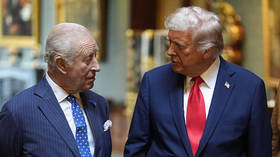
The British monarch’s trip showcases an alliance held together by shared complicity and decline
King Charles III has gone to Washington, ostensibly to help the transatlantic cousins celebrate getting rid of his predecessor George III 250 years ago. But being a royally gracious loser is, of course, only a pretext.
In reality, as The Economist, the premier British mouthpiece of transatlantic orthodoxy, has deplored, Charles’s mission is to salvage what’s left to be salvaged from the sinking “special relationship” between Washington and London.
That the relationship is in very bad shape is obvious from the compulsive manner in which Britain’s leader Keir Starmer keeps insisting that it still exists, while also emphasizing that he “will remain laser-focused on what is in the British national interest.”
Indeed, the abysmally unpopular Starmer has been subjected to so much typical Trump hazing that, as The Guardian notes, he may be enjoying “a vanishingly rare moment of public approval for his relatively robust response.”
Historically, the “special relationship” has certainly seen better days. It goes back a long way, even if the term itself was coined as late as 1946, when Winston Churchill needed a polite way of suggesting a political friendship with benefits: The British Empire was bankrupt and shrinking, and London was ready to submit to its former colonists in America in return for a new place as their permanent privileged sidekick in the beginning Cold War crusade against the Soviet Union.
Historically, the moderately sized island realm off Europe’s shores had laid the foundations for the continental behemoth across the Atlantic, even if – to be fair to the British – not deliberately but by strategic blunder. The bloody divorce between the rebellious colonists and the obstinate mother country – in many respects really a war between competing oligarchies, including plenty of slave holders and traders – has been imaginatively baked into the bedrock of US self-glorification as a war of independence and revolution.
It is true that, at first, the British were very cross indeed and returned in 1812 to burn the White House. When the Americans went to war with each other in the 1860s, Britain’s upper classes mostly rooted for the South, that is, for the break-up of the US. But even then, London was already cautious enough to maintain official neutrality.
Disclaimer : This story is auto aggregated by a computer programme and has not been created or edited by DOWNTHENEWS. Publisher: rt.com



