Grant Peck
Bangkok: Myanmar’s detained former leader Aung San Suu Kyi has been moved from prison to house arrest, state television announced on Thursday night.
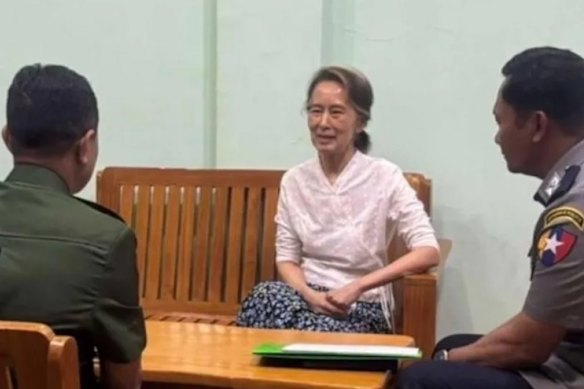
Myanmar’s military information office confirmed the news through a text message to the press. Accompanying the announcement was a photo of the 80-year-old leader dressed in a traditional white blouse and skirt, sitting facing two unidentified men in uniform.
The photo was also shown on the TV broadcast, but it is unclear when or where it was taken. Her son, Kim Aris, said the announcement did little to dispel fears about her condition or even confirm that she was still alive.
“I still do not know where my mother is. I do not know how she is. I remain deeply concerned about whether she is still alive,” he said. “If she is alive, I ask for proof of life.”
In December, Aris told Reuters he had not heard from his mother in years, receiving only sporadic, secondhand details about health issues, including heart, bone and gum problems, since her detention after a military coup in 2021. Her legal team told Reuters they had had no direct notification about her transfer to house arrest.
Suu Kyi has not been seen publicly since the Myanmar army seized power from her elected government on February 1, 2021. The last official photo of her was released on May 24, 2021, showing her in court.
The 2021 army takeover triggered massive public resistance that was brutally suppressed, triggering a bloody civil war that has killed thousands of people.
According to the Assistance Association for Political Prisoners, a rights monitoring organisation, 22,047 people have been detained for political reasons since the army takeover.
Suu Kyi was originally sentenced to 33 years in prison in late 2022 for several offences that her supporters and rights groups described as attempts to discredit her and legitimise the army takeover that removed her from office, as well as to prevent her return to politics.
Thursday’s amnesty, the second applied to her in recent weeks, would reduce her sentence to 18 years, with more than 13 years left to serve, according to the calculation.
Authorities had announced her prison sentence was being reduced as part of a prisoner amnesty marking a Buddhist religious holiday, the Full Moon day of “Kason,” known as Buddha’s Birthday and Demise. It covered 1519 prisoners, including 11 foreigners, with the sentences of convicts remaining in prison cut by one-sixth.
Announcing the transfer, Myanmar’s military leadership said she had been moved from the main prison in Myanmar’s capital Naypyitaw to house arrest, “to celebrate Buddha Day, to show humanitarian concern, and to demonstrate the kindness of the state.”
It did not specify her exact location but said that, according to the law on designating a place of imprisonment, “she will now serve the remainder of her sentence at a specific home instead of in prison.”
The amnesties came after senior general Min Aung Hlaing was sworn in as president on April 10, following an election that critics described as neither free nor fair and as orchestrated to maintain the military’s tight grip on power.
In his inauguration speech, he said his government would grant amnesties aimed at promoting social reconciliation, justice and peace. Actions, including the amnesties and Suu Kyi’s transfer, are widely seen as an effort to burnish his image.
US Secretary-General António Guterres said the move represented “a meaningful step toward conditions conducive to a credible political process”.
The UN chief reiterated his call for the swift release of all political prisoners, spokesman Stéphane Dujarric said, stressing that this is “a fundamental step” toward a political process and solution that “must be based on an immediate cessation of violence and a genuine commitment to inclusive dialogue.”
Suu Kyi, the daughter of Myanmar’s martyred independence hero General Aung San, spent almost 15 years as a political prisoner under house arrest between 1989 and 2010.
Her tough stand against military rule in Myanmar turned her into a symbol of nonviolent struggle for democracy, and won her the 1991 Nobel Peace Prize.
AP, Reuters
Get a note directly from our foreign correspondents on what’s making headlines around the world. Sign up for our weekly What in the World newsletter.
From our partners
Disclaimer : This story is auto aggregated by a computer programme and has not been created or edited by DOWNTHENEWS. Publisher: www.smh.com.au