
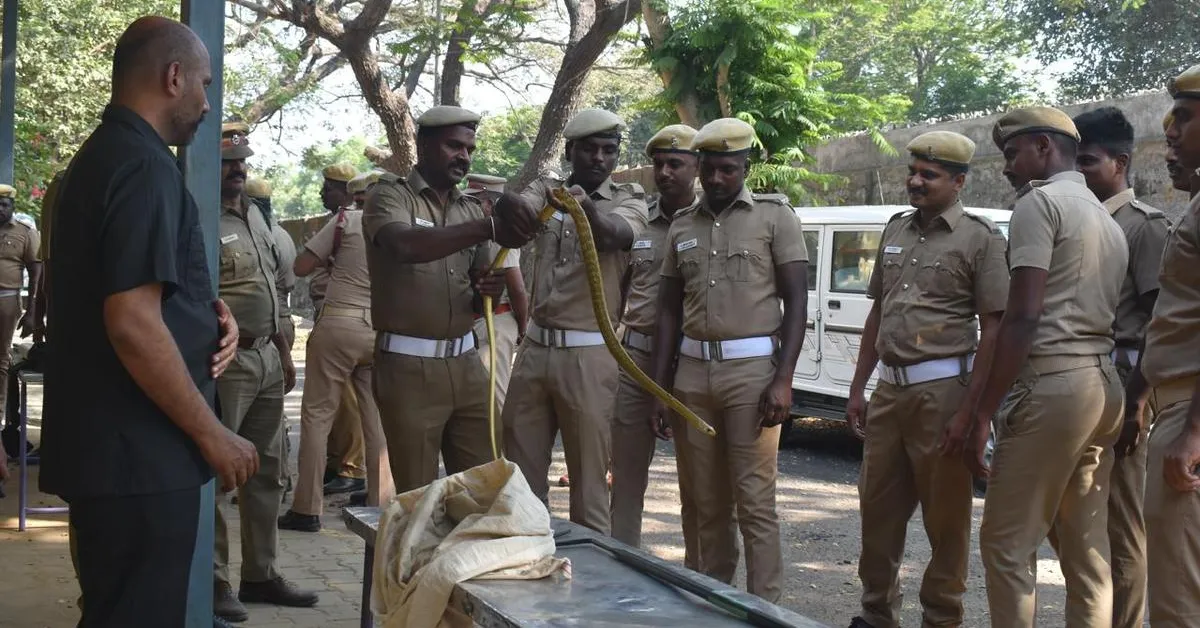
Ask most people what a firefighter does, and the answer comes quickly: they put out fires. The helmet, the hose, the red engine screaming down the road.
The image is so fixed in our minds that we rarely stop to question it. Which is why it might come as a surprise to learn that in Mumbai, across an entire financial year, fires accounted for less than 27% of everything the city’s fire brigade was called to handle.
The other 73% was everything else. And in India, “everything else” turns out to be quite a lot.
There are cobras behind washing machines and crocodiles in school toilets. There are lift breakdowns in high-rises and children who lock themselves into bedrooms at 3 am. There are elderly residents alone behind jammed doors, baby monkeys tangled in barbed wire, and beehives the size of suitcases hanging over building entrances.
For each of these, across every city and town in India, there is one number people reach for. And it is the same number they would dial if their kitchen were on fire.
India’s firefighters show up for all of it — without a separate helpline, without a specialised unit, and without complaint. This International Firefighters’ Day, observed annually on 4 May, we look at some of the regular and unusual calls fire and rescue personnel handle every day.
The snake shift
Of all the things that land in a fire station’s lap, snakes are perhaps the most telling.
A peer-reviewed study found that 63% of snake rescuers in Tamil Nadu were primarily contacted through the fire and rescue service. When a family finds a cobra behind their appliances at 9 pm, their first call is not to a herpetologist — it is the fire station.
In fact, Tamil Nadu Fire and Rescue Services officially lists snake-catching among its services, noting that personnel “are involved in catching snakes which take shelter in residential areas”.
A study on beehive removal found that 55 fire stations in Tamil Nadu received an average of 24 beehive calls per station in a single year. Snake rescues are even more frequent.
“During peak monsoon months, rescuers report more than four snake-related calls per day. Summer drives snakes indoors for shade, winter for warmth, and Indian homes — with food scraps, rodent populations, and firewood stacks — are reliably hospitable,” says Sathish Kumar, a Fire and Rescue Officer in Coimbatore.
Firefighters who trained for burning buildings have become some of the country’s most practised handlers of creatures that would rather be left alone.
The crocodile in a toilet
Snakes are routine. Crocodiles require a different kind of composure.
In Vadodara, where the Vishwamitri river runs through the city alongside a resident mugger crocodile population, the local fire service and wildlife rescuers work closely out of necessity.
In Firozabad, Uttar Pradesh, a seven-foot-long mugger crocodile entered an academy and took up residence in one of its toilets, requiring both a rescue operation and considerable improvisation.
/filters:format(webp)/english-betterindia/media/media_files/2026/04/29/3-2026-04-29-16-57-43.png)
In Gujarat, a six-foot crocodile was found inside the squat toilet of a home in Sozitra village. Emergency services responded, and the animal was relocated unharmed.
At 3 am, a locked door
Between wildlife calls, there is the work that takes up more time than almost anything else: people locked in, locked out, or trapped somewhere no other emergency service will come for.
In May 2025, a team from Chandrayangutta Fire Station in Hyderabad was called to rescue two children — Abdul Rahman, seven, and Mohammed Azam, three — who had accidentally locked themselves inside their bedroom.
Their parents and neighbours had tried everything, but when all efforts failed, they called the fire station. The team arrived with hydraulic cutters, broke open the lock, and found the children fast asleep inside. The firefighters were back at the station within the hour.
/filters:format(webp)/english-betterindia/media/media_files/2026/04/29/4-2026-04-29-17-02-53.png)
In Pune, an 80-year-old woman who had fallen ill was found locked inside her home. Fire brigade personnel rushed to the spot, opened the door, and ensured she was safe.
These calls — locked rooms, toddlers in hot cars, elderly residents who stop responding, or people trapped on balconies when a door swings shut — form the daily texture of a fire station’s work.
“These might seem like one-off incidents to many, but they are our daily reality. Once, we even received a call from someone whose finger had become painfully swollen because a ring was stuck around it,” recalls Jyothimani, another officer from Chennai.
What the numbers actually say
In Mumbai’s 2021–22 financial year, the fire brigade responded to 12,815 emergency calls, of which only 3,484 were fire incidents. Another 5,557 were rescue calls, while 3,985 were categorised as other incidents.
Actual fires made up less than 27% of the total. The locked rooms, the animals, the lift failures, and the flood rescues filled the rest.
/filters:format(webp)/english-betterindia/media/media_files/2026/04/29/3-2026-04-29-17-04-11.png)
In Ahmedabad, firefighters responding to a lift breakdown broke through a concrete wall and cut through a metal sheet near the third floor of a building to rescue 10 women trapped in a hidden lift well enclosed on all four sides.
In Delhi, firefighters freed a black kite caught in manja — glass-coated kite thread — from a tree inside a residential complex. In another incident, they rescued a baby rhesus macaque tangled in barbed wire and reunited it with its mother the same morning.
India’s Directorate General of Fire Services has put it plainly: “When the experts panic, they call the fire department.”
Tamil Nadu’s fire service alone — the second largest in the country — has 365 stations and 7,347 personnel covering an entire state. Nationally, India operates around 8,559 fire stations against an estimated requirement of over 28,000.
The people taking the cobra calls and the 3 am bedroom calls are doing so in a service that has never been funded in proportion to what it is asked to do.
/filters:format(webp)/english-betterindia/media/media_files/2026/04/29/6-2026-04-29-17-05-56.png)
They train for fires, but they arrive for everything else too — with hydraulic cutters, snake bags, ladders, and the steadiness that comes from never quite knowing what the next call will be.
India’s fire emergency number is 101 — for fires, rescues, snakes, crocodiles, and most things in between.
Sources
‘Fire cases on rise in Mumbai; received 10K emergency calls in the 7 months of 2023’: by ANI for Business Standard, Published on 27 September 2023
‘Epidemiology of snakebite and role of rescue services in Tamil Nadu’: by National Institutes of Health (PMC), Published 2024
‘Beehive removal practices in urban India: Bane of bee’s life’: by ResearchGate, Published 2020
‘Pune: Elderly woman rescued after being locked inside home in Wanwadi; fire brigade responds swiftly’: by Pune Pulse, Published 2025
‘Rescues from the helpline: April 2022’: by Wildlife SOS, Published 2022
‘Firefighters break through wall in India rescue’: by Elevator World, Published 2023
‘Firemen rescue 2 children accidentally locked inside room in Chandrayangutta’: by Deccan Chronicle, Published 2025
‘Hyderabad: Firefighters rescue two children locked inside room at midnight’: by The Siasat Daily, Published 2025
Disclaimer : This story is auto aggregated by a computer programme and has not been created or edited by DOWNTHENEWS. Publisher: thebetterindia.com



