
Below is an Q and A with McLaren Head of Design – Irons and Wedges, JP Herrington on Rose’s testing process with the club. Herrington personally built the irons Rose is using this week.
(Ed. note: This Q and A has been lightly edited for clarity and brevity.)
Jack Hirsh: What does the fitting process look like for someone who had a hand in designing these irons?
JP Herrington: One of the first things we want to do is really establish that address profile — what it looks like looking down at the golf club, the face profile, toe height, par height, that transition in between that leading edge and all those offset and those things. Justin said early on that the first thing you do is set it down at address, right? So if you feel that confidence or just that the look that fits your eye, that starts those positive vibrations.
JH: What comes after you lock in the look?
JP: Once you establish that face profile, then you can start on the next phase, which would be ultimately the sole and CG. We created a lot of prototypes and just kind of had a competition of the soles based on his performance and feel. If there were adjustments, you go back, you make adjustments, you retest, you just keep repeating that process until you get it right.
JH: How do you test and refine CG?
JP: You want to hold one variable constant — let’s say the CGX — and do a variable on CGY, and then vice versa. So now you’re identifying those variables. Then you want to hold all those things that we prototyped and tested into what that design is going to ultimately end up being.
JH: What was he looking for in this set that he wasn’t getting with what he was playing previously?
JP: The sole that he was using felt a bit clunky through the turf, right? And that also created some knuckleballs type of thing, flyers and things like that, not generating that consistent spin. Consistency in those spin rates and launch angles is very high priority for Justin. He’s like a human launch monitor at the end of the day.

McLaren Golf Series 1 Custom Irons
A Tour blade with the feel you expect and the forgiveness you don’t.
Series1 is a modern Tour blade, engineered through Metal Injection Molding. It delivers a level of forgiveness traditional forging can’t achieve, while maintaining the feel and workability often lost in cast designs.
The result is performance without compromise – a blade for elite players who demand more from their irons.
View Product
JH: What kind of sole is on his irons right now?
JP: So currently right now we’ve got him into a lower bounce than that. One big bounce step down from the stock set with a real crisp leading edge. He has both sets and and will be going back and forth depending on turf conditions and softness and things like that. So if he needs a little bit more resistance to digging through impact, based on turf conditions, then he has that option.
JH: How does his delivery influence those decisions on what you do to avoid that with these irons?
JP: He has that kind of moderate attack into the golf ball. He’s not picking it every time and he’s not digging trenches out there. It’s just a real smooth delivery. He hits that ball first and then that thing is going to cut into the turf, and then get out of the divot and maintain that speed through the divot, which is important to finish the swing.
Q: Where do the Series 3 irons fit in? He mentioned he wasn’t sure whether he was putting in a Series 3 4- or 5-iron to his set.
A: He played the 4- and the 5-iron Thursday in the Series 3. One of the main things was that it was really holding its line very nicely, that face stability. That club has a higher MOI than the Series 1. It got a little bit more peak height and a little bit more ball speed, and that trajectory that he’s looking for as well.
Q: What kind of ball speed is he seeing with, let’s say a 6-iron
A: He was in the realm of about 135 mph 6-iron, and he’s been approaching 140 mph very comfortably. But it’s not just about that ball speed. It’s coupled with the spin, and that spin combination at that number was really performing.
Q: Any other key fitting elements?
A: “That progressive offset that we’re carrying forward into the retail Series 1. With more offset in those long irons, he can square the face easier, and then into the mid irons it reduces and then reduces further into the short iron.
And there was never a question about the shaft. He loves his KBS C-Tapers. It’s super stable, and we didn’t want to change too many variables.

McLaren Golf Series 3 Custom Irons
An engineering powerhouse providing distance and forgiveness.
Featuring a powerful engine built around its Metal Injection Molded frame, Series3 is a complete performance system. Internal weighting and carbon fiber elements work in unison, positioning the center of gravity with precision and stabilizing the club through impact.
The result is scintillating speed, responsive control and vibration-dampening feel.
View Product
Fleetwood loads up the top of the bag
Doral’s Blue Monster features not one, not two, but three beefy par-3s that are listed over 215-yards on the scorecard. That means you better have clubs that will specifically be ready to cover those yardages this week. There’s no reason to be in between clubs when you know the yardages ahead of time.
Tommy Fleetwood prepared exactly for those extra long shots.
Fleetwood has dropped his 56˚ wedge this week (going 52-60 instead) and has added a TaylorMade P770 4-iron in between his 9-wood and 5-iron.
According to TaylorMade Tour Rep Adrian Rietveld, Fleetwood’s P7TW 5-iron carries 220 while his 9-wood carries 240, so the goal was to find something to fit that 230 carry window.
The pair tested both this weak 4-iron (24˚) and a stronger P770 5-iron to try and fill the gap. Rietveld said both clubs have their advantages for roll out and different distances, but ultimately they went with the weak 4-iron, which he said might also get use on layups for the par-5s this week. All of the par-5s this week measure 570 or longer and two are over 600.

TaylorMade P770 Custom Irons
SOLID FORGED FEEL
Improved for a more solid feel like never before. The 2024 P•770 has been strategically tuned using a player’s forged construction and modal analysis to create a notable improvement and the best feeling P•770 to date.
MODERN PLAYERS IRON
TaylorMade’s FLTD CG™ coupled with precision milled face and grooves, deliver the launch and spin modern players demand. Designed with forgiving, high launching long irons and lower launching, high spinning scoring irons for accuracy and control.
CONSISTENCY
Consistent ball striking and accurate shot making from a forged iron construction designed with meticulous mass optimization and an updated tungsten weight design for more forgiving long irons.
REFINED SHAPING
Refined shaping for a cleaner look and improved turf interaction. The 2024 P•770 has a thinner topline visual balanced with a confidence inspiring, compact head shape. A newly modified leading edge design helps deliver consistent shot making and crisp turf interaction.
View Product
Fleetwood and Rietveld were sold when the former flushed the 4-iron on the par-3 9th during practice rounds and produced 151 mph ball speed, 108-foot apex height, 4683 rpms of spin and a carry of 229 yards. A perfect gap filler.
This is an awesome example of building golf clubs specifically for the course and many amateurs would be wise to do the same for their home course.
Most weeks, Fleetwood can live with the 20 yard gap between his 9-wood and 5-iron, but when he is presented with so many shots between 220 and 240 yards, why not add another option there to avoid having to hit half shots with a fairway wood or long iron?
Check this out
This section is dedicated to cool photos we’ve snapped recently on Tour, but haven’t had a reason to share yet. For this week, check out Jordan Spieth’s T.P. Mills Trad II Forged putter.
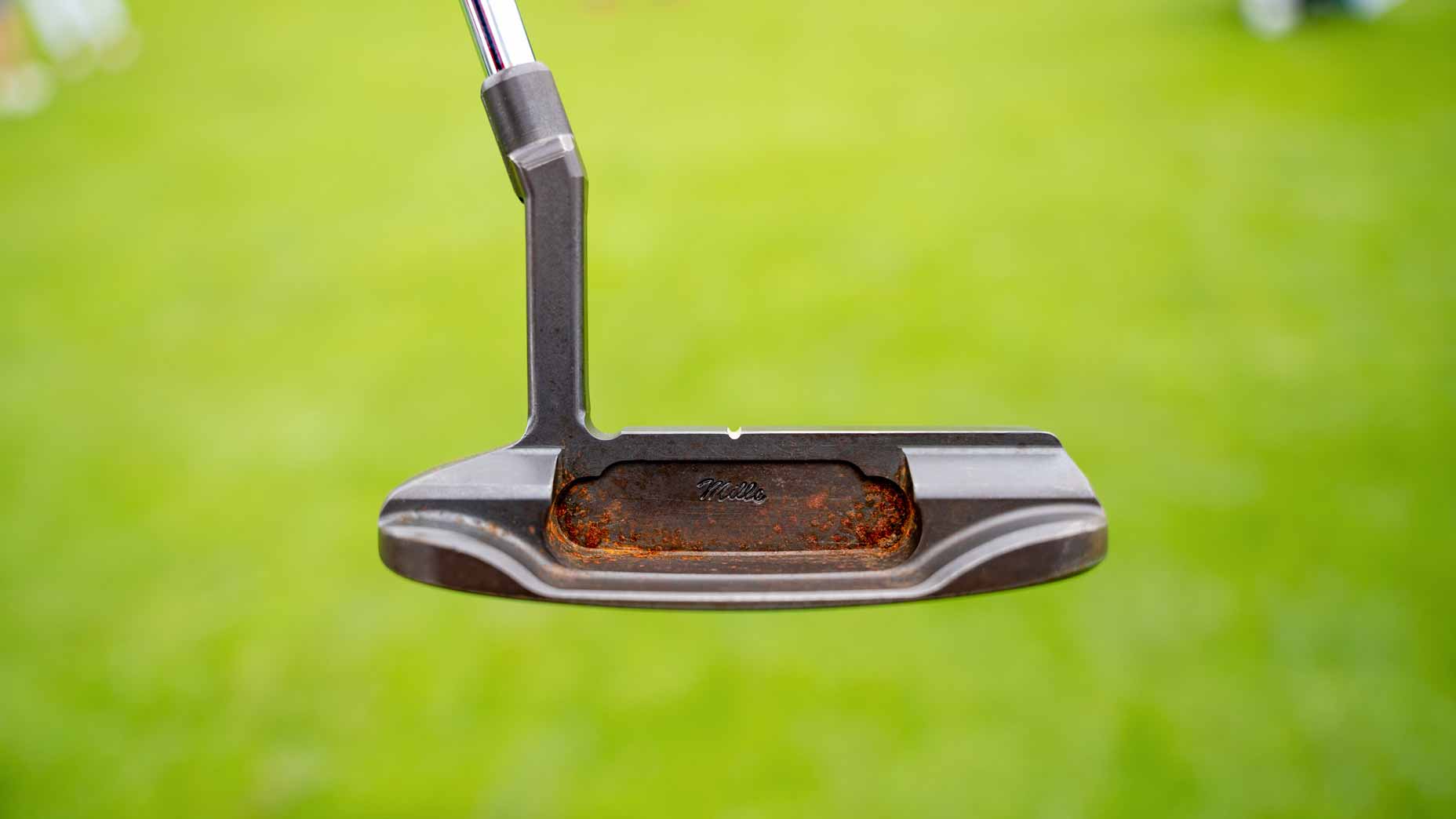
Jack Hirsh/GOLF
Disclaimer : This story is auto aggregated by a computer programme and has not been created or edited by DOWNTHENEWS. Publisher: golf.com


