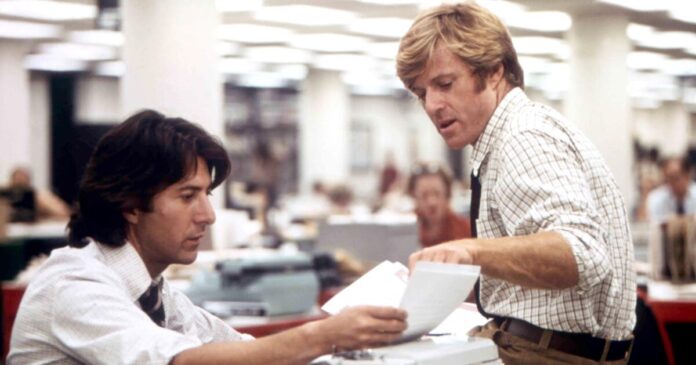
“All the President’s Men” was released 50 years ago this month, an anniversary that’s been greeted with equal parts rue and reverence by the journalists, political junkies and discerning cinephiles who have worshiped the film for five decades.
As a member of all three of those constituencies, I’ve done my share of genuflecting, most recently as chief film critic at the Washington Post, whose city room was as vivid and fully realized in the movie as Robert Redford’s Bob Woodward and Dustin Hoffman’s Carl Bernstein.
Like so many Posties of my generation, I’ll never forget the so-real-it’s-surreal experience of walking into the fifth-floor newsroom for the first time in 2002. By then, standard-issue electric typewriters and six-ply carbon paper had been replaced by far less visually interesting computers. But the office’s pervading atmosphere of hard work and quiet focus felt uncannily similar to its big-screen analog.
For the last two years, I have been researching a book about the making of “All the President’s Men,” whose production involved almost as many contingencies and unresolved questions as Watergate itself. Among the film’s many mysteries, one I’ve found particularly intriguing has to do with Katharine Graham, publisher of the Washington Post and CEO of its parent company during the Watergate investigations. As the movie amply demonstrates, it took guts for Woodward and Bernstein to persevere with their reporting in the face of terrified sources and their own growing paranoia. But, unbeknownst to many observers at the time, Graham was enduring even more withering pressures, with determination that was all the more impressive for being almost entirely invisible.
I’m still in the process of discovering why she remained invisible in “All the President’s Men.” For now, it’s clear that the backstory is more nuanced than mere oversight or, as many are quick to assume, simple sexism.
In fact, William Goldman’s first script of the film featured a sequence with Graham and Woodward, a scene that appeared in every subsequent draft. Based on an actual meeting between the two, it’s a cagey game of cat-and-mouse, with the publisher taking the measure of a nervous, still-inexperienced journalist, looking for reassurance that his reporting will prove out.
Earlier this year, at a January staged reading of “All the President’s Men” at Harmony Gold Theater in Hollywood — a fundraiser for the Stella Adler Academy — it was possible for fans to conjure what might have been. Mark Ruffalo played Woodward and Ethan Hawke played Bernstein in a version of the movie assembled from different Goldman drafts.
A high point of the evening was when Ruffalo and actor Susan Traylor brought the Graham-Woodward scene to tentative, tense and teasingly playful life. After grilling Woodward about his sources and coyly asking him about Deep Throat’s identity, Traylor’s Graham asked him if the truth about Watergate would ever be revealed. “It may never come out,” Ruffalo’s Woodward replied. “Don’t tell me ‘never,’” Graham laments, before bringing the meeting to a close with a gently peremptory “Do better.”
In poring over director Alan J. Pakula and Goldman’s papers, I’ve probably read that scene dozens of times. But when I heard it play out in real time, I was ambushed by the emotions it stirred — a mixture of pride in Graham’s legacy and deep sadness at how that legacy has been so inexplicably ignored in recent years.
I was also sad that Redford, who died in September, wasn’t there. He often expressed regret that Graham wasn’t a featured character in “All the President’s Men.” Keenly aware of how her spine and steadfastness made Woodward and Bernstein’s work possible, he wanted to honor that crucial support. When I interviewed him for the first time in 2005, he insisted that fearless owners were every bit as important in preserving democracy as the reporters he and Hoffman helped glamorize.
Over the next two decades, every time I saw Redford, he bemoaned the “downward slide of this thing,” by which he meant the constellation of institutions “All the President’s Men” celebrates: not just journalism and a robust First Amendment but a Washington where investigators, prosecutors, judges, the Senate and Congress did their jobs regardless of partisan loyalties, and a Hollywood where a studio as mainstream as Warner Bros. would agree to finance a tough-minded film about a contentious and still-raw period in recent history.
Granted, that film was based on a bestselling book and anchored by two huge stars. But today, with political and corporate leaders — including media companies — falling over each other to curry favor with President Trump, “All the President’s Men” feels like an artifact from a vanished age.
Nowhere is this more distressingly true than at the Post itself, where the newsroom immortalized by the movie has been slashed by more than a third, and where Jeff Bezos, who bought the paper in 2013, seems intent on erasing Katharine Graham’s legacy until it vanishes completely. During the first Trump administration, Bezos stood up to threats against the Post and the press at large that would make Nixon blush, or at least pea-green with envy.
Now, Bezos has become a one-man meme of what author Timothy Snyder calls “obedience in advance,” quashing an endorsement of Kamala Harris, ostentatiously grinning his way through Trump’s second inauguration, vastly overpaying for a promotional film about First Lady Melania Trump and staying conspicuously mum (at least publicly) when a Post reporter’s home was raided by the FBI in January.
All of this has come at an enormous moral and material cost, with thousands of readers canceling their subscriptions and an alarming number of the Post’s finest reporters and writers leaving for other publications and platforms. As my former boss Marty Baron told my former colleague Ruth Marcus in the New Yorker in February, Bezos’ turnaround has been “sickening” to witness: “a case study in near-instant, self-inflicted brand destruction.”
Of course, that brand was built, in no small part, by “All the President’s Men,” which taught a generation how to walk, talk, dress and act like real reporters. (Hint: A good corduroy jacket and a pen in your mouth can’t hurt.)
In 1976, Pakula was interviewed about his dealings with Graham, whom he admired tremendously and with whom he would become close friends. “I could do a film about the Katharine Graham story,” he enthused. “It’s a superb story.”
Thirty years later, Steven Spielberg would bring Pakula’s idea to fruition with “The Post,” about Graham’s decision to publish the Pentagon Papers, a dress rehearsal for the even higher stakes of Watergate a year later.
“The Post,” which starred Meryl Streep in a shrewdly judged performance of aristocratic assurance and creeping insecurity, premiered in Washington less than a year into Trump’s first administration. Bezos attended that screening, which many of us saw as tacit acknowledgment that he was taking her lessons in character, comportment and competence to heart.
That was clearly wishful thinking. Graham may have finally assumed her rightful place in the newspaper-movie canon, but we’re still left to ponder her absence from the most iconic journalism movie of the 20th century.
It’s no longer the shoe-leather reporters who need a big-screen tutorial in how to do their jobs. It’s their bosses. A simple place to start would be to memorize the best two-word speech to never appear in a major motion picture: Do better.
Ann Hornaday was a film critic at the Washington Post from 2002 to 2025, when she retired. “All the President’s Men” plays at TCM Classic Film Festival Saturday at 2:45 p.m.
More to Read
Disclaimer : This story is auto aggregated by a computer programme and has not been created or edited by DOWNTHENEWS. Publisher: latimes.com