Tim Elliott
Each week, Good Weekend’s how-to column shares expert advice on how to navigate some of modern life’s big – and small – challenges. This week: How to survive a rip.
Australians love the beach, but with swimming skills sinking and drowning rates rising, learning how to deal with rips is important. “In Australia, pretty much every open-ocean surf beach will have rips most of the time, and some will have several, usually spaced at various intervals along the shore,” says Dr Rob Brander, a coastal scientist, beach-safety researcher and professor at the UNSW School of Biological, Earth and Environmental Sciences. “On average, about 25 to 30 people drown in rips each year, which is more than the deaths caused by bushfires, floods, cyclones and sharks combined.”
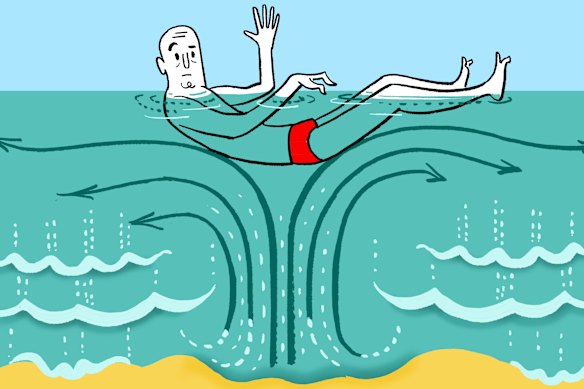
Brander, aka Dr Rip, has made an entire career out of educating people about rips. “Think of rips as rivers of the sea,” he says. “They exist as a mechanism to transport the water brought in by breaking waves back offshore.” Rips start close to the shoreline, where many people swim, and flow out through the surf and some distance beyond. They often feature deeper, darker water, and fewer breaking waves. Surfers often use them to get out beyond the break, kind of like a liquid travelator.
The best way to get out of a rip is to not get in one in the first place. Brander recommends swimming between the flags where there are lifeguards. But if you’re swimming at a beach without flags or lifeguards, and you do get caught, the first rule is, don’t panic. “Try to relax and float, and signal for help by raising your arm to get attention.” If there is a surfer nearby, call out. Remember that a rip is just taking you for a ride. Contrary to popular perception, Brander says a rip won’t pull you under the water or sweep you out to New Zealand or into shark-infested waters (unless you’re already in shark-infested waters). Many rips actually circulate, he adds, so if you just float and conserve your energy, you’ll end up safely back in shallow water (although it might be 100 metres or so from where you started).
Another crucial rule: never try to swim back to the beach against the rip. Rips can be strong and flow faster than most people can swim: by battling against one, you’ll only exhaust yourself. “If you’re a good swimmer, look around and swim slowly towards the side of the rip,” Brander says.
Think of it like swimming to the side of a river. Once you no longer feel the water pulling you out, then you can start heading back towards land, or let the waves wash you in.
Get the best of Good Weekend delivered to your inbox every Saturday morning. Sign up for our newsletter.
More from How to …
From our partners
Disclaimer : This story is auto aggregated by a computer programme and has not been created or edited by DOWNTHENEWS. Publisher: www.smh.com.au