The cost of petrol and diesel is set to climb again in coming weeks after Australia’s regional oil prices hit a new wartime high, piling pressure on the federal government to extend its 26¢ cut to the fuel excise beyond the June 30 deadline.
Motorists have enjoyed a two-week window of relief at the pump after the US-Iran ceasefire raised hopes of an imminent end to the conflict, spurring a swift fall in crude oil and fuel prices.
But as a series of peace talks foundered, crushing prospects of Middle East energy exports returning to normal any time soon, benchmark oil prices have risen to their highest levels since Iran all but closed the Strait of Hormuz on February 28.
On Friday, Australia’s regional oil benchmark, Tapis crude, was trading at $US125 ($174) a barrel, its highest mark since the global energy crisis sparked by the war in Ukraine in 2022, and more than double the $US65 price point underpinning the Australian government’s mid-year budget update.
While prices dropped slightly on overseas markets overnight, international oil bosses are sounding the alarm as stockpiles run down.
“A lot of the inventory and spare capacity has been depleted already,” Chevron chief financial officer Eimear Bonner told Bloomberg. “There’s very little of the buffer left.”
“The market hasn’t seen the full impact of that yet,” Exxon chief executive Darren Woods told analysts overnight. “There’s more to come if the strait remains closed.”
“Markets are not liking what is happening in the Middle East,” said Peter Khoury, a spokesman for the National Roads and Motorists Association.
Prime Minister Anthony Albanese said on Friday that economic damage from the war would have a “long tail to it”.
“We don’t know when this war will end. We don’t know what the consequences will be. We don’t know if the Strait of Hormuz will be open, what the timeframe is, and we know that even if it opened tomorrow,” Albanese said.
Albanese has not ruled out extending the fuel excise cut beyond June, and said last month that the government would “examine it at an appropriate time”.
Treasurer Jim Chalmers has emphasised the role the cut has played in driving down prices since April, after a 33 per cent jump in petrol prices helped push inflation to 4.6 per cent in March.
“This shows how important and how necessary that decision from the government was since we halved the fuel excise,” he said on Wednesday.
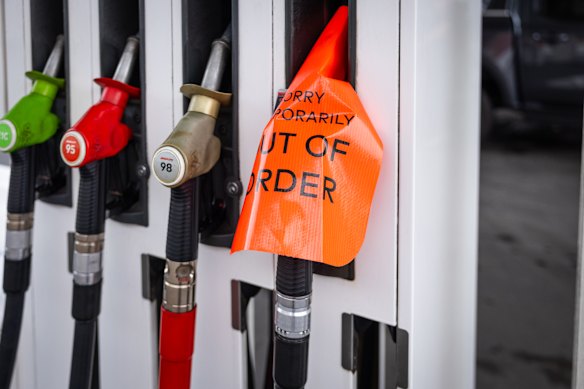
While Sydney and Melbourne drivers saw regular unleaded averaging $1.80 and diesel at $2.50 a litre on Friday, those figures are expected to jump within seven to 10 days’ time as the international spike filters through to local service stations. In late March, diesel prices hit a high of $3.10 a litre, while unleaded petrol rose to $2.59 a litre.
While price spikes are imminent, pressure on the local fuel supply chain has eased.
Previously unpublished government data reveals that panic buying has subsided as petrol and diesel sales have returned to typical levels, after consumption hit a high point in the first week of March.
Fuel excise volumes – a key indicator of how much fuel has been sold in the nation as it is charged per litre – surged to a six-year peak in the weeks following February 28, when US President Donald Trump launched his attack on Iran.
The spike was driven by a wave of panic buying as motorists and businesses braced for the risk of major price hikes and supply shortfalls.
However, demand has plummeted by as much as 20 per cent since early March, signalling that motorists are changing their driving behaviour.
Prices have eased and supply has increased since fuel importers procured additional cargoes in March and the government secured agreements with Asian fuel exporters to shore up supply.
The number of local service stations without fuel has fallen to less than half the number recorded during the first weeks of the war.
Experts attribute the massive fall in fuel demand to people changing their driving behaviour to deal with higher prices, as well as the impact of increased government and industry messaging encouraging motorists to adopt fuel-saving measures, take public transport where possible, and not fill up unnecessarily.
“I would suggest it’s all of the above,” Khoury said. “Sustained periods of really high prices result in people driving less, combining trips and using public transport more.”
Cut through the noise of federal politics with news, views and expert analysis. Subscribers can sign up to our weekly Inside Politics newsletter.
 Mike Foley is the climate and energy correspondent for The Age and The Sydney Morning Herald.Connect via email.
 Nick Toscano is a business reporter for The Age and Sydney Morning Herald.Connect via X or email.
From our partners
Disclaimer : This story is auto aggregated by a computer programme and has not been created or edited by DOWNTHENEWS. Publisher: www.smh.com.au