
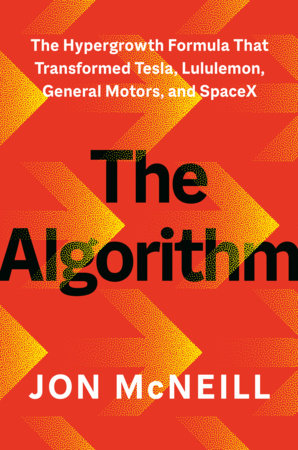
In his book, ‘The Algorithm’ published by Penguin, Jon McNeill draws from his time working closely with Elon Musk to challenge conventional ideas of growth and efficiency. In this conversation, he breaks down why questioning processes, simplifying systems and resisting the rush to automate could be the real drivers of speed in today’s complex business landscape.
In your book, ‘The Algorithm’, you argue that innovation comes from removing rather than adding. So, what’s the hardest thing leaders must learn to let go of?
Most leaders say they want speed and innovation. Then they reinforce the conditions that suffocate those two things — not questioning rules, bloating processes, and making slow decisions – until the urgency is gone. That’s why speed and innovation are ultimately leadership problems. Leadership shows up less in charisma and personality, and more in what a leader is willing to question and cut, especially when an organization insists, “this is just how we do things.”
The hardest thing leaders must learn to let go of is the assumption that existing processes, approvals, and ways of working are necessary. Speed rarely comes from adding more. It comes from taking things away. And bureaucracy is what happens when leaders stop asking, why are we doing it this way. The discipline is to challenge every requirement before accepting it as required — separating real limits like law, safety, and physics from habits that only feel necessary.
Having worked closely with Elon Musk at Tesla, what is the most misunderstood aspect of his approach to speed and decision-making?
The most misunderstood aspect is that speed isn’t about doing more, it’s about removing what slows things down. At Tesla, during a period of hypergrowth when revenue grew from $2 billion to $20 billion in just 30 months, the principle was that the fastest companies don’t win because they add more; they actually win because they subtract better. Speed comes from shortening cycles and exposing problems early, and is actually the most unfair advantage because the team that learns faster can out-execute teams with more resources.
Another misunderstanding is where decisions happen. Too many executives try to run companies from conference rooms, then wonder why work slows down and decisions get muddy. You can’t run a modern company from conference rooms – leaders get better results when they stay close to what customers actually experience.
Your framework prioritises ‘automate last’…how should companies rethink their current rush toward AI and automation?
Automation is tempting, especially with AI everywhere, but the mistake is using tech to cover up dysfunction. Make the work run by hand first, then automate what’s already working. In fact, automating inefficiency just locks it in. That’s why the order matters: fix the work first, then let technology speed it up.
The Algorithm is simply a way to push back. Question what’s “required,” cut what doesn’t help, make the process easy to explain, shorten the time between idea and action, and only then use tech to speed it up. The upside is fewer pointless routines, clearer ownership, more time spent on building and fixing what matters – plus, yes, more speed.
In a market like India, where scale and speed often collide with complexity, how can your five-step system be applied realistically?
The framework is extremely practical and universal. It comes down to five key steps: question, delete, simplify, accelerate, and automate last.
First, treat every requirement as guilty until proven innocent. Don’t accept constraints just because they are popular or have history. Keep asking why until you hit something truly non-negotiable.
Second, speed things up by deleting, not adding. Most organizations respond to complexity by adding approvals, meetings, or tools — which only slows them down further.
Third, keep it simple enough to explain (and do again). If the process is hard to explain, it’s too complicated and you likely can’t repeat it reliably at scale.
Fourth, accelerate cycle time. Shorter cycles expose quality and process issues while problems are still small enough to fix.
Finally, automate last. Fix the work first, then let technology scale what already works.
You witnessed Tesla grow exponentially under pressure; what separates companies that survive chaos from those that scale through it?
I was lucky enough to have a front row seat to how growth can either force clarity or bury teams in process. The companies that scale are the ones that keep simplifying as they grow, instead of layering on complexity.
A lot of smart companies get this wrong. The process gets more and more layered until you can’t explain it, teach it, or run it the same way twice. Once that happens, it won’t hold up as you grow.
The companies that scale through chaos are the ones that continuously question, delete, and simplify — instead of letting bureaucracy take over.
If leaders today adopted just one principle from your framework, which would create the most immediate and transformative impact?
Adopt the discipline of questioning absolutely everything. If leaders consistently questioned what’s required and cut what doesn’t help, they would unlock immediate gains. That means fewer pointless routines, clearer ownership, more time spent on building and fixing what matters — plus, yes, more speed.
Disclaimer : This story is auto aggregated by a computer programme and has not been created or edited by DOWNTHENEWS. Publisher: deccanchronicle.com



