
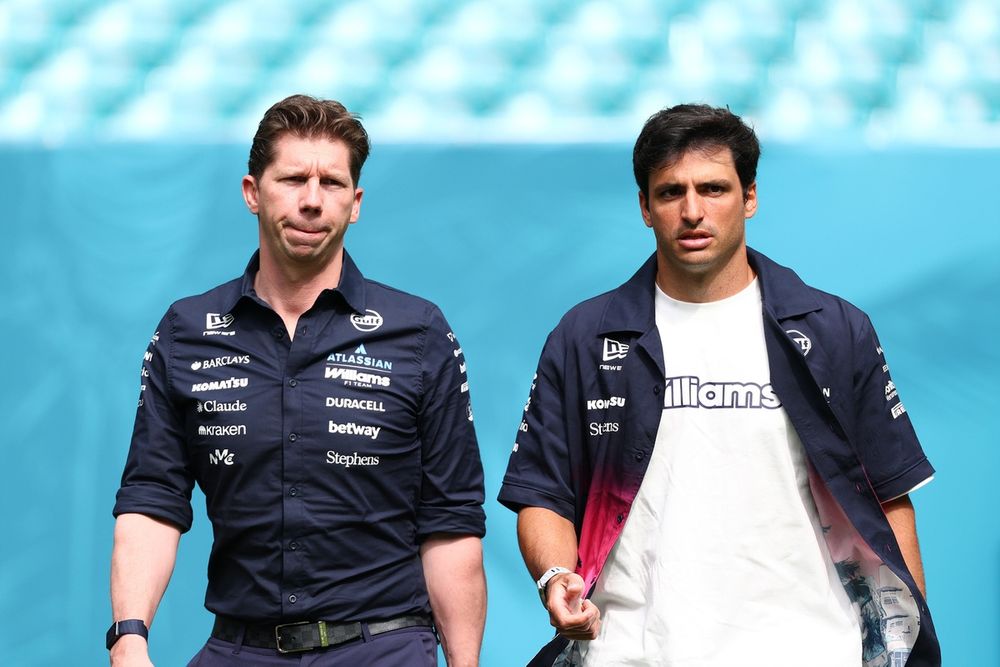
Williams is suffering from an extremely heavy 2026 Formula 1 car and team boss James Vowles revealed that ‘painful mechanisms’ are delaying its weight reduction.
The FW48 is understood to be 28kg above the regulated minimum weight of 768kg, down from 800kg last year as part of the drastic rule change for this year’s campaign.
It’s resulted in a slow start for Williams with just two points after three rounds, leaving it ninth in the championship and above only Cadillac and Aston Martin.
In a bid to turn its fortunes around, the Grove outfit has brought seven updated car components to this weekend’s Miami Grand Prix with weight reduction being its priority.
But driver Carlos Sainz doesn’t believe Williams will see the benefits of that until later in the year, as Vowles revealed only “a couple of kilos” has been taken out of the car this weekend.
That’s despite the factory having already engineered the FW48 to the ideal weight, it’s just that it “will take a bit of time” to apply the work to the car with gradual steps at each race.
Carlos Sainz, Williams, James Vowles, Williams
Photo by: Clive Mason / Getty Images
“Why does it take so long to get the weight out? The engineering work is done, so the designers aren’t designing, fundamentally,” said Vowles.
“But you have to make sure you’re printing the components in a way that makes sense. So, in other words, we could take out, and we have this weekend, several kilos out of the floor because we’ve done a new floor.
“I don’t want to just make exactly the same front wing being several kilos lighter. That doesn’t make any sense to anyone.
“So, you’ve got to body that into an aerodynamic update at the same time and so that’s the efficient way in cost cap of doing it.
“We could right now take out, if there’s no cost cap, print the other bits in the car. We have capacity, we’d take out pretty much all the weight.
“But there’s some mechanisms that we have to do along that journey. It’s painful but it’s balancing adding aerodynamic performance as well as weight reduction.”

Carlos Sainz after P3 at the 2025 Azerbaijan GP
Photo by: Rudy Carezzevoli / Getty Images
This is not the start that was expected of Williams, especially when it kicked off its 2026 wind tunnel testing in January last year ahead of a vastly improved 2025 campaign.
It finished fifth in last season’s standings, up from ninth in 2024, with third for Sainz in both Azerbaijan and Qatar giving Williams its first multi-podium season since 2015.
But then it endured a “messy” off-season, per Vowles, causing it to skip the opening test in Barcelona, from which it has struggled to recover.
When pressed on why it was “messy”, Vowles responded: “We made a lot of changes a few years ago, putting in ERP (enterprise resource planning), PLM (product lifecycle management) systems, different ways of doing planning, different ways of structuring, different ways of working.
“This was the first proper car build where all of those brought into account. We have made some mistakes on some of that software that we’ve been using.
“It was our first proper go at planning a completely new regulation car from start to finish and when we went through effectively a global review of all of that, it’s tiny, small details but hundreds of them starting to add up.

Alexander Albon, Williams
Photo by: Lars Baron / Getty Images
“So, there were just inefficiencies across the board that weren’t taken into account and only came to light once you started stressing the system.
“Whilst we started early in the wind tunnel, no doubt about that, we did not start the build of the car early because what you want to do is keep all of that goodness in the wind tunnel as long as possible.
“We wanted to stress ourselves to the point of not quite a championship team but more aggressive than we had done before.
“The car we produced is the most complex. It doesn’t matter if I use number of parts, it’s about two times the number of parts. Doesn’t matter if I only use the number of parts in the chassis or the time it took, all of it was about one and a half to two times more complex and it didn’t go smoothly through much of that process.
“It might not seem this way, but your reaction once that starts to happen is there are very few alternatives. You can’t really go to outside manufacturers because they are all booked up by other individuals.
“So, once you start falling behind, you’re in trouble. There were a number of crash tests, some were passed incredibly well, some were difficult, frankly, and that put load back into a system at a very difficult point as well.
“Once you start running out of time, weight is quite an easy addition to effectively get a part through to make sure that you are in a sensible place. It comes basically into a heavy car very quickly as a result.”
Vowles therefore revealed that once Williams has finished developing its car, around the end of August, a successful season would be being back at the “top of the midfield”.
We want your opinion!
What would you like to see on Motorsport.com?
– The Motorsport.com Team
Disclaimer : This story is auto aggregated by a computer programme and has not been created or edited by DOWNTHENEWS. Publisher: motorsport.com



