In a series of world firsts, The Alfred’s team saved the life of US marine Travis Reyes, critically injured in a deadly aircraft crash in remote NT.
Corporal Travis Reyes had 23 US marines crammed in the back of his Osprey aircraft. It was 9.04am and they had just left the RAAF’s Darwin base for Exercise Predator’s Run.
The troops were nervous and hungry, strapped into the unique, though notorious, half-plane/half-helicopter, which has been involved in deadly crashes claiming 35 lives since it entered military service in 2007.
As a crew member fastened only by a wander lead, Reyes was free to move around the flying office he’d grown to love.
“I remember take-off was smooth, and as soon as we got over the water, it was all so smooth,” he recalls.
“I started eating my McDonald’s in front of those grunts, and they were so jealous of me, and I was just smiling and dangling my feet off the ramp.”
The 21-year-old from Maryland was nearing the end of a six-month deployment on August 27, 2023. The war games with 2500 personnel from the US, Australia, Indonesia, the Philippines and Timor Leste were a cool way to sign off.
But, as the jungles of Melville Island replaced the Beagle Gulf waters below Reyes’ feet, the ride became jerky.
The Osprey in front pulled up without warning, forcing Reyes’ pilots to veer to avoid a mid-air crash. The manoeuvre, combined with wind and weight, caused the aircraft to lose lift. It plummeted as Reyes clung to a ramp activator.
“I was grabbing that for dear life because I had no idea what was going on. And then I started hearing ‘mayday’.”
Reyes jolted up, tugging on passengers’ seatbelts.
“The infantry guys, you could just see it in their faces … They just looked like they were literally about to die.
“I remember hearing sounds of trees just snapping against the rotor blades … I was getting rag-dolled around … I just remember hearing a cracking and I hit my head, and then that was it.”
The Osprey was an inferno on the ground. Surviving marines dragged out their unconscious flight attendant onto Melville Island’s distinctive bright red dirt.
“I remember waking up, and then everybody was around me, and everybody was rushing out of the aircraft,” Reyes said.
“I was getting dragged out, and then they were working on me. I could feel my body was all messed up.
“And then I was in Texas, and then that’s when a whole other set of stories start.”
Welcome to the jungle
Dr David McCreary wasn’t supposed to be in the Top End.
The trauma specialist at The Alfred hospital in Melbourne took the place of an injured friend as the emergency flight doctor for Predator’s Run.
On the operation’s first day at Melville Island, McCreary waited for the 9.30am arrival of two Ospreys but was surprised when the famously punctual marines didn’t appear.
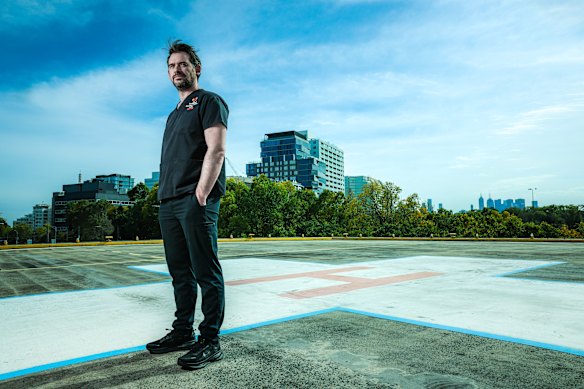
Surprise soon turned to worry when Darwin-based colleagues texted news of a crash. McCreary’s crew was already preparing their own chopper for take-off when official notification came through the US and Australian military. McCreary was only a 12-minute flight away.
“From a distance, I could see smoke and, as we banked round, I could then see how crap it looked,” he recalled.
“When we saw the wreck from above, it looked like nobody could have survived. It was just ashes and smoke, and you could see it had demolished loads of trees on the way in. Then we saw some guys signalling us from the ground.”
McCreary and paramedic Lloyd Herbert winched down to the burning wreck. Three crew members – Major Tobin Lewis, Captain Eleanor LeBeau and Corporal Spencer Collart – were dead, and there were 20 walking wounded.
But the marines were most concerned about one survivor they had dragged from the inferno.
“He [Reyes] was able to tell me his name,” McCreary said. “When you see how burnt the aircraft was – it was incinerated – and you see him with literally nothing … those two things don’t compute to me.
“But as soon as you actually lay hands on him and start doing numbers, it was bad.”
Reyes’ vitals were beyond critical. The numbers indicated massive internal injuries, probably a build-up of blood that was rapidly increasing pressure on his heart and lungs. McCreary also suspected Reyes’ injured lungs were expelling air into his chest, where it couldn’t escape, preventing his lungs refilling and further constricting his heart until it would stop completely.
“I saw there was a lot of blood in his belly and he needed an operation for that.”
Without a blood supply and nothing to stem the bleeding, there was no safe way to operate, so McCreary provided saline, some of the limited oxygen available, and ketamine, to buy time.
Then Reyes’ blood pressure dropped so low it could not even be measured. McCreary realised he had to perform an operation that would probably kill the young marine, but he knew Reyes would certainly die without it.
Suddenly, a miracle appeared from above.
“Literally, at the point where I was like ‘I just need blood’, I remember seeing this little cooler that appeared,” McCreary said.
A US CareFlight helicopter had winched down eight litres of blood.
At that moment, Reyes’ heart went into arrest. McCreary performed a thoracostomy procedure, plunging a knife into both sides of Reyes’ chest to release the pressure.
“There was a big gush of air, a big gush of blood – it’s like a balloon going down – about 500-750 millilitres.”
Reyes’ heart restarted. Medics inserted a chest drain and intubated him, leaving him unconscious and paralysed while a ventilator breathed for him.
He was in too critical a condition to be winched, so an Australian Army Bushmaster armoured ambulance was brought in. The vehicle was gutted to fit in the team and, despite its being heavily damaged by trees during the one-kilometre race to an airstrip, Reyes was successfully transferred to the US chopper.
A race against time in Darwin
By the time the chopper crossed the Beagle Gulf, Royal Darwin Hospital had ordered a code brown emergency, ceasing all other operations to prepare for mass casualties.
News crews captured images of an injured, tattooed marine being rushed into the hospital at 1.29pm, and the footage soon beamed around the world.
Trauma surgeons rushed Reyes into theatre and it became obvious what had happened.
As the Osprey hit the ground, he had been slammed against the bulkhead. A helmet saved him from instant death, but the tethered marine had bounced off the walls, pulverising his internal organs. His injuries were too numerous to count; his lungs were near obliterated, his neck broken, and every rib fractured.
Surgeons had only minutes to remove his left lung before its uncontrolled bleeding would kill him. They hoped a ventilator could support his right lung. His heart stopped for a second time, though medics brought him back again.
A laparotomy followed to take out his battered spleen and litres of pooled blood. Twenty-six litres of blood were transfused – enough to replace the blood of five adults.
Reyes’ liver was packed with gauze, while serious pelvic injuries were sidelined and he was moved to intensive care.
More than 8600 kilometres away, in Hawaii, it was nearing midnight and Reyes’ wife, Jasmine Policarpio, couldn’t come to terms with what she’d just seen. Vague reports of a crash were filtering through military families. She was monitoring the news for details when images of a marine being unloaded from a helicopter appeared.
“It was a shirtless male, and they had a bunch of machines on him to keep him alive. I saw his tattoos, and I said, ‘That is Travis’ tattoos’,” Policarpio said.
The US military notified her of the crash at 2am Hawaii time. Several hours later, a Darwin nurse FaceTimed her so she could see her husband.
“They had told me that he had 48 to 72 hours to live. But I remember being very optimistic and just trying to get to him,” Policarpio said.
Over the next 24 hours, Reyes developed gangrene on his fingers due to low oxygen. Darwin doctors consulted specialists in Adelaide and Melbourne. All agreed his only chance was extracorporeal membrane oxygenation (ECMO), the most extreme life support available, which replaces a patient’s lungs.
The last-ditch treatment for the most critical patients is typically only considered an option for fewer than 10 days as many people suffer organ failure.
It was an even more extreme long-shot for Reyes. In the previous 10 years, only 11 Australian trauma patients had been on ECMO, because the blood thinners needed to survive on the machines are typically fatal for such patients.
It seemed a moot point anyway: Darwin didn’t have ECMO facilities. But The Alfred did.
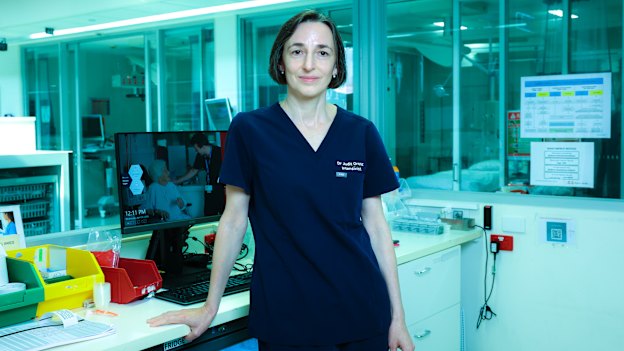
Dr Judit Orosz, The Alfred’s intensive care deputy director, who had been involved in a handful ECMO retrieval flights from Darwin, agreed it might be worth a shot.
The Alfred’s retrieval team arrived in Darwin at midday the next day. Doctors performed further damage-control surgery to keep Reyes alive long enough to endure the 3000-kilometre flight.
The next morning, tethered to machines, he was loaded onto a plane as fellow marines provided a guard of honour on the Darwin runway.
Day Zero
The moment Reyes arrived at The Alfred, Associate Professor Joseph Mathew and his trauma team rushed him into theatre. It was 5pm on August 29 and, for a team that soon had more than 100 members, it became Day Zero in the fight to bring Reyes back.
“He was the sickest patient in the state and possibly the country at that time,” Mathew said. “We identified new injuries, new concerns.”
As well as his missing left lung, surgical examination and CT scans revealed a shattered chest and pelvis, spinal fractures, a strained heart, and liver and kidney damage. Reyes’ leg was turning black from lack of blood flow. He had multi-organ dysfunction and his kidneys had failed. He had developed pneumonia and gangrene was spreading.
The greatest concern was his brain. Starved of oxygen for up to 48 hours, he had suffered multiple strokes. He was moved to intensive care, kept alive by ECMO and record-breaking doses of heart-boosting drugs, as well as a dialysis machine.
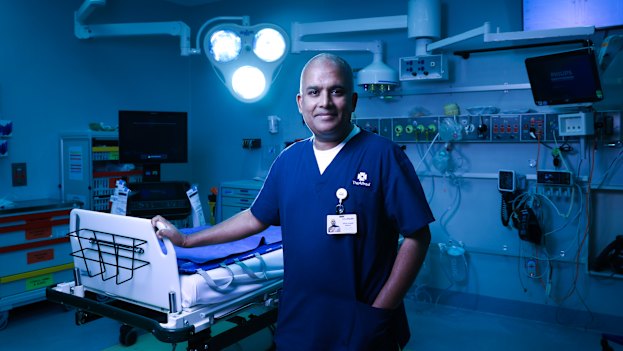
Mathew set up a bed in his office so he could be ready for any emergency 24/7. He wouldn’t go home for 22 days.
Pressure was also building elsewhere. Media were camped outside the hospital, and the medical team fielded phone calls from the highest levels of US defence.
Jasmine Policarpio arrived in Melbourne, along with Reyes’ parents, Joe and Karyn Reyes. They were glued to his bedside in the intensive care unit.
“There was direct communication with the [US] embassy, and all the way to the US defence secretary, and we realised that they needed updates every day,” Mathew said.
“Along with that, our Prime Minister’s Office also directed us, through the defence contact, wanting updates.”
A new threat then emerged from the red Melville Island soil: rare tropical fungi and bacteria. As Reyes grew sicker, it appeared the life-saving jungle surgery may now be killing him slowly.
Back in the operating theatre, doctors saw that the stump of Reyes’ removed lung was affected by deadly sepsis and toxic fluid. He became critically unstable during seven surgeries performed over the next 11 days.
For McCreary, the bitter twist was difficult to face.
“I was the last person to speak to him conscious, and the one who made him unconscious on purpose …
“It makes you constantly question yourself as a doctor – could I have done something differently?”
With pneumonia in his remaining lung, Reyes was too unstable for more surgery, so the specialists dusted off an old technique used on severe tuberculosis patients – essentially an open chest hole to constantly drain and flush them with saline and antibiotics.
Reyes’ sepsis eased.
“And that’s when, on the 10th or the 11th day, we noticed a little pimple on his face,” Mathew said. “We didn’t expect what happened next.”
Face-off
Perched at the top of Reyes’ bed since arriving in Melbourne on August 31, Policarpio held and stroked his face while speaking to him. She also noticed the pimple. On day 10, she was convinced it had changed.
“It was very swollen,” she said. “As soon as I pointed it out to the nurse, they biopsied and they took samples.
“That’s when my morale went down a little bit – it got very real very quick.”
Doctors made an incision and were shocked – a blanket of deadly black fungus was growing under the skin.
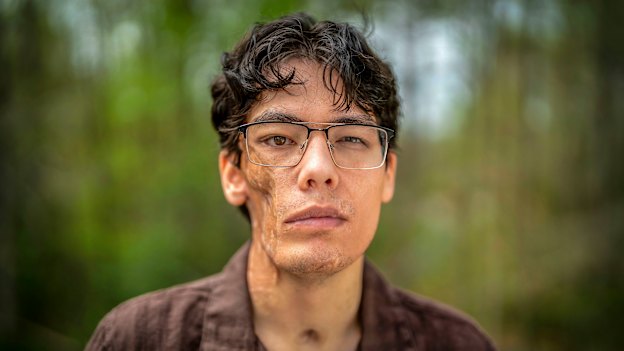
Rare mucormycosis and fusarium spores from the Melville Island soil were thriving in the warm, oxygen-free space, blocking blood flow as they spread, and robbing Reyes’ tissues of the oxygen they needed to survive. Bit by bit, his face was dying.
“Mucor” infections are rare – about .05 cases per million people in Australia – and even with treatment, kill in half of cases.
Plastic surgeon Associate Professor Scott Ferris and his team began debriding, or cutting away, Reyes’ face piece by dying piece.
“I’ve never had to cut anybody’s face off for an infection in my life,” Ferris said. “I’m not squeamish, obviously with this job, but I had to pause once or twice before proceeding, just to double-check myself.”
From September 8, Reyes underwent debriding surgery 11 times in a week, usually inside intensive care. Each time the hole grew as Ferris removed skin, then muscle, a salivary gland and facial nerves. By September 15, Ferris was removing the cheekbone, and, eventually, some of the lining of Reyes’ mouth.
The plastic surgeons would soon be removing Reyes’ jaw, raising the likelihood the deadly infection would get into his bones.
Tensions rose between the Australians and US officials. US military medics, desperate to repatriate the catastrophically injured marine – particularly someone from a deadly crash in a notorious aircraft – suggested a future full facial transplant if debridement continued. The Alfred team was unconvinced and sought guidance from Reyes’ family.
“That’s the moment where my heart … I really didn’t know what else to think,” Policarpio said.
“We’d only been married for seven months, and I’m over here signing papers on behalf of him.
“In that moment, I didn’t tell anybody, but I was very terrified because I did not know if what I was ultimately making the decision for was the right option.”
The family’s consensus was that Reyes would not want to wake without a face or the ability to care for himself. During an extraordinary meeting with yet more US experts, the push to endlessly remove Reyes’ parts was rejected. As a precaution, The Alfred obtained extraordinary liability coverage from the Victorian premier’s office against potential US lawsuits.
Thirty-two frantic hours
In a remarkable twist of fate, Reyes had landed at the only facility in the world trying to work out how to safely use hyperbaric medicine on patients with life support.
The oxygen-rich atmosphere in the huge steel chambers can supercharge healing, but the chambers are also highly volatile. Even wearing non-100 per cent cotton clothes causes static electricity, and previous patients overseas have burst into fatal flames.
But for the previous two years The Alfred’s biomedical engineers had gradually tested ECMO machines in their chamber – first establishing the steel parts did not crush like a can, then that those with brushed frictionless mechanics could avoid an explosion, and that flow rates through ECMO machinery’s circuit appeared strong enough to sustain a life. They were at least 18 months away from contemplating human trials, and fire safety was paramount. But the clock was ticking.
Hyperbaric services manager Dr Bridget Devaney heard Reyes had a non-survivable mucor infection, and that there was nothing more specialists could do, so she began to contemplate something “crazy”.
“It was a different situation now – he’s going to die, so there’s not really anything to lose…” Devaney said. “So I messaged the ICU director …
“I said, ‘I’ve heard that Travis is highly unlikely to survive, and this is probably a crazy idea, but should we think about putting a team together to explore whether we can get them in the chamber on ECMO? It’s going to be super-complicated, and I won’t talk about it with anyone else unless you come back to me.’
“I thought it was a very crazy idea, and I didn’t expect the response that I got. But, within two or three minutes, the whole ECMO team was in the hyperbaric unit.”
While scientific literature on hyperbaric treatment for mucor is scarce, The Alfred had successfully treated 10 immunosuppressed teenagers. That hope was enough to spark 32 frantic hours for hundreds of staff.
Mathew and Orosz informed Reyes’ wife and parents that he was dying and proposed the experimental treatment.
“I was just thinking, ‘Everything they’ve done so far has been for the best, it’s for his best interest.’ So I was very optimistic about the hyperbaric situation,” Policarpio said.
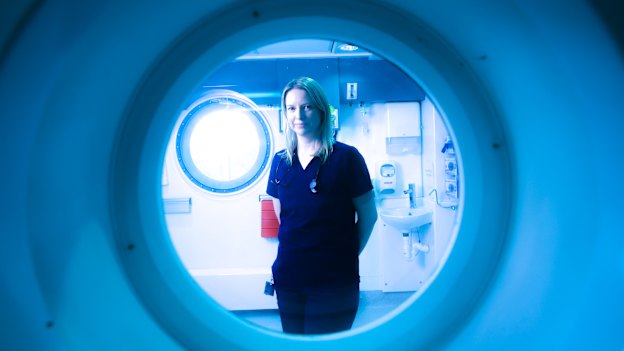
Hyperbaric and intensive care specialists worked around the clock to apply for ethics approval, and an emergency out-of-session ethics committee meeting was called. A clinical innovations committee also convened.
By 6pm on September 15, the procedure was signed off. Surgeons had one final attempt at debridement, but could do no more, so they wheeled Reyes into the hyperbaric chamber with mould still growing in his face.
“I very much felt compelled. We have to give it a go, right?” Devaney said. “It was very much experimental, no guarantees; we might harm him.
“It’s easy now, looking back – of course it was the right thing to do. But … we could have been all over the news for having killed someone by doing something that’s never been done.”
Under pressure
Each day, 16 specialists managed Reyes’ treatment, including three sealed inside the chamber with him and monitored through portholes. Exactly why the chamber worked remained a mystery, but the oxygen levels – which are five times higher than usual – likely saturated his tissues, jump-starting his immune system.
“By day four, you could no longer see mould on his face, and those medications that were needed to support his blood pressure were dramatically coming down,” Devaney said.
“And … they tapered off and the tissue began to look clean and healthy.”
The benefits were pronounced.
“It’s phenomenal. He got 13 treatments in 15 days,” she said. “All of a sudden, there was a small amount of hope.”
Mathew was also stunned: “He started waking up and they started lightening his sedation. He started obeying commands, responding to family, which is amazing to see,” he said.
Against all odds, the Australian medics had saved the marine.
The Alfred has used the experimental hyperbaric-ECMO long-shot that saved Reyes to save two more lives – including that of a two-year-old girl at Christmas.
Homeward bound
As Reyes needed fewer drugs to remain stable in a coma, a window opened for an airlift to the US. But, like almost all steps in his survival, it was another world first.
The Brooke Army Medical Centre in San Antonio was more than 14,000 kilometres away. No one as sick as Reyes had flown that far.
The US Defence Department dispatched a C-17 Globemaster, fitted as a 51-metre-long mobile ICU. The 38-strong US Institute of Surgical Research burn ICU team touched down at 6.30am on October 5.
Policarpio and Reyes’ parents, Joe and Karyn, also had to be ready to step aboard an airforce plane.
“I was fearful, but also very happy that he was in a spot where he could travel,” Policarpio said. “It’s just the fact that it was another military aircraft – the reason why we’re even in this situation is because he was on a military aircraft.
“… The hard part was saying goodbye to these people that did so much for him …”
With a curfew exemption at Melbourne Airport, Reyes was loaded at 1.30am the next day– this time, the Australian medical team provided a teary guard of honour as he departed.
There was more drama to come, though. While the flight was descending in Hawaii to refuel, the ECMO machine shut down. In an emergency move, US Air Force Captain Sarah Juhasz and Army Captain Matt Wood were strapped over Reyes to keep him alive while the plane landed. On the tarmac, the ECMO machine could not be restarted, so it was swapped for a back-up machine while the aircraft was still moving – creating another world first. Fortunately, the remaining 6000-kilometre leg was uneventful.
“We were all hands on deck for 18 hours. It was the longest flight in ECMO history,” Juhasz said. “The Australian team was fantastic. They provided such good care to our service member and we are very grateful for that.”
Waking up is hard to do
“I woke up and there were doctors around me,” Reyes said.
It was October 12, almost seven weeks after the crash. He tried to ask for his wife, but tubes in his throat prevented speech.
He had no idea what was going on or where he was. For 46 days, his brain had endured a version of the horror movie The Purge.
“I was in hell,” he said. “It felt like a year-long repeating of just getting tortured inside my own home …
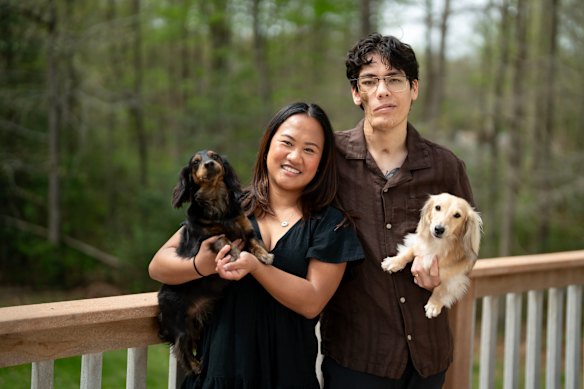
“There was a pause in the dream where I woke up, and I was in Australia, and I was in surgery, and that’s when they were working on my left leg. I thought these doctors were cutting my legs off and nobody said anything to me.
“I fell back to sleep, and I’m back in that dream, and then I wake back in Texas. It was just so confusing.”
It was another four weeks before Reyes learnt the whole story and that some of his mates hadn’t survived. It was longer yet before he saw a mirror.
“I couldn’t move my arms, my legs, and I’m in so much pain, and doctors and nurses are just coming in to work on me. I had no idea about the whole face and lung thing for a while. There was a suspicion … because I’d go to touch my face and everybody would go, ‘No, don’t touch your face’.”
Reyes had been bed-bound for three months and lost 40 kilograms. He began a love-hate relationship with physical therapists who forced him to stand, despite being on ECMO and dialysis.
It was seven months before he could take a step on his own, but his determination earned him the nickname “the One-Lung Warrior”.
To inspire others, he filmed his journey training and competing in archery, swimming, and track and field in the Warrior Games (staged by the US Defence Department for injured or ill service personnel and veterans) – even winning a bronze medal in powerlifting last July.
“It’s terrible, and I’m still going through it every day,” he said of the consequences of the air crash. “In the past two months it has gotten so much better, but … it’s still a challenge.
“I can barely fit the medical records on my computer. It’s 22,000 pages… But we’re still here, and we’re still kicking.
“It’s so crazy how many hands have literally touched me to keep me alive.”
Start the day with a summary of the day’s most important and interesting stories, analysis and insights. Sign up for our Morning Edition newsletter.
Disclaimer : This story is auto aggregated by a computer programme and has not been created or edited by DOWNTHENEWS. Publisher: www.smh.com.au