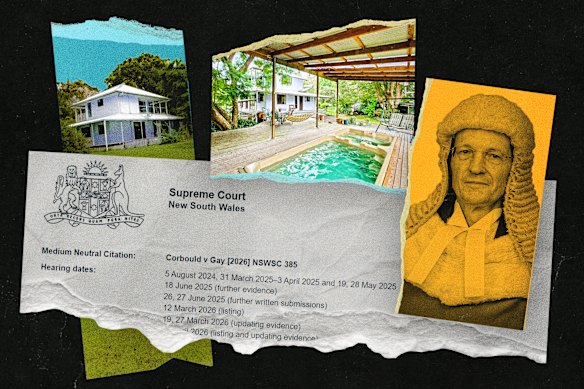

On the face of it, the fight over Andrew Young’s will is the very opposite of the type of estate battle that titillates Sydney. In this case, there are no eastern suburbs mansions up for grabs, no high-profile figures squabbling over tens of millions of dollars, and no top-tier legal firms slugging it out.
But what this NSW Supreme Court brawl lacks in glitz, it more than makes up for in grunge thanks to a cast of unsavoury central players, a suspicious deathbed will signing, the damning evidence of a forensic document examiner, and a judge grappling with what constitutes love, friendship and family in the modern social era.
The saga began in 2013, when Young first bumped into Micheal Gay at a Salvation Army-run rehab clinic, optimistically named Miracle Haven. Both men came to the Central Coast facility with serious baggage. Young, whose life was strangled by alcoholism, was there after stabbing a friend. Gay’s history of offending is even more serious: a NSW Police database shows at least 132 events next to his name, including drink-driving, stealing, fraud, drug offences, domestic violence, assaults, break and enters, and car theft.
Despite a 20-year age gap, the two struck up a close – but non-romantic – bond, and lived together in Young’s four-bedroom home in Morisset for more than eight years after leaving Miracle Haven.
Determining the extent and impact of the connection between Young and Gay formed a core part of the battle over the estate. The case, Justice Michael Meek said, gave rise to a “myriad” of questions for the law which challenge norms of what constitutes relationship, friendship and kinship.
Seeking to define the dynamic between the pair, Justice Meek at one point sought the counsel of British author CS Lewis via his classic The Four Loves, and Jane Austen through her novel Northanger Abbey. His honour even mulled over the recently coined term “situationship” as he weighed up the curious case before him.
On one side of the fight was Young’s six cousins who were the beneficiaries of a will he signed in 2010. On the other was Gay, who insisted his friend had signed a new will in Gosford Hospital just two days before the 68-year-old died of lung cancer in 2021.
Remarkably, Young had the rare distinction of dying on Christmas Day and being born on Christmas Day. Justice Meek noted that by design or pure happenchance, Young “gave delightful credence to his Christmas heritage, presenting with long hair and a bushy ‘Father Christmas’ beard”.
The new purported will gave everything to Gay – including the Morisset house worth $1.15 million. Young’s cousins were highly suspicious of what went down and launched legal proceedings.
Indeed, all was not as claimed and Gay’s version of events fell apart in court. For one, the two people who swore in an affidavit that they had witnessed the will signing in Gosford Hospital did no such thing. They weren’t there at all. The two people who lied were Gay’s son, Travis Borgas, and his former girlfriend, Kylie Phillips. Gay eventually admitted in court he knew they hadn’t witnessed the document.
It got worse. Melanie Holt, a forensic document examiner, gave evidence about Young’s signature on the rushed hospital will and found it was unlikely that he had actually signed it, noting among other problems that it contained too many loops.
“Ultimately, in all the circumstances I am not satisfied that the deceased signed the will,” Justice Meek concluded. He also said he was unpersuaded that Young knew and approved of the new will, meaning the original 2010 document stood, and his cousins would inherit the estate.
Ordinarily, such damning findings and the clear perjury committed by Gay would be the end of his case. But not this one. As part of the proceedings, Gay also lodged a family provision claim, which allows someone who thinks they’ve been left out of a will or not given a big enough slice to challenge it. These claims are often made by close family members, but in an era where “traditional” family relationships are harder to define as social norms change, the Supreme Court case provides an interesting perspective on how the legal system may consider this issue in the future.
Under the law, perjury does not necessarily end all prospect of a family provision order. Astonishingly, lawyers for Gay argued that, despite the earlier lies, he should still be given the whole house. His legal team claimed the connection between the pair was an extremely strong, close and dearly loving friendship in which Young regarded Gay as his “family”, or like a son or nephew.
Lawyers for Young’s cousins said otherwise – describing the two as more like basic friends and flatmates – and argued Gay did not deserve a cent.
A proponent of a family provision claim must meet a high bar to be eligible, and Justice Meek spent many hours contemplating whether Young and Gay had a genuine “close personal relationship” as required under the law. The job was made harder by what Justice Meek described as Gay’s “deplorable” conduct in lying about the hospital will signing.
But in assessing the evidence, Justice Meek eventually found Gay did qualify for a family provision claim. He said he was satisfied with various things in Gay’s favour, including that he had provided “domestic support and personal care” in the form of some cooking, washing and other household chores as Young became ill, and helped clean him up after he occasionally soiled himself. The court also found Gay gave Young emotional support by visiting him at the hospital and providing companionship during that difficult time.
Critically, Justice Meek also accepted that even though the pre-Christmas hospital will of 2021 was not signed by Young, he had told other people over previous years that he wanted the house to go to his friend upon his death.
After considering Gay’s age, financial circumstances, lack of earning capacity, health, contributions to the maintenance of the Morisset property, contributions to Young’s welfare, and other “future needs”, Justice Meek made two orders.
The first was that the estimated $160,000 to $173,000 value of Gay staying at the Morisset property between Young’s death until now should effectively be written off in his favour. The second was that Gay should also receive $350,000 from the estate once the house is sold.
That leaves $800,000 left for Young’s cousins, while Gay walks away with $350,000 cash.
The catch? Legal fees for both sides totalled $600,000 – more than half the value of the estate they were fighting over. Justice Meek said he was concerned about the size of the costs and ordered the parties to sort it out and be sensible.
“One can only sincerely hope that the case does not reflect a Pyrrhic victory to some extent for each of the contestants,” he concluded.
Start the day with a summary of the day’s most important and interesting stories, analysis and insights. Sign up for our Morning Edition newsletter.
 Bevan Shields is a senior writer, and former editor of The Sydney Morning Herald.Connect via email.
From our partners
Disclaimer : This story is auto aggregated by a computer programme and has not been created or edited by DOWNTHENEWS. Publisher: www.smh.com.au