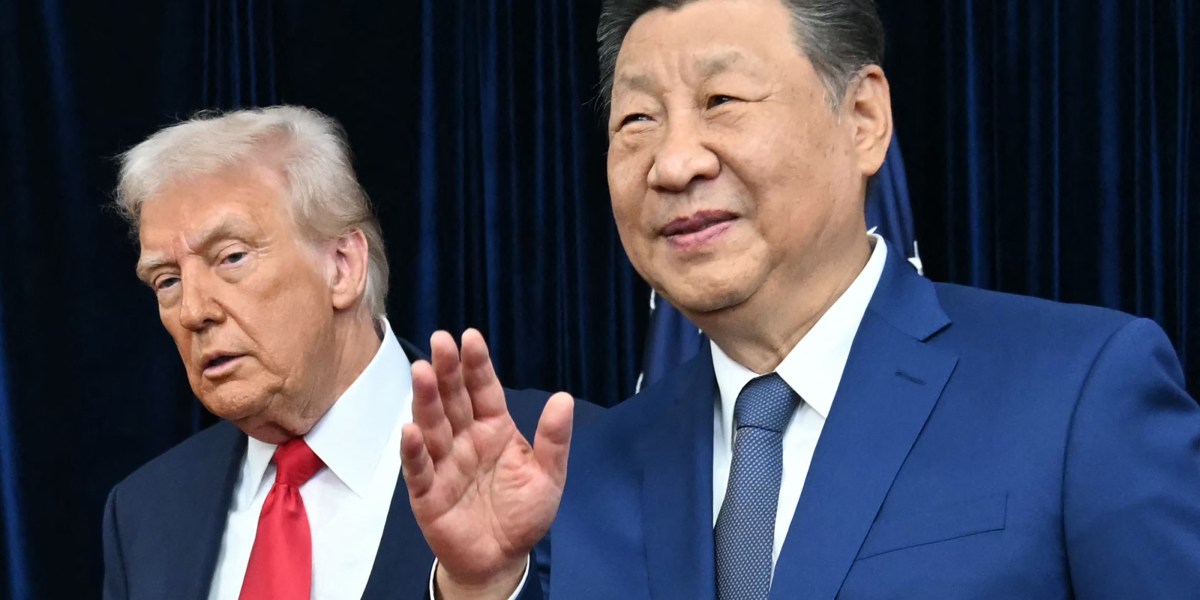
President Trump will meet Chairman Xi Jinping in Beijing on May 14–15. Xi Jinping has all the high cards, and he knows it. China made sure President Trump knows it, too.
On May 2, China’s Ministry of Commerce (MOFCOM) issued Announcement No. 21. The operative language is built on three unambiguous negatives that govern how Chinese parties must treat U.S. sanctions: “shall not recognize,” “shall not enforce,” and “shall not comply with.” Every Chinese citizen, company, and organization is directed to apply those three prohibitions to Trump’s Executive Order 13902 of January 10, 2020, and Executive Order 13846 of August 6, 2018, which sanction any individual or firm that trades with the Iranian regime. Invoking those orders, the U.S. Treasury on April 24 of this year designated five Chinese refiners for buying Iranian crude — Hengli Petrochemical (Dalian) and four smaller producers in Shandong and Hebei. With Announcement No. 21, Beijing has declared those sanctions unenforceable on Chinese soil.
Two things are noteworthy: what China did, and when it did it.
The choice of instrument is the first thing to understand — and it is unprecedented. China’s Ministry of Commerce promulgated the Rules on Counteracting Unjustified Extra-Territorial Application of Foreign Legislation on January 9, 2021. For more than five years, they went unused. With Announcement No. 21, Beijing has invoked the Rules for the first time to bring a case, effectively dusting off a long-dormant statute. Now that it has been activated, this prohibition is unlikely to remain a one-off tool.
Some might argue that the practical bite of Beijing’s recent move is small, that four of the five named refiners are small potatoes. But this is a move with teeth.
Until last weekend, Beijing’s statutes were a paper tiger. With the issuance of Announcement No. 21, that changed. The order activates, for the first time, a private right of action. Its implications are sweeping.
Here is the mechanism: if a U.S. or foreign bank, trader, insurer, or shipper were to cut off one of the five named refineries to comply with U.S. sanctions, the refinery could sue for damages in a Chinese court.
The second aspect of Beijing’s counterattack is its timing. The announcement was immediate and a deliberate prelude to the Beijing summit. The Chinese know exactly the hand they are holding — and exactly the hand the President is not. Announcement No. 21 is the “welcome mat” for Trump’s arrival. The message to the American delegation is unmistakable: the rules of the road are being rewritten, and they are being rewritten in Beijing.
The implications extend well beyond Beijing. China leads the BRICS, and the BRICS will follow Beijing’s template. For decades, Washington projected its sanctions architecture on the assumption that no major counterparty would counterattack with a reciprocal one. That assumption expired on May 2.
We have long argued that sanctions are cards played by losers. The historical record is unambiguous: sanctions rarely achieve their desired ends and often give rise to counterattacks. Announcement No. 21 is exactly that.
It is Beijing’s “welcome mat”—and its first shot. It will not be its last.
The opinions expressed in Fortune.com commentary pieces are solely the views of their authors and do not necessarily reflect the opinions and beliefs of Fortune.
Disclaimer : This story is auto aggregated by a computer programme and has not been created or edited by DOWNTHENEWS. Publisher: fortune.com