The Holocaust Museum LA, the first survivor-founded and oldest Holocaust museum in the United States, will reopen after a 10-month closure as part of the new Goldrich Cultural Center — a $70-million campus expansion set to debut June 14 in Pan Pacific Park.
Centrally located by the Grove LA and joining the ranks of nearby arts and culture destinations including Los Angeles County Museum of Art’s new David Geffen Galleries, the 70,000-square-foot center, which builds on the museum’s original 1960s mission of teaching about the Holocaust, doubles the museum’s original 35,000-square-foot footprint. It also broadens its focus on inclusion and community, with a diverse range of events and ramped-up educational offerings.
“The creative arts and education programming that will take place at the Goldrich will bring that vision from over six decades ago to a new level,” said Goldrich Chief Executive Beth Kean, adding that while the old museum brought in 75,000 visitors annually, including 30,000 students, the Goldrich expects 500,000 annual visitors, with 150,000 students.
“The goal of the Goldrich is to be an exciting intersection of hope and optimism in the heart of Los Angeles,” Kean said. “We want to make sure the Goldrich is synonymous with Holocaust education, fighting hate and telling these personal stories in a place as a beacon of hope, understanding and opportunity.” Opening day admission is free for all visitors, and always complimentary for students.
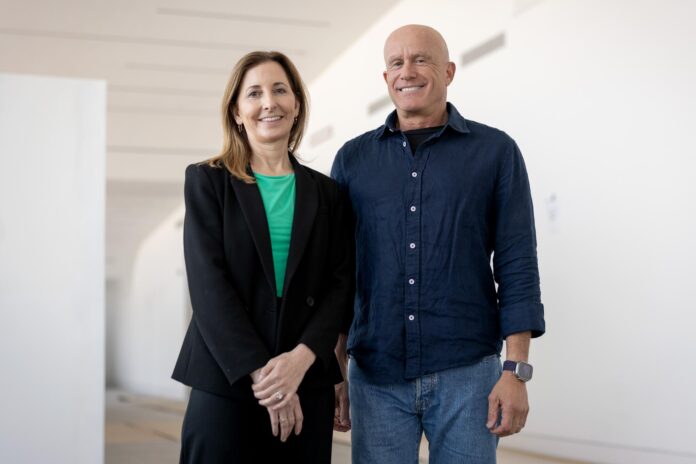
Beth Kean, left, CEO of the new Goldrich Cultural Center, stands with architect Hagy Belzberg. “The goal of the Goldrich is to be an exciting intersection of hope and optimism in the heart of Los Angeles,” Kean said.
(Eric Thayer / Los Angeles Times)
On a recent spring day, the sky bursting with blue, Kean and architect Hagy Belzberg gave a tour of the almost completed center. While the original museum is contained in a subterranean space built into the landscape of the park, the new light-filled campus is a swooping architectural feat that features three pavilions connected by an open canopy. The pavilions expand and contract, stretching along Grove Drive, with white fencing along the street, and space for school buses to drop off students.
The Goldrich is named in honor of the late Jona Goldrich, an L.A.-based Jewish Holocaust survivor, philanthropist, real estate developer and co-founder of Holocaust Museum LA.

The new $70-million Goldrich Cultural Center contains a central atrium that branches off to multiple paths through campus.
(Eric Thayer / Los Angeles Times)
New features include an expansive exhibition gallery space and a 200-seat theater for lectures, film screenings and live performances. There is also a rooftop garden with views of the Hollywood sign, a reflective garden, classroom spaces for educational programs, an open-air performance plaza and a pavilion housing a Holocaust-era boxcar.
The evolution of the center dates to the late 1950s when a group of Jewish Holocaust survivors met while taking an adult English class at Hollywood High School. They founded Holocaust Museum LA in 1961 to display their artifacts and tell their stories. In a 1967 document that inspired the Goldrich, the museum’s founders emphasize its purpose as “a memorial to all victims of Nazi atrocities, with emphasis on 6 million Jews” who were targeted and murdered in the Holocaust.
The founders, said Kean, wanted to ensure “that the atrocities of the Holocaust against minorities, LGBTQ people, political dissidents, people of color and Jews would always serve as a lesson to all to fight hatred and inspire positive action.”
The museum was originally located at a local hub for Jewish community members on Vermont Avenue, before moving to several different locations. In 2010 it opened its permanent Pan Pacific Park home, also designed by Belzberg.
On this day, the museum displays a variety of historic front pages published by The Times, blaring gritty and chilling headlines, including 1933’s “Jews given assurance: German violence subsiding,” and in 1942, “Nazis wiping out Jews in cold blood.” The structure brings visitors below ground, from lightness to darkness, with sounds slowly dissipating.

Newspaper from the 1940s on display at the Holocaust Museum LA at the new Goldrich Cultural Center, which opens June 14.
(Eric Thayer / Los Angeles Times)
“In the first gallery in the museum, we talk about thriving Jewish life that existed before the Holocaust,” Kean said. “Jews lived in Europe, Northern Africa, the Middle East for thousands of years. It’s important to share that history and for people to understand that Jews come from all these places, and there are Jews of different colors. There’s Ashkenazi Jews, Mizrahi Jews, Sephardic Jews, Ethiopian Jews, and more. Antisemitism is the oldest form of hate, and it didn’t start or end with the Holocaust. It morphs over time.”
The Goldrich will open with a museum exhibition titled “Meet Your Neighbor,” amplifying diverse L.A. communities and featuring stories of Angelenos and their ancestors who resettled, immigrated or sought refuge from persecution and violence. Visitors can interact with the exhibition by looking through peepholes to find photographs that tell a story.
“As you go through each exhibit in the museum, you step a bit deeper into the ground,” said Belzberg. “When you go to the more difficult part, about the concentration camps, there is no natural light, and you’re at the lowest, most compressed, point.”
The Goldrich, added Kean, shifts the landscape from darkness to light.

The new Goldrich Cultural Center shifts the landscape of Holocaust Museum LA from darkness to light.
(Eric Thayer / Los Angeles Times)
Visitors entering the complex arrive at an open plaza where they can choose to walk down to the existing museum, or explore the above-ground pavilions. The Goldrich’s sprawling white central canopy serves as a meeting place, and an entry and exit point, to other buildings in the complex. The canopy also curves to the shape of Pan Pacific Park’s outdoor amphitheater next to the Goldrich.
“The canopy is meant to be a welcoming element, with no walls, so that all are welcome, and all feel safe,” said Belzberg, who founded Belzberg Architects in 1997. “This is a safe place to come and have a conversation.”
Walking through the new complex’s above-ground main exhibition gallery space, which stretches as a bridge over a storm water basin in Pan Pacific Park, Belzberg points out how the space, with its curved windows and exposed trusses, ebbs and flows.

Construction of the new $70-million Goldrich Cultural Center is ongoing. The 70,000-square-foot new space, which includes the Holocaust Museum LA, will open June 14 in Pan Pacific Park.
(Eric Thayer / Los Angeles Times)
Excitement extends beyond the architecture to what Kean describes as a “truly groundbreaking” debut exhibit.
Titled “The Beautiful Game: The Untold Story,” and timed to the 2026 FIFA World Cup’s arrival in L.A., the exhibit will explore the origin story of soccer in the U.S. — before, during and after World War II — and how it intersects with Jews and the Holocaust. It will feature the stories of six talented soccer players, including Max Wozniak, a Holocaust survivor who helped develop the American Youth Soccer Organization. The exhibit will include rare artifacts from 12 different countries, said Kean, plus immersive media, original photos and more.
“Many Holocaust survivors in our community talk about playing soccer as a kid, and they also talk about how when they were in the camps, playing soccer was a way to forget the pain and hunger,” said Kean.

Construction continues at the Goldrich Cultural Center in Pan Pacific Park. The new center will feature a theater and classrooms for educational programming.
(Eric Thayer / Los Angeles Times)
Education is key to the Goldrich, and two classrooms next to the gallery can be combined into one, and can also serve as safe rooms in the event of emergency, said Belzberg. The Goldrich’s main entrance includes metal detectors for added security.
Learning will also take place in a new 60-seat theater featuring the USC Shoah Foundation’s Dimensions in Testimony technology. This enables visitors to ask questions that prompt real-time responses from pre-recorded video interviews with Holocaust survivors and other witnesses to genocide. The theater’s debut exhibition will feature 102-year-old Holocaust survivor Renée Firestone.
Nearby, a new black box theater with high curved ceilings and 200 seats is meant to have a soft look.
“Everything is an attempt to be a bit more inviting,” said Belzberg.
The decision to build the Goldrich came in 2019. Anti-Jewish bigotry was on the rise, Kean said, and the museum was concerned that space restraints, and the deaths of aging survivors, would make it harder and harder to continue telling these important stories. “After every board meeting, Jona Goldrich would pound his fists on the table and say, ‘I’m fighting against never forgetting!’ and it was important for him to teach younger generations about this history,” said Kean.

A memorial placard at the Holocaust Museum of LA, which is reopening on June 14 as part of the new Goldrich Cultural Center.
(Eric Thayer / Los Angeles Times)
Goldrich died in 2016, but Kean says that building the new center was only possible because Goldrich negotiated the land lease with the city to include parcels in the park beyond the footprint of the original Holocaust Museum LA building.
“He knew one day we were going to outgrow the space,” Kean said.
When she became Holocaust Museum LA’s chief executive in 2017, Kean realized that demand couldn’t be met within the confines of the existing museum, and also that 99% of visiting students were not Jewish.
“Most of them didn’t know anything about the Holocaust before they came here,” Kean said. “The idea of the Goldrich came in because we needed to create spaces that could bring in younger kids and students. We know that our programs change student behaviors. If they enter as bystanders, they leave as upstanders.”

The Boxcar Pavilion at the Goldrich Cultural Center houses a giant boxcar that was unearthed outside the Majdanek concentration and death camp in Poland, and is believed to have transported Jews to the camp during the Holocaust.
(Eric Thayer / Los Angeles Times)
Students will also have the opportunity to experience one of the Goldrich’s most powerful elements: its Boxcar Pavilion. The pavilion houses a giant boxcar that was unearthed outside the Majdanek concentration and death camp in Poland, and is believed to have transported Jews to the camp during the Holocaust.
There is a stillness upon entering the pavilion. The boxcar is in the center, on train tracks, and glass windows wrap the space.
“Seeing one up close just guts you,” Belzberg said. “We show you the artifact from all angles. When you leave, there’s a small reflection garden, with reclaimed logs from the Eaton and Palisades fires, where you can talk to a docent or a survivor, and your teacher. You pause.”
Being in the Pavilion is emotional for Kean, whose Jewish Polish grandmother survived the Holocaust, and a brutal cattle boxcar ride in 1945 from the Auschwitz death camp to the concentration camp Ravensbrück when she was just 16.
“Every time I walk in here, it affects me,” she said. “It’s a constant reminder. And there’s that juxtaposition of experiencing something here that’s very important, but life is also happening right outside.”
More to Read
Disclaimer : This story is auto aggregated by a computer programme and has not been created or edited by DOWNTHENEWS. Publisher: latimes.com