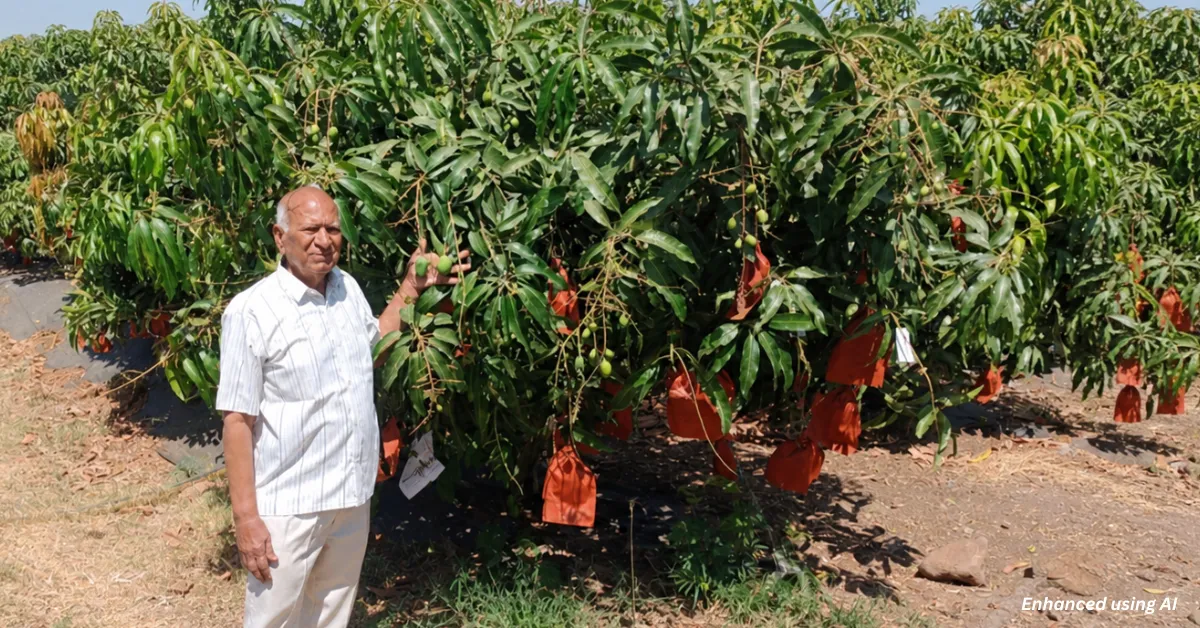
Pratap Gavaskar has been growing mangoes in Vengurla for most of his 65 years. He knows what Alphonso is supposed to look like, how it should smell, and when it should flower. And he’s watched, season after season, as something has gone quietly wrong.
“Having realised the limitations of Alphonso,” he says, “I have been looking out for an alternative.”
He isn’t alone. Across Maharashtra’s Konkan coast — the narrow strip of laterite soil and coastal air that produces some of India’s most prized mangoes — farmers who have grown Hapus for generations are quietly asking a question that would have seemed absurd a decade ago: Is there something better?
Gavaskar’s answer, for now, is 20 saplings of a variety called Sindhu, planted alongside his existing Alphonso trees. He’s hedging his bets. Most farmers here are doing the same.
Fifteen years in the making
Sindhu wasn’t bred in a hurry. Dr Ramchandra Gunjate and his team at Dr Balasaheb Sawant Konkan Krishi Vidyapeeth (DBSKKV) in Dapoli spent over 15 years developing it — crossing, testing, watching how the tree behaved across different seasons, different soils, different years.
“Developing a new variety is a long-term process,” Dr Gunjate says. “It takes about 12 to 15 years to release one variety, if you are lucky.”
That luck, in horticulture, has nothing to do with chance. It means the tree performs consistently. It means the fruit doesn’t taste like one thing in year three and something else in year seven. It means the yield holds up when the weather doesn’t.
Sindhu is technically a backcross — Ratna (itself a cross of Neelam and Alphonso) crossed again with Alphonso. The goal was to keep what people love about Hapus while quietly fixing what’s been quietly breaking it.
The most visible fix is the seed. An Alphonso seed weighs between 25 and 37 grams. Sindhu’s weighs around 6 grams — almost vestigial, more pip than stone. This is linked to parthenocarpy, a trait where the seed doesn’t fully develop. For anyone eating the mango, it means more fruit and less waste. For anyone selling it, it means more pulp per kilo.
What farmers are seeing on ground
Gavaskar slices open a Sindhu and holds it next to a Hapus. “If you mix Sindhu with Hapus, you cannot differentiate which is which,” he says. “Only a grower or a connoisseur can identify it.”
Near Shirdi, Satish Nene grows Sindhu almost entirely for himself and his family. “Not a single one of them reaches the market,” he says. “It’s very popular among family and friends.” He says it with the quiet pride of someone who has discovered something before the crowd.
Not everyone is impressed. In Devgad, farmer Mahesh Gokhale finds Sindhu tilted too far toward sweetness. “Sindhu is too sweet, and its keeping quality is not good,” he says. For him, Alphonso’s balance — that particular edge that stops it tipping into cloying — is exactly what Sindhu lacks.
/filters:format(webp)/english-betterindia/media/media_files/2026/05/04/featured-img-1-2026-05-04-18-18-25.png)
Kakasaheb Sawant, a nursery owner who has been selling Sindhu saplings for several years, puts the demand in perspective: around 200-plus saplings a year. “Buyers mostly grow it for home use,” he notes. It’s a market, but a modest one.
Three decades after its release, Sindhu is still a niche variety. Dr B R Salvi, a horticulturist who has watched Konkan orchards for years, estimates that roughly 90 percent of the region’s orchards are still Alphonso. Farmers, he says, don’t switch varieties the way they change phones. They wait. They watch neighbours. They let a decade pass before they trust something new enough to plant it at scale.
The numbers on the ground
Under good conditions, a Sindhu tree can yield between 80 and 150 kg. Each fruit weighs 200 to 300 grams. Those are solid numbers, but experts are careful about attaching too much weight to them — they reflect well-managed trees, not average ones.
What is genuinely different is the planting density. Alphonso needs space: around 40 trees to an acre. Sindhu can be planted at up to 100 per acre. That changes the maths considerably. More trees per acre, more fruit per acre — though also more irrigation, more labour, more inputs. It’s a trade, not a gift.
Sindhu also fruits earlier. Three to four years after planting, compared to the longer wait most traditional varieties demand. For a farmer who has just put in a new orchard, that matters.
What the weather is doing to Hapus
Ask almost any Alphonso grower in Konkan what the last five years have been like, and they reach for the same words: unpredictable, erratic, unseasonal. Cloud cover during flowering. Cold snaps at the wrong time. Rains that arrive early or don’t arrive when expected.
/filters:format(webp)/english-betterindia/media/media_files/2026/05/04/sindhu-mangoes-closeup-2026-05-04-17-57-07.jpg)
Alphonso is a finicky tree. It has a preferred rhythm for flowering, and when the weather breaks that rhythm, so does the harvest. The spongy tissue that some farmers have been reporting — a condition that ruins the fruit’s texture without warning — appears to be linked to these disruptions, though researchers are still mapping the exact cause.
Sindhu is being explored partly because it seems to handle some of these conditions better, or at least differently. But farmers and scientists alike are cautious about declaring it climate-resilient. “It’s too early to say anything definitive,” one farmer says. There are too many variables, and too few years of data.
A mango crossing state lines
Sindhu has travelled. Trials have been reported in Gujarat, Karnataka, Andhra Pradesh, Telangana, and Bihar. That it grows at all in these different climates says something about its adaptability. That it hasn’t yet taken hold in any of them at scale says something about how slowly mango cultivation changes.
The variety also interests food processors, because its high pulp-to-seed ratio makes it well-suited for juices and purees. Whether that industrial interest ever translates into farm-level demand is a separate question.
Even naming the mango has thrown up complications. At a mango festival in Raipur, a variety called Sindhri attracted objections because of its association with Pakistan — a reminder that fruit, like everything else, travels through politics as much as soil.
The road ahead
Gavaskar tends his 20 Sindhu saplings without ceremony. He didn’t plant them because he is convinced. He planted them because he is curious, and because the cost of curiosity is low when you’re already unsure about what the future of Alphonso looks like.
That is roughly where most of Konkan stands. The Hapus is still king — in the markets, in consumer imagination, in the orchards. Sindhu is the tree farmers are walking past slowly, pausing at, taking notes on. Maybe next season they plant five. Maybe ten years from now, a hundred.
/filters:format(webp)/english-betterindia/media/media_files/2026/05/04/sindhu-mangoes-2026-05-04-17-57-07.jpg)
Mango farmers in this part of the world have always played a long game. They have had to. The climate is now forcing that game to change faster than anyone expected, and Sindhu — thin-seeded, early-bearing, adaptable, sweet to the point of controversy — arrived at precisely the right moment to be noticed.
Whether it earns a permanent place in Konkan’s orchards, or stays the mango that families keep quietly to themselves, will depend on seasons nobody can yet predict. But in a region learning to hold its harvests a little more loosely, the fact that farmers are watching, planting, and staying open to something new is itself a kind of answer.
Disclaimer : This story is auto aggregated by a computer programme and has not been created or edited by DOWNTHENEWS. Publisher: thebetterindia.com