
Scrapping tax breaks on landlords and property investors may yet be softened by a surprise tax cut in next week’s budget, as Labor frames its broken promise on negative gearing as a virtuous one.
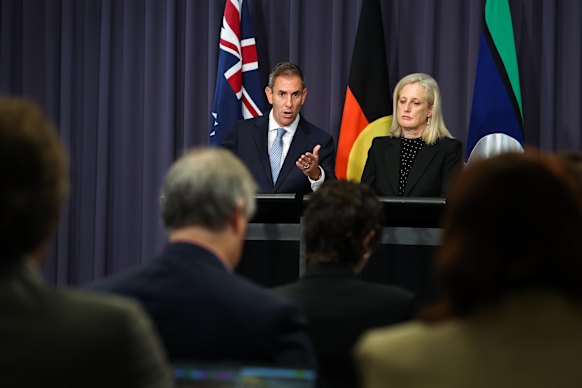
Treasurer Jim Chalmers gave no indication he was planning to cut income taxes when asked on Monday, instead saying “we’ve already got tax cuts coming”. He also cited a policy allowing a $1000 standard tax deduction.
“I’ve seen some speculation about tax cuts: I would just remind everyone that this is a government cutting taxes, cutting income taxes,” he said, referring to minor cuts sprung on the opposition before the last election that will come into effect in July.
However, Chalmers did not rule out further tax cuts, potentially to kick in next year. This masthead asked sources in cabinet and other parts of the government if the budget, due next Tuesday, would give workers a tax boost. Some of them referred to Chalmers’ comments, and others said they would prefer not to discuss the speculation. None ruled out the prospect, though.
Offering income tax cuts has for years been cited as a politically savvy method of selling tax reform that would include higher taxes in other areas.
Labor is preparing to re-adopt most of its failed 2019 tax agenda put forward by Bill Shorten, including paring back negative gearing and capital gains tax breaks, and potentially taxing family trusts more heavily, as it aims to create a bigger revenue base and convince voters to reject left- and right-wing economic populism. Labor will not pursue changes to franking credits, as then-opposition leader Shorten did.
Shorten, defeated by Scott Morrison in a fight over the breadth of his tax agenda, has argued for years that his mistake was failing to balance tax rises in certain areas with income tax reductions.
The two largest reforms of the tax system – by Paul Keating in the mid-1980s and John Howard at the turn of the century – included new imposts which were offset by deep cuts in income tax.
Prime Minister Anthony Albanese and Chalmers ruled out any changes to negative gearing before the election, though they did not offer the same guarantee for the tax on capital gains. Chalmers suggested a backdown would be justified, just as the government did when explaining its reversal on stage 3 tax cuts last term.
“You build trust by taking the right decisions for the right reasons,” Chalmers said on Monday. “I’ll refer you, for example, to the necessary and I think warranted steps that we took when it came to the stage 3 tax cuts. When we came to a different view, we explained why.”
Shadow treasurer Tim Wilson attacked Chalmers for pursuing a “full suite of family savings taxes”, paving the way for a traditional fight over taxation levels between Labor and the Coalition.
“Chutzpah is Jim Chalmers arguing he needs to betray Australians to be trusted,” Wilson said.
Weighing against the case for tax cuts is the need to take money out of the economy to tame inflation, which was above the Reserve Bank’s target range even before the war in Iran broke out. Chalmers and Finance Minister Katy Gallagher announced on Monday that Labor would bank windfall revenue upgrades, pitching the budget as “very responsible”. Labor has spent at near record levels, fuelling criticism that it has added to inflation.
But consumer confidence and purchasing power have been hit by higher fuel prices caused by the closure of the Strait of Hormuz, putting pressure on Labor to make life easier for households. Labor has already spent nearly $2.5 billion cutting the fuel excise.
“We’ve still got a fair bit of work to do this week,” Chalmers said.
Any change to negative gearing – the ability to offset a person’s taxable income with losses made on rental properties – would be in breach of a commitment made by Albanese in a debate against then opposition leader Peter Dutton last year.
Albanese declared that any change to negative gearing was “off the table” and the change would not help build more houses. At the time, Dutton said he did not believe Albanese’s comments.
Negative gearing changes are likely to be grandfathered and apply to new properties to encourage housing supply.
Productivity Commission chair Danielle Wood said last week it would make sense for Labor to pair changes to property taxation with income tax cuts.
“We would certainly … hope to see these types of changes reduce pressure on income tax over time,” she said on the ABC’s Insiders podcast.
When asked about new tax cuts, Chalmers only talked about Labor’s existing “top-up” tax cuts, which begin in July. They are modest, delivering just $5 a week to people earning more than $45,000 a year, and will cost the budget $3 billion in 2026-27.
The second cut that starts in mid-2027 is forecast to cost $6.7 billion, while the introduction of the $1000 standard deduction will cost the budget $1.2 billion.
Higher inflation is expected to force the Reserve Bank on Tuesday to inflict a third consecutive interest rate rise. Another increase will mean a cumulative rise in repayments on a $600,000 mortgage of almost $300 a month.
Financial markets put the chance of a rate rise at 75 per cent with at least one more increase expected by October.
HSBC Australia chief economist Paul Bloxham said Chalmers could take some pressure off the Reserve Bank through targeted spending cuts.
“A surgical approach with the fiscal scalpel … would reduce the need for the RBA’s governor [Michele] Bullock to have to deliver more blows with the sledgehammer,” he said.
The Reserve will release its own fresh forecasts on the economy after its interest rate announcement on Tuesday afternoon. Those are expected to confirm a slowdown caused by the Iran war.
ANZ commodity analysts Daniel Hynes and Soni Kumari warned that even if demand for oil started to ease and production began to recover in coming months, there would be a permanent loss of capacity that would weigh on the global market well into next year.
They said even the threat of a possible sudden closure of the Strait of Hormuz meant Brent crude could stay above $US90 a barrel for the rest of 2026.
“Even if the worst of the oil shock is over by late 2026, the underlying causes of the Middle East conflict are unlikely to go away. Iran has proven it can close the Strait of Hormuz and could do so again,” they said.
Cut through the noise of federal politics with news, views and expert analysis. Subscribers can sign up to our weekly Inside Politics newsletter.
 Paul Sakkal is Chief Political Correspondent. He previously covered Victorian politics and won a Walkley award and the 2025 Press Gallery Journalist of the Year. Contact him securely on Signal @paulsakkal.14.Connect via X or email.
 Shane Wright is a senior economics correspondent for The Sydney Morning Herald and The Age.Connect via X or email.
From our partners
Disclaimer : This story is auto aggregated by a computer programme and has not been created or edited by DOWNTHENEWS. Publisher: www.smh.com.au


