
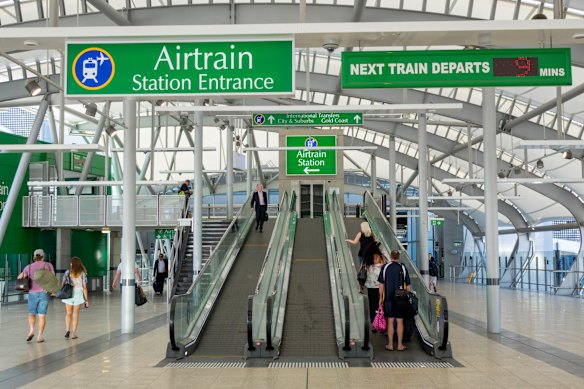

The deal that gives Airtrain exclusive public transport access to Brisbane Airport has entered its final decade, with transport advocates and airport operators warning it no longer meets the city’s needs.
Tuesday marks 10 years until the May 5, 2036, expiry of Airtrain’s 35-year exclusivity agreement to provide public transport services to the airport.
Under the terms of that contract, passengers using the train will continue to pay 4300 per cent more than commuters on other lines, who only have to pay 50¢ a journey – a one-way trip from Central to the airport on Airtrain costs $22.30.
Airport workers are not immune to the higher fares, although they do receive a discounted rate.
Brisbane Airport data shows only 5 per cent of passengers use the Airtrain, with 87 per cent arriving by car. Six per cent arrived by private bus or coach, with 2 per cent arriving by other means. More than 100,000 vehicles enter and exit the airport daily, according to the data.
Better Transport Queensland president Rowan Gray said public transport usage to and from Brisbane Airport was “pitiful”.
“For anyone in a group of three or more at least, it’s cheaper to catch a cab or an Uber into the city than it is to get an Airtrain,” he said.
Former transport minister Bart Mellish, now the Labor opposition’s spokesman for the portfolio, tried to extricate the Queensland government from the restrictive contract when he was in office.
Mellish said Airtrain’s owner, the UK-based Universities Superannuation Scheme, was “not emotional” about the asset and was open to negotiation.
“We just ran out of time, at the end of the day, before the election,” he said.
Mellish said the buyout price was more than the Labor government was prepared to pay, but the closer the contract’s end-date came, the cheaper it could be.
“The premier should stick to his word and actually follow through on what he said before the election he would do,” he said.
In a written statement to Brisbane Times, Airtrain chief executive Chris Basche gave no sign the company was open to an early exit.
“Airtrain … is unable to comment on its discussions with the state government on Olympic planning or other confidential matters,” he said.
Its parent company, USS, did not respond to detailed questions put to them last week. Likewise, a request for comment from Transport Minister Brent Mickelberg went unanswered.
The questions Transport Minister Brent Mickelberg would not answer
- Does the Crisafulli government support ending Airtrain’s exclusive contract before 2036?
- Have you or your department held any discussions or negotiations with Airtrain since the election about changing or exiting the contract? If so, when?
- Do you accept that current airport rail fares are incompatible with Brisbane’s 2032 Olympic visitor experience, and what action will you take to address that?
- Is a “fare-free” Games, inclusive of Airtrain, being considered?
- Has the government received advice on the cost of an early buyout, and can you say whether that cost is rising the longer action is delayed?
- If the monopoly remains in place until 2036, how will you prevent worsening congestion and forced car dependency at Brisbane Airport as passenger numbers surge toward 2032?
Instead, a Transport and Main Roads spokesman would only say the department was “working with Airtrain and broader stakeholders” on transport options to the airport.
Brisbane Airport head of planning Michael Jarvis said better public transport links were vital.
“Brisbane Airport knows the 25,000 workers who commute here every day, and the 25 million passengers who travel through the airport each year, need public transport that is more affordable, more frequent, and available at the times people travel,” he said.
“Brisbane Airport will continue to advocate for better public transport connections to one of the city’s most critical jobs and transport precincts. This includes making Airtrain more affordable, more frequent, and operating for more hours each day, in addition to connecting busways to the airport.”
Brisbane Airport’s draft 2026 master plan included a busway corridor that would allow Brisbane Metro services to the terminals – something prohibited under the terms of the Airtrain agreement.
Gray said that contractual lock-out of public bus services was a bigger issue than Airtrain’s pricing.
“You can’t get a bus over the Gateway Bridge from the Redlands region, or the south-east portion of Brisbane City Council, to get to the airport via public transport,” he said.
“You have to catch a train all the way into the city and back out again, which just isn’t really convenient at all.”
Mellish said if the government would or could not buy out the contract, it should reinstate – and make permanent – Labor’s 50 per cent subsidy, which was in place for six months.
“We budgeted around $10 million – in the scheme of things, $20 million a year – to halve the prices to the airport. If the government is not willing to negotiate on the overall contract, why not keep that for 10 years?” he said.
Extrapolating those figures would suggest Airtrain stands to pocket $400 million over the final 10 years of the contract.
The 8.5-kilometre train line was completed in 2001 for about $200 million (about $380 million in today’s money) and, in return for building the infrastructure, Airtrain was promised 35 years’ worth of fares.
Brisbane Airport projected passenger numbers and employment would both double by 2046, to 52 million passengers and 50,000 jobs.
Start the day with a summary of the day’s most important and interesting stories, analysis and insights. Sign up for our Morning Edition newsletter.
From our partners
Disclaimer : This story is auto aggregated by a computer programme and has not been created or edited by DOWNTHENEWS. Publisher: www.smh.com.au







