
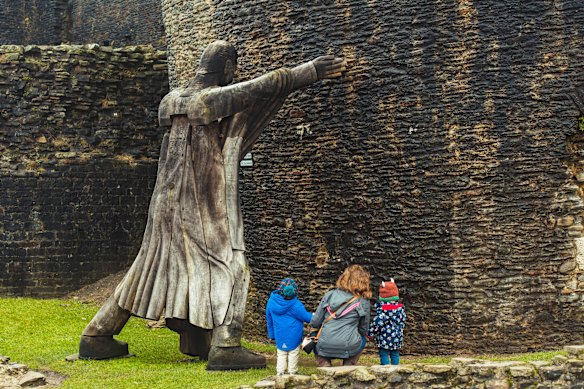

For all the tourists who wanted a cheesy photo of themselves holding up the leaning tower, there’s some bad news: John Crichton-Stuart, the 4th Marquess of Bute, has beaten you to it. Well, at least his statue has.
The wooden figure gamely trying to hold up the tower is not in Pisa, however – it’s in Caerphilly, South Wales, about 15 minutes by car from Cardiff. Caerphilly Castle is the largest by footprint of all the Welsh castles, something Wales doesn’t exactly have a shortage of, and the second largest in the UK after Windsor Castle.
It also has a tower that leans more precariously than its better-known Tuscan rival. The Leaning Tower of Pisa does so at a four-degree angle. The South-East Tower at Caerphilly Castle lurches at roughly 10 degrees. There are other significant differences. Caerphilly’s tower is older (late 13th century versus Pisa’s late 14th), shorter (15 metres versus 56 metres) and in considerably worse condition.
The South-East Tower at Caerphilly Castle is a ruin, with its back end long gone. Grasses, weeds and other assorted vegetation are making game efforts to reclaim the tower, while what remains is held together by two metal pins. It resembles an abandoned folly more than an integral part of a hulking fortress.
Alas, when Crichton-Stuart – he of wooden statue fame and a noted architectural restorationist – had the rest of the castle restored, between 1928 and 1939, he decided the tower should be left untouched. And so it stands, jutting out like a wonky tooth. Elsewhere, the castle looks in a considerably better state, and even more so following a £10 million ($18.8 million) makeover that culminated in the Great Hall’s reopening in July 2025.
Sign up for the Traveller Deals newsletter
Get exclusive travel deals delivered straight to your inbox. Sign up now.
If anything, the Great Hall now looks rather too modern. Information labels come with QR codes, the long dining tables are topped with more information about who would be sitting where and animations telling the history of the castle play out across faux tapestries on the walls.
Construction started in 1268 under the orders of Gilbert de Clare, Lord of Glamorgan, Earl of Gloucester and intermittent ally of Prince Edward – who would become King Edward I four years later. The castle was designed to keep the Welsh out – notably Welsh prince Llywelyn ap Gruffudd who had built a snowballing power base to the north. Somewhat predictably, Llywelyn attacked in 1270 while the castle was still under construction.
The ridiculously complicated story of interweaving marriages, tussles for power, sieges and King Edward II hiding away from his estranged wife’s army continues with more dramatic projections on the route through the castle.
Those whose minds are broken trying to remember which lord is which and who married who can stick to the safer ground of the castle design. A 3D model shows the layers of defences and the lake-like moat, while wooden swords can be pulled upwards to unveil panels explaining the purpose of each design feature.
Alamy
The presentation is made as child-friendly as possible. Animated versions of the castle’s inhabitants tell of what life was like, while costumes can be tried on and nosily pushing buttons reveals titbit after titbit. There are even two giant model dragons in the old storehouse, where an audio commentary tells how the red one became the symbol of Wales.
Aside from the statue pretending to hold it up, the leaning tower is left relatively gimmick-free. No projections tell its story, and that’s probably because no one’s quite sure what its story is. The more exciting take on why it leans is that it was damaged during the English Civil War of the 17th century, but there’s no documentation from the time that either supports or disproves the theory. The lean could just as easily have been caused by the boring option, subsidence.
In a giant castle that attempts to bring sieges, complex alliances and enmities to life, the leaning tower of Caerphilly is an awkward oddity. It tells no tales and fits no theme. It just – unconvincingly – stands there.
THE DETAILS
Visit
Caerphilly Castle is managed by Cadw, the Welsh Government’s heritage arm. See cadw.gov.wales
Visit
The nearest international airport with one stop flights from Australia is Birmingham, a two-hour, 40-minute drive away. Emirates flies from Sydney and Melbourne via Dubai. See emirates.com
Stay
The grand Parkgate Hotel in Cardiff, inside the Welsh capital’s former County Court and Head Post Office, has doubles from £119 a night. See theparkgate.wales
 David Whitley is a writer based in Sheffield, England, who has made it his mission to cover as much of Australia as possible. He has a taste for unusual experiences and oddities with a great story behind them. As far as David’s concerned, happiness is nosily ambling around a history-packed city or driving punishing distances through the middle of nowhere on a big road trip. He is also probably the only person to have been to Liechtenstein and the Cook Islands in the same week.
From our partners
Disclaimer : This story is auto aggregated by a computer programme and has not been created or edited by DOWNTHENEWS. Publisher: www.smh.com.au


