
In Wollongong, it was council planners trading developer approvals for cash, sex and luxury handbags. Closer to home in Melbourne’s sprawling City of Casey, there were allegations of cash drops in brown paper bags in suburban Subway outlets and political schmoozing at soirees in Chinatown’s Flower Drum restaurant.
In both instances, authorities allege money was spent to buy outcomes. In NSW, following the sensational Operation Atlas corruption probe which saw the entire Wollongong council sacked, the state banned donations by property developers to politicians and local councillors in 2009 – within a year of the allegations being aired.
But in Victoria, eight years after the anti-corruption watchdog launched an inquiry into Casey council and almost three years after its damning Operation Sandon report on the scandal, there has been no wholesale crackdown on developer donations in local government.
In December, the Allan government had a clear chance to end the integrity headaches plaguing Victorian councils through its new planning bill, where it had the opportunity to cap or ban donations from developers to councillors.
Instead, the government ignored two formal levels of expert advice and explicitly refused to stem the flow of developer money.
There are still those pushing for change. The state’s anti-corruption watchdog, IBAC, says there is more work to do and its former commissioner, Robert Redlich, KC, says the state has not done enough to prevent the next corruption scandal.
Councillors who operate within the rules are saddled with so many potential conflicts of interest they are repeatedly required to recuse themselves from important votes.
And it seems everyone – including some incumbent City of Melbourne councillors – agrees the current settings are far from best-practice governance. Lord Mayor Nick Reece moved a motion last year to call on the state government to consider reforms, which was supported by the council.
“I am on the record multiple times advocating for donation reform in local government and improvements to the City of Melbourne Act,” he said. “I am hopeful we will see new rules in place for the next local government elections.”
But as it stands, when it comes to big-developer money in local councils – it’s business as usual.
A squibbed opportunity for reform
Reece and his “Team Nick” group of councillors raised $950,484 for the 2024 City of Melbourne election campaign.
This was three times the amount his predecessor Sally Capp raised for her final campaign. Team Reece donations were forthcoming from a who’s who of Melbourne, including wealthy business people, trade unions and people who own large amounts of property in the City of Melbourne.
Reece and his team were able to do this entirely within the existing rules, and there is no suggestion of impropriety on the part of the candidates or donors. Indeed, Reece went further than the law required him to by seeking to limit donations from property developers, which in some other states would be disallowed entirely.
Many other candidates made no such attempts. “Team Kouta”, fronted by former AFL star Anthony Koutoufides, received $325,280 from property developer Intaj Khan, who was running alongside the footballer for the position of deputy mayor. That accounted for almost 70 per cent of donations to Koutoufides’ failed mayoral tilt.
Khan’s contribution would be impossible in South Australia, NSW and, until recently, Queensland, but was entirely legal under Victorian law.
The state is now a stark outlier in Australian integrity standards.
In NSW and Queensland, individual donations are capped at $3900 and $7200 respectively. In NSW and the ACT, developer donations are entirely banned. Queensland had also outlawed developer donations, but the Crisafulli LNP government recently overturned the ban.
In these jurisdictions, a property developer is broadly defined as an individual or corporation engaged in a business that regularly makes “relevant planning applications” for residential or commercial development with the ultimate goal of profit.
To prevent developers from using family members or satellite companies to funnel money, these jurisdictions use a “close associate” rule. This effectively broadens the ban to include the developer’s directors, officers, and their spouses.
South Australia has moved even further at a state level, implementing a world-first blanket ban on almost all political donations to candidates, parties and sitting MPs, although that prohibition does not yet extend to local councils. Still, for local elections in SA, individual donations to local candidates are capped at $5000 per year, with any gift over $2500 requiring real-time public disclosure within five days.
This is far from the case in Victoria.
Here, while a $4970 limit has existed for state government elections (at least until the High Court recently upended the state’s electoral funding laws), council-level donations – where the vast majority of planning decisions are made – remain entirely unlimited.
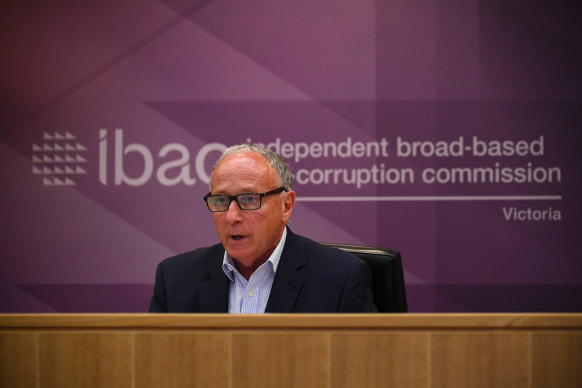
Redlich, the former IBAC commissioner who led the Operation Sandon investigation, told The Age the government’s refusal to match state-level caps at the local level was inexplicable.
“There really hasn’t been a satisfactory explanation by government for why, in the case of councils, caps are not necessary,” said Redlich, who now sits on the board of non-partisan integrity advocacy group the Accountability Round Table.
“There are even more compelling reasons why caps should exist at local government level as unlike MPs at state level, councillors are not only influencers, they are the decision-makers to whom the donor has direct access.”
Operation Sandon, the longest-running corruption probe in the state’s history into the Casey scandal, was supposed to be the catalyst for change.
In 2022, the corruption watchdog recommended local government donations be capped and to match the state level limits. A year later, its Operation Sandon report went further, calling for serious consideration of a total ban on donations from “high-risk groups” including property developers – repeating a call from former Victorian Ombudsman Deborah Glass in 2015.
The then-Daniel Andrews led government referred IBAC’s 2022 recommendations to an expert panel. That panel suggested a ban might be unnecessary – provided political finance laws were “sufficiently robust” and included a cap.
In October, the Allan government promised its new planning bill would finally address the recommendations from the Sandon report.
However, the bill that passed in December includes neither a ban nor a cap. It merely includes a new disclosure requirement– which critics say was rushed, clunky and fails to seriously mitigate the risk of corruption.
Currently, council candidates must disclose donations greater than $500 within 40 days of an election. The new law adds a separate rule: when a developer submits a planning application, they must disclose gifts to councillors or staff and that document becomes included in public council papers – effectively spreading the onus to disclose to developers.
However, the new rule includes a strange mismatch. While councillors need to declare anything over $500, developers only need to disclose over $1240.
Sarah Mansfield, a former Geelong councillor and now Greens MP, said tweaks like this were a “mess” resulting from a failure of government departments to collaborate.
“I strongly suspect we will be revisiting this issue soon,” she said. “[They] add to confusion and further inconsistency, which are really the perfect circumstances for corruption to occur in”.
The peak body for local councils, the Municipal Association of Victoria, has repeatedly pointed out that the government’s reforms failed to properly address the Sandon recommendations. MAV president Jennifer Anderson said the association was not consulted on the amendments, and had called unsuccessfully for sections to be rewritten before the bill was passed.
Local councils themselves are desperate for a tightening of donation laws; since 2021 the MAV has consistently called for a cap on all council-level donations and a total ban on donations from the property and gambling industries.
Even the usually tight-lipped IBAC told The Age that flaws remain in the regulation of local government donations in Victoria.
A spokesperson said the watchdog maintained the stance outlined in its 2022 special report that the cap that applies to donations at the state government level should also apply at the local government level.
“IBAC acknowledges the progress in the proposed Planning Amendment (Better Decisions Made Faster) Bill 2025, however considers there is more work to do to reduce the corruption risks surrounding donations and lobbying in Victoria,” they said.
Could a Casey-like scandal happen again today?
A Victorian government spokesperson defended the new legislation, stating the Allan government is “strengthening transparency and integrity”, and claimed it was acting on Operation Sandon recommendations by “making the disclosure of gifts and donations mandatory” – referencing the new disclosure rule for developers.
But other key recommendations from Sandon and the subsequent expert panel remain on the shelf.
The spokesperson said the government was considering the expert panel’s advice – which was received by the Premier more than two and a half years ago. In April, the government maintained it would respond “in due course”.
Local governance expert Rhys Thomas is sceptical: “None of these recommendations have been acted on, and there seems to be no momentum to do so.
“I am of the view that the lack of attention to local government electoral donations reflects the state government’s view that there should be a ‘light touch’ to regulation of the sector and councils should be in control of their own destiny,” Thomas said.
Redlich said without either a ban on developers at a minimum or even a cap, nothing had meaningfully changed since he oversaw the Casey investigation.
“In the end, neither of the recommendations have been adopted, and we’re in exactly the same position as we were at the time that the events in Sandon occurred,” he said.
The retired KC was blunt about the danger of history repeating itself. When asked if another Casey scandal could happen today, he replied: “Well, I don’t see why not”.
The wheels of integrity turn painfully slow elsewhere; it was only in September that IBAC pressed charges against two people in the Casey saga — former mayor Sam Aziz and developer John Woodman. The first court hearing for the pair was held earlier this year — 15 years after issues at Casey were first publicly raised by The Age in 2011 and again in 2018. Their case was adjourned in the Magistrates’ Court last week again until June 25.

If found guilty, Aziz could face significantly more potential jail time than Woodman. While both are charged with indictable offences carrying 10-year maximum terms, Aziz faces five separate counts, including misconduct in public office and secret commissions. Woodman is facing a single charge for allegedly giving a secret commission to show favour toward his company, Watsons Pty Ltd.
Even the strictest laws may not prevent a repeat of the Casey events. Notably, the donations and political spending attributed to Woodman was never disclosed. Operation Sandon highlighted that while councillors are required to declare conflicts, numerous representatives failed to do so over many years.
Redlich said tighter rules and an active watchdog would put councillors and council staff on high alert for corruption in their ranks. He warns as time moves on from the Sandon investigation, and without stronger laws, any short-term “enthusiasm and discipline” regarding integrity will eventually dissipate.
Last year this masthead revealed a private company run by a property developer donated more than $35,000 to candidates for the Mornington Peninsula Shire Council. This included two elected councillors and others who had publicly vowed not to accept developer money.
In the City of Melbourne, Reece’s conflicts remain under scrutiny. Nevertheless, he has committed to advocating for a change to the laws that benefited his campaign. Last June, he wrote to former local government minister Nick Staikos asking for a review of the act. Staikos was recently replaced by Paul Hamer.
“I support reform of campaign finance arrangements for local government,” Reece said.
In a statement from the former minister’s office in late March, a spokesperson made no commitment but said there was “time to consider” Reece’s proposal ahead of the 2028 local government elections.
Redlich said beyond actual integrity concerns, public confidence in councils was diminished without stronger guard rails. He argued that even if a councillor remains impartial and no corruption exists, the lack of a donation cap and real-time reporting creates a “public perception” that favours were bought.
Start the day with a summary of the day’s most important and interesting stories, analysis and insights. Sign up for our Morning Edition newsletter.
Disclaimer : This story is auto aggregated by a computer programme and has not been created or edited by DOWNTHENEWS. Publisher: www.smh.com.au