
Washington: Iran fired missiles at civilian targets in the United Arab Emirates and appeared to strike ships in the Strait of Hormuz as tensions reignited in the Middle East and the price of oil shot up another 5 per cent.
Iran’s renewed aggression came on the first day of US President Donald Trump’s so-called “Project Freedom” to encourage vessels to risk transiting the log-jammed strait by offering a form of military protection, with Trump now calling on Indo-Pacific allies for help.
The US responded in kind, sinking seven Iranian “small boats”, Trump said, and threatening further strikes.
It represents the greatest challenge so far to a four-week-old ceasefire between the US, Israel and Iran that has constrained fighting but failed to lead to a peace agreement or sustained negotiations between the parties.
The UAE said it condemned the “dangerous escalation” from Iran in the strongest possible terms, and reserved its rights to respond. Three Indian nationals were injured in the drone and missile attacks, the UAE’s Ministry of Foreign Affairs said.
An “advanced fire” broke out in the petroleum industrial area of Fujairah following an Iranian drone attack, the Fujairah Media Office said. Bloomberg reported the facility struck was a VTTI oil terminal partly owned by IFM Investors, the Australian investment house.
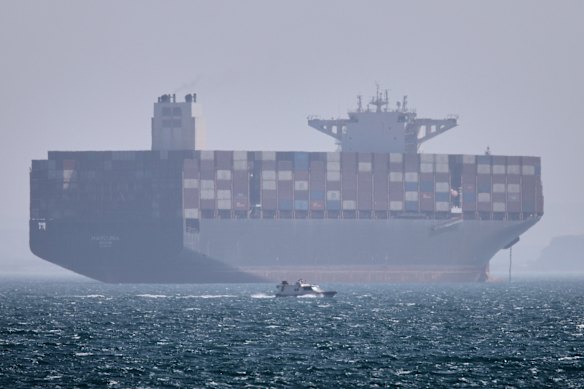
Meanwhile, there was an explosion and fire on board a cargo vessel operated by South Korean liner HMM in the Strait of Hormuz, the South Korean foreign ministry said.
Trump appeared to confirm the incident was related to an Iranian attack as he called on Seoul to assist in the military mission to guide ships through the waterway.
“Iran has taken some shots at unrelated Nations with respect to the Ship Movement, PROJECT FREEDOM, including a South Korean Cargo Ship,” he posted on social media.
“Perhaps it’s time for South Korea to come and join the mission! We’ve shot down seven small Boats or, as they like to call them, ‘fast’ Boats. It’s all they have left. Other than the South Korean Ship, there has been, at this moment, no damage going through the Strait.”
Trump announced the initiative on the weekend, saying the US Navy would guide ships safely out of the strait. Many have lingered in the Persian Gulf for two months since the war’s outbreak and are running low on food.
The US president said the exercise was a humanitarian gesture and anyone who interfered would “have to be dealt with forcefully”.
He later told Fox News that if Iran attacked American vessels involved in the exercise, “they’ll be blown off the face of the earth”.
As part of Project Freedom, American guided-missile destroyers have moved through the strait into the Persian Gulf, although it is not believed they are providing a physical escort for ships wishing to exit the Gulf.
US Central Command – the military division in the Middle East – said it had “reached out” to dozens of ships and shipping companies to encourage them to move through the strait. Two US-flagged merchant ships successfully transited the Strait of Hormuz as a first step, it said.
“The distinction, from my perspective, is crystal clear,” said Centcom commander Brad Cooper. “US forces are helping the international community in restoring the flow of global commerce, while the Islamic Revolutionary Guard Corps, on the other hand, is doing everything it can to terrorise and threaten global shipping”.
The promise of US Navy assistance failed to calm markets amid the renewed hostilities on Monday (US time), with the price of Brent crude climbing nearly 6 per cent to just below $US115 a barrel. In the US, the national average price of petrol rose above $US4.45 a gallon ($1.64 a litre).
Danny Citrinowicz, an Iran researcher at Israel’s Institute for National Security Studies, said that when faced with a choice between escalating or capitulating, Tehran would choose to escalate.
“Many of those shaping [US] policy regarding Iran still struggle to fully understand the nature of the adversary they are dealing with,” he said on X.
“Even now, renewed threats are unlikely to change Tehran’s behaviour. If anything, Iran’s actions today serve as further evidence of that reality.”
Get a note directly from our foreign correspondents on what’s making headlines around the world. Sign up for our weekly What in the World newsletter.
 Michael Koziol is the North America correspondent for The Age and Sydney Morning Herald. He is a former Sydney editor, Sun-Herald deputy editor and a federal political reporter in Canberra.Connect via X or email.
From our partners
Disclaimer : This story is auto aggregated by a computer programme and has not been created or edited by DOWNTHENEWS. Publisher: www.smh.com.au